Multichannel B2B Customer Communication Stacks
Unified orchestration across channels creates coherent B2B buyer conversations.

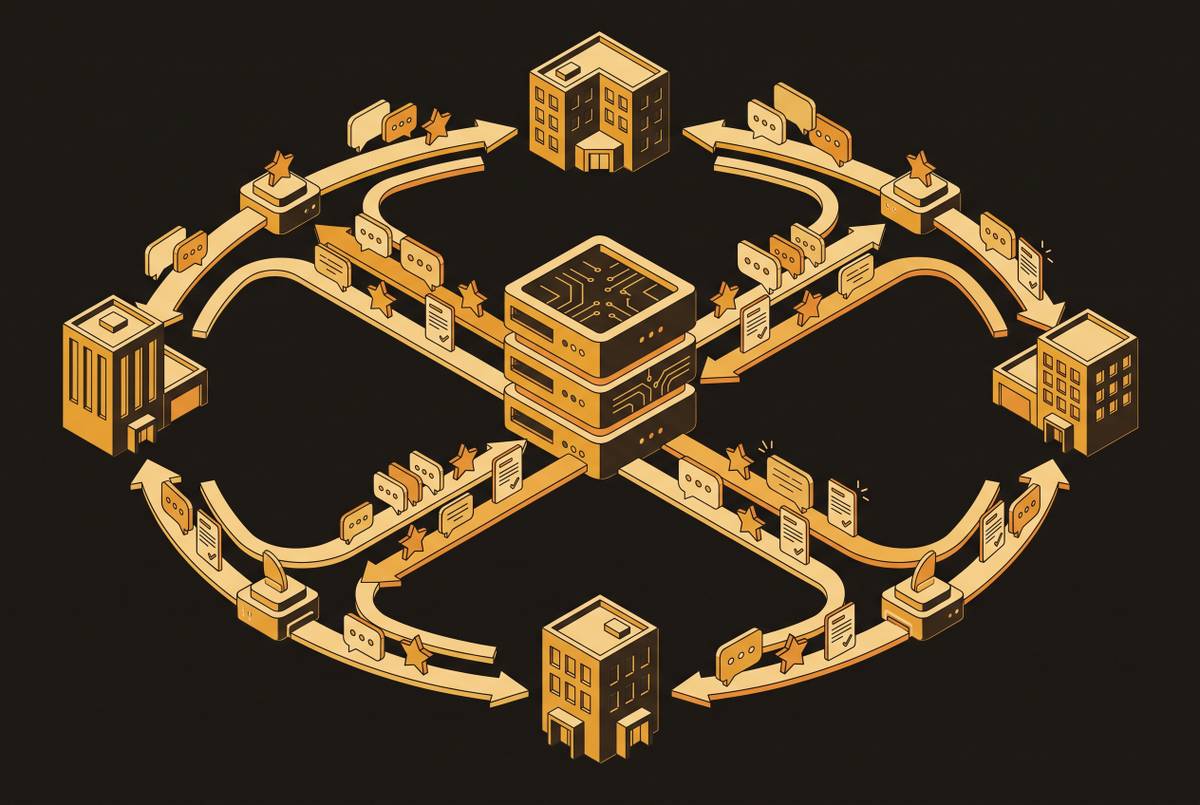
Shared orchestration defines a multichannel B2B customer communication stack, whatever the number of channels it has. Its value comes from connecting contact history, channel selection and sequencing into one coherent conversation. That principle also applies to AI answer engines, where presence depends on deliberate publishing, citation and measurement.
Why channel count is the wrong measure of a B2B communication stack
B2B buyers use email, LinkedIn, phone, search and self-service before they talk to sales. The instinctive response is to add coverage wherever buyers spend time. An email tool and a LinkedIn tool can contact the same prospect independently, on the same day, with similar messages.
The architectural distinctions matter more than the labels. Multichannel means channels are present but siloed, while cross-channel means they pass information to each other. Omnichannel means a unified data model supports a consistent experience regardless of touchpoint. These terms are often used interchangeably, but they describe different levels of coordination.
What an orchestration layer actually does and why it is the stack's core job
Without orchestration, a reply in one channel does not necessarily change what happens in another. A sequence can continue according to its calendar even though the buyer has already engaged elsewhere. Shared state is missing across channels. Adding another independently managed channel compounds that gap. An orchestration layer closes it by making every channel aware of what the others did.
That layer holds unified contact status, including whether someone replied to email, connected on LinkedIn, answered the phone or watched a video. It also maintains a consistent sender persona and uses behavior alongside elapsed time to guide branching. An email can lead to a LinkedIn connection request, followed by an email that references the LinkedIn note. A subsequent phone call can then reference the prior email.
Branching logic is the practical test of this capability. The platform must handle if/then conditions, fetch data from outside it during the flow and set delays based on what the user does. Team members without technical skills must also be able to change the sequence without help from engineers. Smart routing follows from those capabilities, selecting the next channel through preferences, urgency, historical engagement and real-time context. Automatic fallback then takes the place of an instruction to send through every channel.
The channel categories a B2B stack actually needs and what each one contributes
A channel earns its place through the role it can play in that sequence. Email is the foundation for B2B outbound that handles the most volume and has the most leverage because it can scale, can be tracked and reaches nearly every buyer. Its crowded environment makes personalization and deliverability operational concerns. LinkedIn provides the next-highest-leverage outreach channel because it attracts more professional attention than other networks. Profile views, content engagement and shared groups also supply signals that can shape later touches.
Phone serves a different purpose. Despite its reputation as a channel where nobody answers, it offers a high-trust touch for complex or high-emotion issues. That value comes with a capacity requirement, including a dialer, a list, a script and dedicated staff time. Personalized video has the highest conversion potential of an individual sequence touch, but it is also the slowest to produce. Its production constraint makes it appropriate for selective use with high-priority accounts.
Live chat and self-service suit low-friction, transactional questions during the buying process, while a good knowledge base reduces inbound ticket volume without degrading the experience. For B2B products serving enterprise buyers, native Slack and Microsoft Teams integrations keep important notifications from depending entirely on a crowded email inbox. SMS offers high open rates but low reply rates and substantial friction in most B2B verticals. WhatsApp works well in certain international markets but is a poor fit for broad B2B outbound in the US. Both need a specific use case to justify their place.
Four platform categories that serve the stack and the handoffs where context breaks
Platform selection starts with the job, because these categories have limited overlap. Sales engagement and outbound prospecting platforms initiate contact through sequence management, multi-touch cadences and prospecting data, with Outreach, Salesloft and Apollo.io as examples. GTM data and agentic outbound platforms emphasize audience intelligence and autonomous campaign execution, with Landbase serving that category. Contact center and voice-led platforms support high-volume, high-touch inbound and outbound conversations, with Nextiva, Talkdesk and Kustomer among the examples. Marketing lifecycle orchestration supplies the nurturing side that precedes the handoff to sales.
Buying from the wrong category is a more expensive mistake than choosing the wrong vendor within the right one. Most B2B teams above a small size run an outbound platform and a support platform connected through the CRM. A single platform rarely does both jobs well because each is built on different assumptions. Initiating a planned sequence is not the same task as responding to an incoming conversation. The shared record must bridge those operating models.
Context breaks at three recurring handoffs. At outbound-to-inbound, a prospect who replied to a sequence becomes an inbound lead without the support desk receiving that history. At marketing-to-sales, a nurtured lead reaches sales engagement without a record of what the lead has done. At agent-to-agent, a new support agent takes over without the prior channel history. The CRM is the connective tissue when no platform spans all four categories, and orchestration needs a reliable CRM data layer to hold together.
How AI-driven routing and agentic sequencing are changing the orchestration layer's job
Within the stack, AI is becoming a decision engine. AI chatbots already act as a first-response layer across channels, attempting resolution before transferring the conversation to a human. Escalation can follow failed attempts, a sentiment signal or a keyword such as “cancel”. The decisive part of that transfer is the attached context. A human handoff without conversation history preserves the old coordination failure under a new interface.
Agentic sequencing extends the same principle to specialized agents. Specialized agents can operate against a shared data layer, with each step aware of the work before it. That structure resembles coordinated outreach because both depend on continuity between actions. It also creates a clear need for human review gates. Approving the brief, checking the outline, reviewing before publishing and triggering a check when published work underperforms put human review at the points where it matters.
The outline check has the most leverage because it sets direction before drafting resources are committed. Review also has a defined regulatory role. Under the EU AI Act's transparency rules, which apply from 2 August 2026, AI-generated or manipulated public-interest text is exempt from disclosure if it has had human review or editorial control and a person or organisation takes editorial responsibility. Human review is therefore both a quality preference and a condition of that exemption. More broadly, automation must preserve the ability to refuse an action before it ships, with AI-generated actions reviewable and reversible at meaningful boundaries.
AI answer engines as a distinct channel in the B2B communication stack
AI inside orchestration is different from AI answer engines as a buyer-facing channel. Buyers use ChatGPT, Perplexity, Claude, Gemini and Google AI Overviews to form shortlists and evaluate vendors. A brand's presence in those answers is not inherited from its Google ranking. The engine selects fragments it considers credible enough to include in a generated response.
That mechanism changes the meaning of visibility. Traffic from AI search converts at a materially higher rate than Google organic traffic, but click-through from chatbot citations and AI Overviews is very low. These facts make clicks alone an incomplete measure of the channel. Some practitioners therefore see GEO as brand management. Yet representation at the moment a buyer forms a shortlist is directly relevant to a communication stack, even when that interaction produces no immediate visit.
Agentic GEO extends this role as AI agents research and recommend options on buyers' behalf. Brands that are mentioned often and described accurately in retrieved sources are well placed to be included in those recommendations. This follows the retrieval logic already used in RAG-based systems. The channel needs deliberate content and measurement that serve the wider buyer conversation.
What earns citation in an AI answer: the grounding page and the phantom-site layer
AI answer presence depends on two content layers. The owned foundation gives systems a credible source to retrieve and anchor answers to. The distributed third-party layer, or phantom-site layer, gives answer engines the range of sources they draw on. More owned content does not, by itself, solve a lack of presence across trusted third-party sources.
The grounding page is a dedicated owned-site URL built to be machine-citable. The text people see has no adjectives, gives one fact per sentence and has timestamps labelled Created, Updated and Verified. BLUF-structured sections put the answer first, with each H3 answering one question. Each section must give a complete answer that makes sense on its own. The aim is an extractable factual foundation rather than prose that depends on a reader following the whole page.
Retrieval-Augmented Generation, or RAG, anchors many AI answers to live web sources. A grounding page suited to that retrieval uses self-contained chunks of 80–180 tokens and avoids pronouns that refer back to prior sections. Because these chunks are easy to extract, they have an edge over longer, richer text that only makes sense with the text around it. The GEO-SFE study on arXiv and Princeton's GEO benchmark report material visibility gains from citation-friendly structural edits. JSON-LD schema markup reflects what the page says, but the visible HTML text remains the decisive layer.
The third-party strategy must also rest on a healthy owned-site search foundation. When Google visibility collapses after a Core Update or mass low-effort AI content, citations in ChatGPT and Google AI Overviews typically collapse with it. Perplexity citations frequently prove more resilient because its retrieval pipeline is non-Google. That difference does not make the phantom-site layer a replacement for healthy ground-site SEO.
How to measure AI channel presence alongside the rest of the stack
A measurable AI channel needs more than a count of visits. Citation frequency shows whether the brand appears, while sentiment shows what the answers say about it. Competitive perception reveals which alternatives engines surface and whether the brand appears alongside them. Without them, a team cannot tell whether its publishing strategy is working or a competitor is displacing it.
Profound tracks how models including ChatGPT, Claude and Perplexity mention brands, products and competitors in the answers they give. Semrush's AI Visibility Toolkit tracks brand visibility, sentiment and competitive perception across ChatGPT, Google AI Overviews, Google AI Mode, Gemini and Perplexity. Evertune's Brand Score methodology identified perception gaps for Porsche that led to a measurable increase in AI visibility after semantic messaging adjustments. The Bing AI Performance Dashboard, which has been public since February 2026, gives first-party data on citations and grounding queries. Microsoft explicitly notes that the grounding queries shown represent only a sample of overall citation activity.
Monitoring also serves risk management because unmonitored brands take far longer to discover AI errors, while competitor displacement is the leading cause of citation loss. A credible B2B program tracks a defined query cluster weekly across ChatGPT, AI Overviews, Perplexity, Claude and Gemini. That cluster should include brand-name queries and the questions buyers ask when forming a shortlist. The resulting feedback tells the orchestration layer whether the AI channel is contributing to the buyer conversation.