Human-in-the-Loop Review Workflows for AI Content
Building review infrastructure prevents AI content from shipping at speed without quality collapse.

Human-in-the-loop review is the thing standing between AI content at scale and AI content that actually holds up. By 2026, 89% of B2B marketers use AI for written content creation, and that number tells you generation stopped being the bottleneck a while ago. Approval still scales with how many editors a company can hire and pay, so drafts now arrive faster than any team can responsibly read them. That mismatch is the actual subject of this piece: not whether to use AI for content, but how to build the review layer so it holds.
The failure mode is predictable once you see the mismatch. Review either becomes the new bottleneck, choking a pipeline that was supposed to move faster, or it degrades into a rubber stamp because nobody has time to read closely anymore. There's evidence the rubber-stamp path is already the more common one: 12% of B2B marketers report their content quality has gone down since adopting AI tools, and 42% of companies abandoned most of their generative AI initiatives in the past year, up from 17% in 2024. Quality and governance gaps outpaced the technology, not the other way around.
Most teams respond to this by treating it as a staffing problem. Hire another editor. Ask the ones you have to move faster. That diagnosis persists because review is invisible infrastructure: generation leaves behind a visible artifact, the draft sitting in a doc, while review leaves behind only a decision, often undocumented and unrecoverable once it's made. The fix is a change to the process itself. It's treating review as a system with inputs, routing rules, checkpoints, and feedback channels, the same way you'd design any other piece of production infrastructure. That's what the rest of this piece works through.
What human-in-the-loop actually means in a content workflow
Human-in-the-loop, or HITL, is a design pattern borrowed from control-systems and defense literature, where a system can propose an action but only a human can authorize it to execute. The translation to content is direct. The AI proposes a draft, an outline, a headline variant, and a human with actual authority to reject it decides whether it goes forward.
There isn't just one flavor of this. Three oversight models cover most real setups, and which one applies depends on the stakes of what's being published. Human in the loop means every output passes through a human checkpoint before it takes effect, which suits high-stakes content where a single error carries real downstream cost, like a regulatory filing or a client-facing claim. Human on the loop flips the default: the AI runs autonomously, and a human monitors the output stream and intervenes only when something gets flagged. That fits high-volume, lower-stakes work, the kind of content where an occasional miss is recoverable. Human in command sits above both: the AI generates recommendations, but a human retains final sign-off before anything happens, which is the right posture wherever an unchecked error is categorically unacceptable, think legal disclaimers, medical claims, financial guidance.
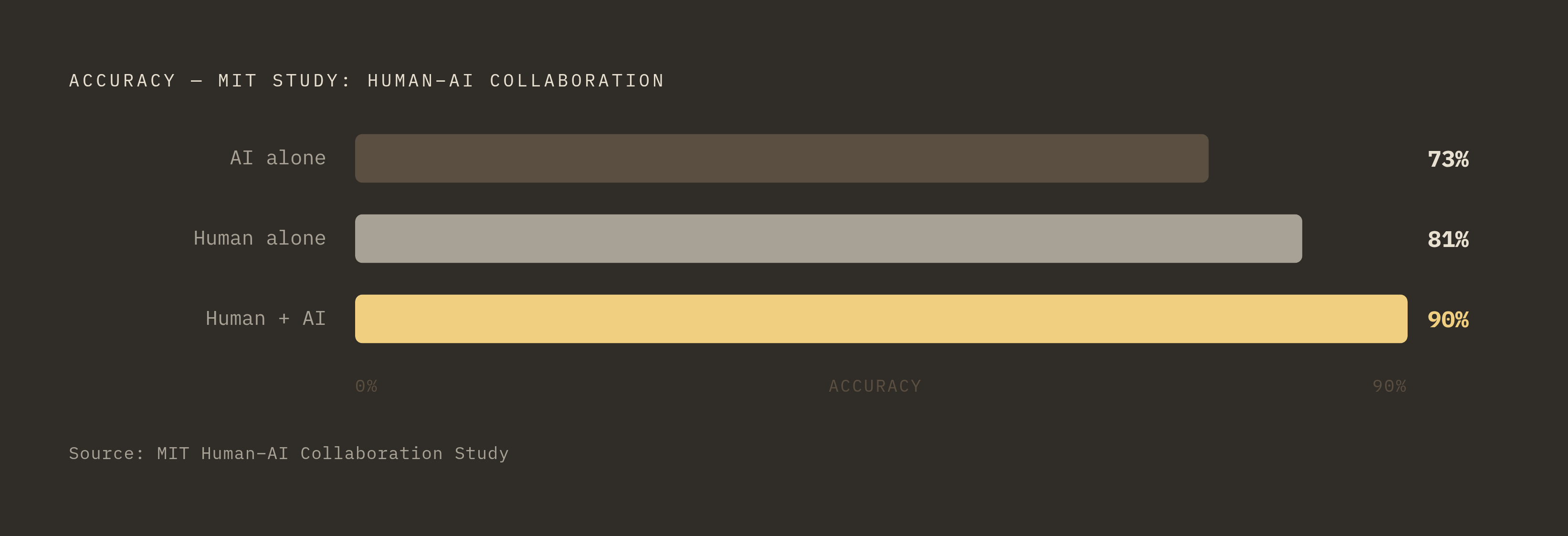
None of these models work as well as humans and AI working together. MIT research on human-AI collaboration found that combined teams hit 90% accuracy, against 73% for AI working alone and 81% for humans working alone. That gap isn't marginal, and it isn't theoretical: it's the empirical argument for building review into the pipeline rather than treating it as an afterthought bolted onto generation.
The split in responsibility follows a clear line, too. Automation is commonly applied to brand voice consistency, terminology enforcement, and plagiarism detection, because these are pattern-matching problems a model can check quickly at scale. Humans stay responsible for factual accuracy, strategic alignment, judgment calls that don't reduce to a rule, and any sign-off that carries regulatory weight. Confusing the two is where most workflows break.
One more distinction matters here, and teams often get it backwards without realizing. In AI-in-the-loop, or AI2L, a human is the primary decision-maker and the AI functions as support, feeding suggestions into a process the human still drives. In HITL, the AI drives the process and humans provide selective correction at defined points. These aren't interchangeable descriptions of the same thing. A content team needs to know, specifically, which mode it's actually running, because the answer determines where the real quality control lives.
The five points where human judgment changes the outcome
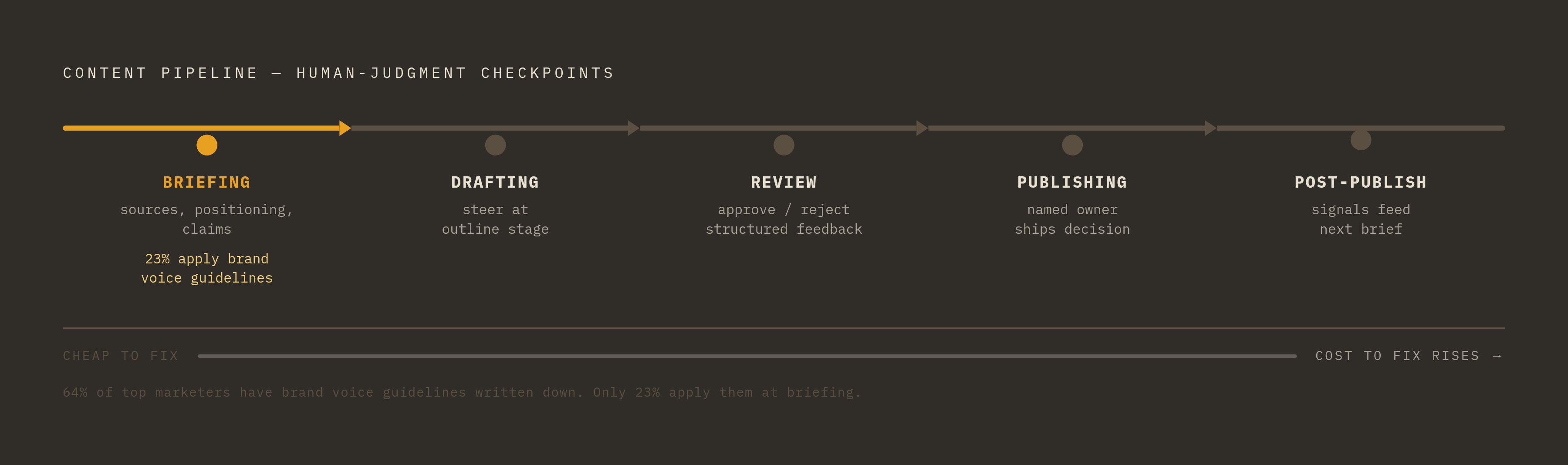
Most teams staff exactly one stage: review. Every dollar of editorial attention gets spent catching problems in a finished draft, which happens to be the single most expensive point in the pipeline to catch them. Reviewing a bad draft against a vague brief is expensive archaeology: someone has to reverse-engineer what the piece was supposed to argue, check it against sources nobody flagged up front, and then decide whether a full rewrite is warranted. Reviewing the brief itself, by contrast, takes minutes. The earlier the intervention, the cheaper the fix, and that principle should decide where checkpoints go.
Five points is where human judgment actually changes what ships.
Briefing comes first. An editor validates the source set, the positioning, the audience, and the specific claims the piece is allowed to make. This is the editorial equivalent of data labeling in a machine learning pipeline: get it wrong here, and every downstream step inherits the error.
Drafting is next, and it's underused. Editors can steer at the outline stage, before a full draft exists and before structural problems become expensive to unwind. Catching a wrong argument structure in an outline costs a paragraph of feedback. Catching it in a finished 1,500-word draft costs a rewrite.
Review is the checkpoint everyone already staffs: editors approve or reject, and edits are part of that approval, not a separate step. What most workflows miss is that rejections need to feed back as structured signal, tagged and logged, rather than vanishing into a team chat that nobody revisits.
Publishing needs a named human who owns the ship decision. Not a queue, not a rotating duty, an actual person whose name is attached to the call. That's what creates the accountability trail compliance teams ask for later.
Post-publishing closes the loop: editors use performance signals and correction requests to shape the next brief, which feeds straight back into checkpoint one.
The briefing checkpoint is the most underused of the five, and the data backs that up. Only 23% of content marketers actively use their documented brand voice guidelines to train or prompt AI tools, even though 64% of the most successful marketers have those guidelines written down somewhere. The guidelines exist. They're just not making it into the briefing step where they'd actually shape the output. Each of these five checkpoints needs a named owner, a defined scope, and a pass/fail criterion attached to it, or it quietly drifts back into whatever informal review habits the team had before anyone tried to design the system.
How tiered routing puts human attention where it earns its cost
The routing logic is simple to state: an AI model assigns each output a confidence score, and when that score clears a set threshold, the output moves forward without a human touching it. Fall short of the threshold, and the system routes to a reviewer. The entire value of this depends on where the threshold sits.
Calibrate it too high, and reviewers end up reading everything anyway, which defeats the point of automating anything. Set it too low, and errors slip through the gate you built specifically to catch them. Neither extreme is automation, they're just automation in name.
A workable risk taxonomy for content sorts into three tiers. Low risk covers internal brainstorms and headlines derived from already-approved source copy, and these can be spot-checked or auto-approved with an audit trail attached. Medium risk covers thought leadership, product messaging, and SEO content that makes factual claims, and this needs editorial and subject-matter review before it ships. High risk covers legal, financial, medical, pricing, security, or public-policy claims, and this routes to a human regardless of what confidence score the model assigns it. No threshold overrides that tier.
Microsoft's guidance for document AI recommends an 80% confidence threshold for general use cases and something close to 100% for sensitive material like financial or medical records. That's a reasonable starting calibration for content teams adapting the same logic, but it's a starting point, not a fixed rule. A 2024 study of LLM-based moderation found calibration error ranging from 11.4% to 34.9% depending on the condition tested. Copy a vendor's default threshold without validating it against your own content, and a meaningful share of what you publish gets routed to the wrong tier without anyone noticing.
Threshold selection has to be an empirical practice, tested against a team's own corpus and revisited every time the underlying model changes. A healthy system abstains, meaning it routes a real share of the queue to a human, on a regular basis. If reviewers are approving nearly everything that lands in front of them, the thresholds are set too low and the system isn't actually filtering anything. This requires real infrastructure underneath it: approval workflows with defined states, audit trails that tie feedback to specific outputs, and escalation paths with SLA targets attached so flagged items don't sit unresolved. Teams running structured governance frameworks like this typically see approval cycles speed up by 40 to 60%, cutting revision rounds from five or seven down to two or three, and shrinking approval timelines from seven to ten days down to two to four.
The reviewer fatigue problem that tiered routing alone cannot solve
Vigilance research going back decades shows detection performance starts decaying within the first half hour of sustained monitoring. That's a systemic issue rather than a matter of motivation or discipline. It's a biological limit on how long a human can watch for rare errors in a stream of mostly-fine material before missing them.
AI content compounds this in a specific way. A 2024 study found reviewers rated repeated false headlines as 7.1% more accurate than novel ones, purely from familiarity with the pattern. Now put that next to what AI generation actually produces. Dozens of drafts share the same structure, the same section headers, and the same rhythm, because they came from the same prompt template. A reviewer working through that batch is walking straight into the repetition illusion the study measured. They'll pass an error in draft nineteen that they would have caught cold in draft one.
The fix is redesigning the workflow so concentration stops being the bottleneck. It's redesigning the batch. Structured breaks during review shouldn't be optional, they should be a workflow requirement written into the process, the same way a factory line has mandated rest periods. Rotating reviewers across content types, rather than parking one person on the same format for a full shift, breaks up the pattern exposure that produces the illusion. Randomizing the order drafts get presented in does something similar. A daily volume cap per reviewer, set against what vigilance research says is sustainable rather than against how many drafts the AI happened to produce that day, keeps the queue from silently degrading review quality.
Audit trails earn their keep here too. When approvals carry a reviewer's name and a timestamp, patterns become visible that would otherwise stay invisible: a reviewer whose approval rate spikes every afternoon is a signal worth investigating, not a coincidence worth ignoring.
Fatigue is ultimately an argument for pushing routing further upstream, not for adding reviewer hours. If medium-risk drafts get tightened at the briefing and outline stages, the volume that actually reaches a human reviewer shrinks, and the attention that's left gets spent on the cases that genuinely need it.
How feedback loops make the system improve over time rather than just maintain quality
Reinforcement learning from human feedback runs on one core idea: capture human corrections as structured signal, and the system producing next month's output makes fewer of last month's mistakes. Apply that same idea to a content operation and the review layer stops being a quality floor and starts being a mechanism that actually improves the pipeline over time.
The mechanism looks like active learning in practice. Human review focuses attention on the uncertain cases, the drafts sitting near the confidence threshold, and accepted edits get carried forward as context for the next round. The review layer catches today's error and, done right, reduces how often that same error shows up next month.
"Structured signal" has to mean something concrete, or the loop doesn't close. Rejections get logged with a reason code, not just a thumbs-down. Edits get tagged by type, brand voice, factual error, tone, regulatory language, so patterns are queryable later instead of buried in a doc history. Approved content gets marked as a positive example that can shape future prompts.
This creates a documentation obligation that most teams skip: tracking exactly what the AI generated, what a human changed, and who signed off on the final version. That record serves two purposes at once, feeding the feedback loop and building the compliance trail regulators increasingly expect. Post-publishing performance, engagement numbers, correction requests, compliance flags that surface after the piece is live, feeds straight back into the next briefing checkpoint, which is what closes the loop across the entire lifecycle rather than just at review.
Most teams don't build this because a rejection feels like a one-off correction in the moment, not a data point. The design choice that actually works is treating every edit as data from day one, before the backlog of untracked corrections makes it too late to reconstruct the pattern.
Why content governance quality is now a direct input to AI visibility
Search itself is shifting under this whole conversation. Gartner predicted in 2024 that traditional search engine volume would drop 25% by 2026. AI assistant traffic rose 86% in 2025, and time spent on those assistants rose 101%. Ahrefs found that AI Overviews cut click-through rates for top-ranking Google content by 58%. Governance isn't just a quality issue anymore, it's a visibility issue, because the content that gets cited by an AI system has to clear a trust bar that a broken review process can't meet.
Citation is also unstable in a way that punishes weak governance directly. A 2025 AirOps study, based on 45,000 citations, found only 30% of brands stay visible from one AI answer to the next, and just 20% remain present across five consecutive runs of the same query. Brands can't afford to lose citation slots to governance failures on top of that natural volatility.
The link between the two is direct. Poor AI content governance produces brand inconsistency, factual errors, and compliance gaps, and that's exactly the kind of content that platforms like ChatGPT, Perplexity, and Google's AI Overviews decline to cite because it fails their trust signals. The stakes go beyond visibility, too: AI search traffic converts at notably higher rates than Google organic traffic, which turns citation from a vanity metric into a revenue line.
Princeton's GEO research (arXiv:2311.09735) found that optimized content can see up to 40% higher visibility in generative engine responses, with citation density, definition-lead formatting, and statistical enrichment as the main drivers. None of that survives a review workflow that lets inconsistent or inaccurate drafts through, because those tactics only work on content that's actually trustworthy in the first place.
There's a sameness risk sitting underneath all of this, too. Every brand now has access to the same frontier models, which means teams publishing fast, polished, machine-written content increasingly sound like every other brand running the same prompts. Differentiation doesn't live in the model anymore. It lives in the governance layer sitting on top of it, made up of the brand knowledge, the editorial standards, and the human judgment that a competitor running the same tool doesn't necessarily have.
What HITL design looks like across a multi-brand agency portfolio
Scale changes the shape of this problem. A single marketing campaign in 2026 can require governing a large number of distinct content units, structural blocks, channel-specific variants, regulatory disclaimers, across several brands at once. No single editor, however good, reviews that volume responsibly alone.
Multi-agent architecture provides the operational answer: agents configured for distinct brands, customer journeys, or use cases, all running inside one platform, with a central team coordinating strategy rather than writing every asset by hand. Shared governance rules get applied dynamically across the portfolio instead of being reinvented per client. The risk taxonomy from earlier, low, medium, high, scales the same way: each client's regulatory context, brand voice rules, and approval stakeholders get encoded into the routing logic itself, rather than living in one editor's memory of how each account likes things done.
Regulation has raised the cost of getting this wrong. The EU AI Act's transparency obligations, along with FTC scrutiny of AI content liability, have turned a defensible audit trail from a nice-to-have into something clients ask about during procurement. Fines under the AI Act can reach €35 million or 7% of global annual turnover for the most serious prohibited-practice violations, and an agency managing high-risk content categories on behalf of clients carries that exposure directly.
Per-client reporting fits into this as more than an account management courtesy. Weekly reports and per-client data exports function as evidence, proof that human oversight was applied, that corrections got logged, that governance standards held up. That's what retains an account when a client's compliance team starts asking pointed questions.
None of this works if the people selling and managing the account can't explain it. An account manager who can't describe what tiered routing does, why a confidence threshold matters, or what AI visibility governance actually delivers can't defend the service under questioning, let alone sell it. Training sales and account teams to talk about this credibly isn't a side project, it's a dependency the whole system rests on.
The governance documentation every HITL system needs to actually function
Four kinds of documentation make the difference between a HITL system that runs and one that's HITL in name only.
Brand and editorial standards come first: documented voice guidelines, approved terminology, product messaging rules. These are the raw inputs that feed every briefing checkpoint and every automated gate downstream, and if they're not written down, there's nothing for either humans or automation to check against.
Routing policies come next, written down as actual threshold criteria for each risk tier, spelling out who reviews what, under what conditions, against what SLA. These need a revalidation schedule tied to model changes, not a one-time setup that gets forgotten.
AI contribution records track what the AI generated, what a human changed, who approved it, and when. This is both the raw material the feedback loop runs on and the paper trail compliance teams will eventually ask to see.
Correction logs round it out: rejections with reason codes attached, edits tagged by type, patterns pulled out on a regular cadence and fed back into briefing updates. Automation can enforce brand voice consistency and terminology on its own. It cannot govern judgment calls, strategic fit, or regulatory sign-off, and pretending otherwise is exactly how the rubber-stamp failure mode starts.