B2B Customer Feedback Loops at Scale
Most B2B teams measure only half the feedback they need to compete in AI-driven markets.

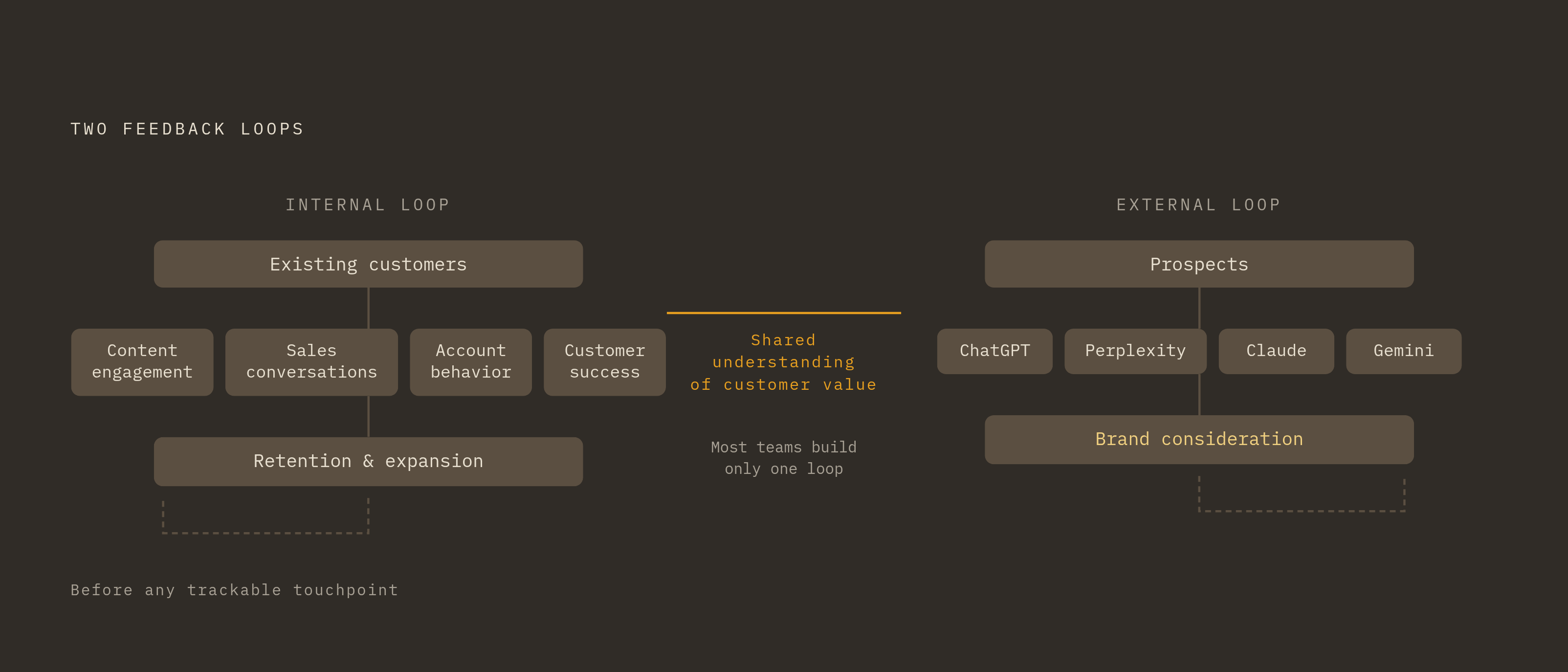
B2B customer feedback loops at scale require two distinct systems. The internal loop tracks what resonates with existing customers, while the external loop tracks what AI answer engines tell prospects about the brand. Most teams have built only half this infrastructure. Closing both loops requires separate measurement and response processes, connected by a shared understanding of customer value.
Why feedback loops have split into two distinct systems at scale
The structural split begins with whose experience the business can observe. Existing customers provide signals through content engagement, sales conversations, account behavior, and customer success interactions. Prospects can encounter brand descriptions, comparisons, and recommendations in ChatGPT, Perplexity, Claude, or Gemini without ever visiting the brand’s site. Those encounters fall outside the usual customer feedback process because standard analytics cannot see the answers that shape them.
The internal loop follows a known sequence of collecting, analyzing, acting, and closing. Its commercial purpose is to improve retention and expansion, whereas the external loop concerns whether a prospect considers the brand at all. Neither system can stand in for the other because they observe different audiences at different decision points.
Where the internal loop actually breaks — and it is not the collection stage
Most B2B teams have reasonable means of gathering signals, but few consistently tell customers what changed because of their input. An unanswered complaint is the operational equivalent of listening to a customer explain why they might leave, then turning around and walking away. The data has entered the business, but the relationship has received no response.
Each feedback stream, including content performance, sales conversations, account-level behavior, and customer success, needs its own routing and an assigned owner. Response SLAs turn those assignments into obligations. Cadence matters just as much because a quarterly review cannot serve a signal that requires a weekly response. By the time the insight reaches planning, the competitive context may already have shifted.
The economic buyer, the champion, and the daily user experience the product differently, so one contact’s response captures only part of the account. Eaton Corporation used CustomerGauge’s Account Experience platform to cut the time its closed-loop process took from four months to 48 hours. That contrast makes the last-mile problem concrete. The operational gain came from shortening the path between feedback and response.
Why AI answer engines constitute a second, structurally separate feedback problem
Traditional analytics record referral sessions and on-page behavior, but AI answers can influence a shortlist before any trackable touchpoint occurs. A zero-click answer may tell someone about the brand without sending them to its website. SEO measurement therefore cannot simply be expanded to cover this problem, because the important event may be an answer that produces no visit.
That distinction also separates a brand mention from a citation. A mention names the brand, while a citation links to content used as a source. A mention shows that the brand is in the answer, while a citation can also bring referral traffic. Treating them as equivalent obscures whether the engine is discussing the brand, using its content, or doing both. Most teams measure neither signal systematically.
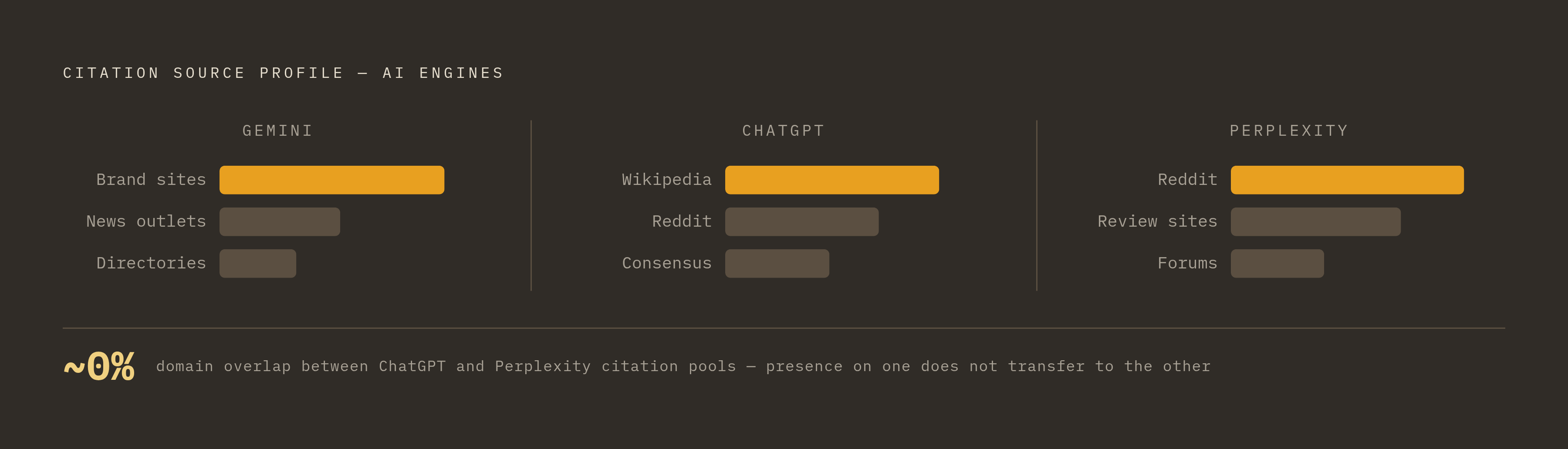
Profound’s analysis of millions of citations across millions of responses found that engines draw on different sources. Gemini leans heavily on brand-owned websites, while ChatGPT relies on encyclopedic sources such as Wikipedia, community platforms such as Reddit, and internet consensus. Perplexity emphasizes community-validated sources, especially Reddit, and review aggregators. Only a small fraction of domains cited by ChatGPT overlap with those cited by Perplexity, so presence on one platform does not predict presence on another. Brand signals, led by YouTube mentions and then broader brand mentions, also correlate more strongly with citation probability than backlinks do, challenging the SEO assumptions many content teams bring to this work.
What the external loop actually needs to measure, platform by platform
Those differences make per-platform monitoring the basic unit of external measurement. An aggregate AI share of voice can conceal a strong presence on one engine and absence on another. Teams should therefore start with defined query sets based on the questions buyers research and run a baseline audit before changing content. Regular checks then track mentions and citations separately on each platform. Without that separation, the team cannot tell which kind of visibility changed or where the change occurred.
The engines’ retrieval behavior makes raw citation totals especially easy to misread. Perplexity runs live retrieval on every query and produces far more citations per response than ChatGPT across most query types, though the gap varies by category. Claude draws from training data by default and uses web search situationally, rather than citing sources as frequently or by default. A lower citation count alone cannot show whether the brand is missing or the engine gives fewer citations.
The Porsche and Evertune case shows why measurement must also capture what an answer says. Porsche used Evertune’s Brand Score metrics to identify a gap between “safety perception” and “performance” in its AI representation. Adjusting semantic messaging then produced a measurable lift in AI visibility. The useful feedback showed that Porsche’s representation in answers was uneven. That diagnosis connected a measurable gap to a content intervention and then to a measured result.
How content built for the internal loop fails the external one — and what the difference looks like in practice
Once those signals are visible, the difference between the two content jobs becomes clearer. Campaign content, sales enablement, and thought leadership can resonate with existing customers without earning citations in AI answers. Internal performance shows that content works for the customers and goals it was made for. It does not establish that an engine can extract an answer from it. Content that is ready for citation may still fail to connect with customers.
AI models extract “chunks,” which are self-contained segments that can stand alone as answers. A narrative may build its meaning over several paragraphs, while an extractable segment must hold everything needed to answer the question. Conversion-focused writing faces the same distinction because its structure serves a reader’s next action and may supply no reusable answer. Good writing is valuable in both cases, but the unit that must work is different.
The “ground site” principle addresses that second job through authoritative owned content deliberately structured for AI extraction. It is the GEO analog to a landing page. The discussion of how to use llms.txt reflects this same split between writing for human readers and helping with AI extraction. The strategic task is to distinguish the objectives before production, rather than assume every successful customer-facing asset also serves the external loop.
Why third-party platforms dominate AI citation rosters and what that means for content strategy
Owned content, however, covers only part of the external system. The majority of AI citations across the major engines come from a small set of third-party platforms, including Reddit, Wikipedia, YouTube, LinkedIn, and Forbes. That concentration means a brand’s website cannot carry the whole AI visibility strategy. The same engines that may cite owned material also draw on sources beyond the brand’s control. External feedback must therefore inform activity outside the CMS as well as changes within it.
The “phantom site” concept describes this distributed brand presence on third-party platforms that AI engines index and cite. It complements the ground site by extending the brand’s presence across the surfaces that answer engines use. Unlike owned publishing, this work is governed by the norms of the communities and platforms involved. This work needs a planned publishing cadence that goes beyond sharing content off-site now and then. The infrastructure investment is not another website, but a sustained publishing process on surfaces the brand does not own.
This does not make owned content unnecessary. Because Gemini favors brand-owned websites, giving up the ground site would leave another part of the external loop uncovered. The requirement is parallel coverage, with owned authority and third-party presence serving different sourcing patterns. Feedback from each platform shows where either side falls short and should guide the response ahead of a preference for owned or earned content.
How a multi-stage AI content pipeline keeps both loops running without trading quality for volume
Running both programs adds work because teams have more places to publish and more goals for their content. A multi-stage pipeline separates repeatable production from editorial judgment. AI handles repeatable work across research, ideation, drafting, repurposing, distribution, and optimization. Humans retain responsibility for strategic fit, factual accuracy, brand voice, and escalation decisions. Speed comes from allocating those responsibilities clearly.
The outline is the most effective junction for substantive human intervention. Before thousands of words are generated, an editor can classify the piece as serving internal resonance, external citation, or neither. That decision gives the later stages an objective against which to work. By the final-draft review, the team has already spent time and effort on what may be the wrong premise.
Later quality gates still matter, but they need not require a person to review every article in the same way. Automated thresholds for readability, fact-checking confidence, brand voice consistency, and citation accuracy can send work that fails to a human for review before it is published. The team then concentrates on exceptions while keeping escalation available throughout the pipeline. Technically acceptable but strategically useless content otherwise fills both loops with noise. At volume, thin or inaccurate material is more than a missed opportunity because it degrades the external loop by adding material to training and retrieval sets that does not earn citations.
Building the measurement layer that closes both loops at once
A complete infrastructure brings these processes together without collapsing their measures into one score. The internal layer ties content performance to traffic and pipeline-relevant behavior. It also captures account-level behavior, structured objection logging, call review, and customer success debriefs connected to expansion and churn signals. Each stream needs an owner and a response SLA. The test is whether the signal reaches someone who can act and close the loop with the customer.
The external layer monitors ChatGPT, Perplexity, Claude, and Gemini against a defined set of real buyer research questions. It records mentions and citations separately at a cadence that can detect changes before they compound. What the internal loop reveals about the value propositions customers respond to should shape those query sets and which external content gets made first. AI visibility then becomes an engineering discipline through instrumentation, a baseline, changes to one variable at a time, and measurement of the effect. The layers share learning without pretending that customer behavior and AI representation are the same evidence.
Most teams have built only half the infrastructure because their measurement stops at one of these boundaries. Internal-only programs refine existing-customer engagement while prospects form impressions in answers the brand does not monitor, whereas external-only programs improve citations while missing retention and expansion signals. CustomerGauge’s research found that companies failing to close the internal loop increase churn by a minimum of 2.1% every year. The external gap has an analogous, though not numerically equivalent, compounding effect as invisible brands miss consideration among a growing share of buyers. The diagnostic is therefore whether both systems turn signals into action, because either unclosed loop allows its blind spot to grow as volume scales.