Perplexity AI for Marketing Research Workflows
Cited sources make Perplexity the research tool marketers can defend.

Perplexity's real advantage over other AI tools has nothing to do with how fast it answers a question. It's that every answer comes with a source you can actually check, dated and clickable, which makes it a different kind of research instrument than a search engine or a chatbot that just talks at you. Perplexity launched in 2022 not as a chatbot but as an answer engine: it reads the live web, pulls from multiple sources at once, and hands back a structured answer with numbered citations attached to publication dates.
Asking the same question of two different tools makes the distinction visible immediately. Ask ChatGPT what the current market size of some industry is and it gives you a confident, well-written number with no traceable source. Ask Perplexity the same thing and you get an answer with citations attached, each one clickable, each one dated, so you know exactly where the number came from and when. That verifiability gap (confident-and-unverifiable versus cited-and-dated) is, per Eisterix's 2026 guide, why Perplexity has become a fixture in serious marketing workflows.
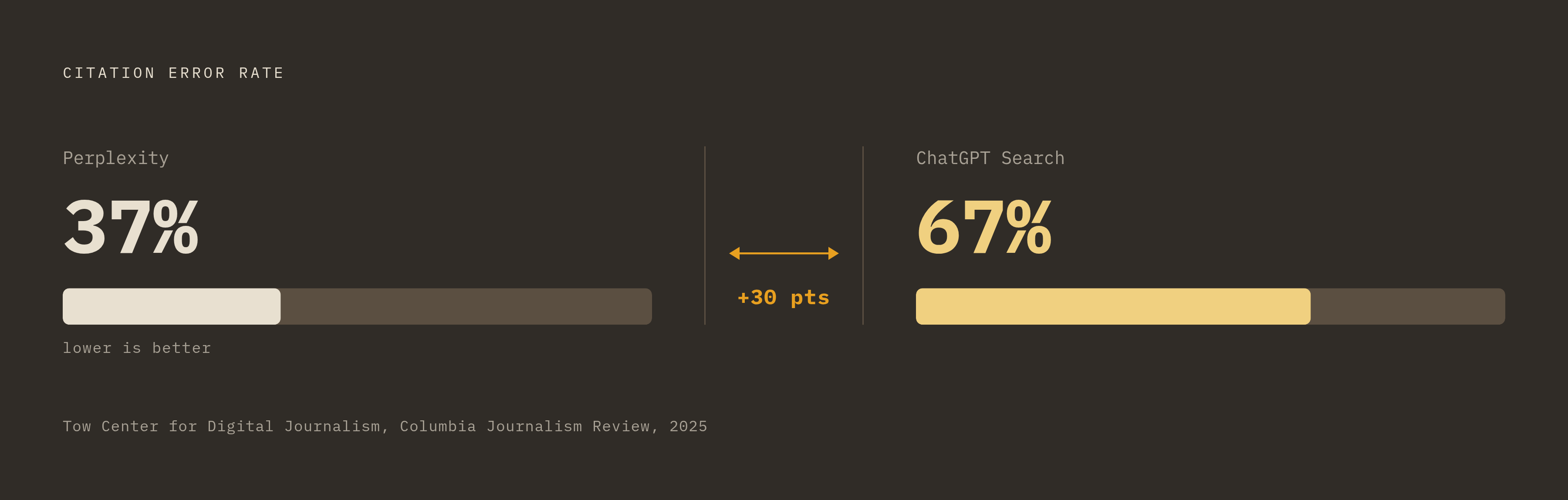
This isn't a marginal quality difference either. Perplexity's citation error rate is 37%, compared to 67% for ChatGPT Search, according to research from the Columbia Journalism Review's Tow Center in 2025. That's a wide enough gap that it stops being a feature comparison and starts being a basic question of whether you can trust what you're reading. Perplexity is a mainstream research tool now, not a niche experiment for AI early adopters.
Sources carry visible publication dates right in the interface, so you're never guessing whether a number is fresh. Focus modes let you point the search at a specific type of source, Academic for peer-reviewed material, Reddit for unfiltered consumer chatter, YouTube for video-based trend signals. This architecture lets you choose which model actually answers the question, GPT-5, Claude, or Perplexity's own models, depending on what the task calls for, and that choice is what determines the rest. None of this is workflow advice yet. It's just the architecture, and it's worth understanding before getting into what that architecture makes possible. Perplexity's growth trajectory (projected to reach 45 million monthly active users by mid-2026, following 104% year-on-year growth) establishes that this is a mainstream research instrument, not an experiment.
Verifiability as the Property That Changes How Marketing Research Works
Marketing runs on statistics, and a meaningful share of the statistics floating around marketing content are misattributed, stale, or simply wrong. Drop a fabricated or outdated number into a client deck and you've created a credibility problem that doesn't go away with an apology. That's the specific failure Perplexity's citation model is built to prevent, not by being smarter, but by forcing every claim to carry a receipt.
Compare the actual time cost of the alternatives. A Google research question means clicking through links, skimming pages, cross-referencing claims against each other, a process Eisterix estimates takes 8 to 12 minutes per question. Perplexity collapses that into one synthesized answer with the sources already attached, no tab-switching required. ChatGPT has a different problem entirely: its training cutoff means anything after that date is either missing or, worse, quietly fabricated to sound plausible. For research headed into a client document, there's a real difference between writing "found this on ChatGPT" and writing "here's the primary source from Statista, published last month." One of those survives a client's fact-checker. The other doesn't.
None of this should turn into research for research's sake, though. The Wolf of AI's framing is the right discipline here: AI research should reduce uncertainty before it increases output. If a given finding doesn't change a decision about the customer, the offer, the message, or the channel, it's probably just noise dressed up as insight. Verifiability matters because it's what makes research defensible, not just accurate. A number traceable to a dated source can go into a strategy document, get handed to a client, get challenged and corrected if it's wrong. A number with no source behind it can't be defended at all, no matter how confident it sounds.
How to set up Perplexity before running any marketing research
Pricing has three tiers. The Free plan covers basic web search and AI-generated answers, and it's genuinely sufficient for most day-to-day marketing research. Perplexity Pro runs $20 a month, removes usage limits, and unlocks the more powerful models along with Deep Research mode Perplexity AI for Marketing Research: The 2026 Guide - Eisterix. Enterprise Pro is $40 per user per month and adds single sign-on, audit logs, and private knowledge bases, features that matter to agencies and RevOps teams more than to a solo marketer testing the waters. The practical rule: stay on Free for ad-hoc questions and testing, and upgrade to Pro once research becomes a daily habit, competitive intelligence running constantly, multiple projects overlapping, or agency-scale volume.
Focus modes deserve deliberate use rather than default settings. Academic mode is the right call when you need sourced statistics and peer-reviewed backing. Reddit mode shows consumer sentiment in language people actually use, not marketing copy.
KnowledgeHut recommends capturing key statistics, competitor strategies, consumer pain points, and market opportunities as structured notes before any synthesis work begins, so the raw research doesn't get lost once you start writing. Integrations and automation come later, once the manual workflow is second nature.
Using Perplexity for competitor intelligence
Competitor intelligence is the use case where live-web access earns its keep the most obviously. A model trained on a fixed cutoff simply misses the last six months of product launches, pricing shifts, and campaign moves, and that six-month window is usually exactly the window that determines competitive positioning.
The prompt patterns that work here are specific rather than open-ended, drawing on approaches documented by both Eisterix and Distk. Ask something like "what has [competitor brand] announced or launched in the last 6 months?" Pair it with a sentiment check: what are customers saying about the competitor's product in reviews and forums, and what are the recurring complaints versus the recurring praise. Then ask how the competitor's positioning has shifted over the past year.
Don't stop at the first answer, either. Eisterix recommends a specific follow-up: ask "what sources did you use for this?" and then "are there more recent sources available?" Perplexity often has additional sources sitting behind the ones it led with, and asking that second question surfaces them. Once the answers come back, the KnowledgeHut workflow applies again: save competitor strategies, pricing signals, sentiment summaries, and positioning shifts as structured notes, which becomes the raw material for a briefing document or a synthesis pass later.
Perplexity only surfaces what's publicly indexed. Non-public pricing, internal strategy memos, unannounced products, none of that shows up no matter how the prompt is phrased. Treat it as a tool for mapping the public competitive picture, not as a substitute for actual market intelligence gathering.
Using Perplexity for trend tracking and market sizing
Market size figures have a habit of outliving their accuracy. A number gets published once, then gets recycled across blog posts and decks for years after the underlying data has been superseded, and most people repeating it have no idea how old it actually is. Perplexity's dated citations solve this directly: you see at a glance whether the figure you're about to use is current or three years stale.
Eisterix documents a specific fact-check workflow worth adopting as a standing habit. Before any statistic goes into a client document, paste it into Perplexity with a prompt along these lines: "Is this statistic accurate, and what is the original source? [paste the statistic]. Include the publication date of the original research." Perplexity will either confirm the number against a primary source, correct it with more current data, or flag that it can't verify the claim at all, and every one of those outcomes beats taking the number on faith.
For pre-brief research, the pattern shifts slightly but the principle holds. Eisterix and Distk both point to prompts like "what are the key consumer trends in [category] in 2026, including market size data, with sources cited." A precise prompt produces a precise answer, and requiring citations forces the data to be checkable before it ever makes it into a brief. Eisterix estimates this turns 45 to 60 minutes of Google digging into 5 to 10 minutes of targeted Perplexity queries for the same pre-brief research task, which is the actual payoff of building this habit rather than the reason to start it.
Using Perplexity for audience research and consumer sentiment
Live language is a different kind of input than a market report.
Reddit Focus mode is the specific mechanism here. Pointing a query at Reddit reveals unfiltered consumer language, the actual words buyers use rather than the polished phrasing that appears on review sites. That unpolished vocabulary tends to be more useful for messaging research than anything scrubbed for public consumption.
The prompt patterns for this kind of work, drawn from KnowledgeHut and Distk, tend to follow a similar shape. Ask what problems people in a given category are most frustrated by, using Reddit and review sources specifically. Ask what buyers of a given product type wish existed, and summarize the requests that keep coming up. Ask what objections people raise before they actually buy. Answers to these feed directly into copy briefs, value proposition testing, and content angle work, and because sources are attached, a creative team can go read the original threads rather than trusting a paraphrase.
This tool fits into a broader toolstack in a specific way.
Deep Research mode and the Sonar API for teams doing heavier lifting
It's available across Free, Pro, and Max accounts, with query limits varying by plan, and it works by scanning multiple sources automatically, synthesizing what it finds, and producing a structured draft. It's built for the heavier lifts: market entry analysis, investor briefings, full competitor landscape reports, the kind of work that would otherwise mean days of manual source-gathering. Espressio.ai's estimate puts the time savings at roughly 50%, which makes it arguably the single highest-leverage feature in the platform for RevOps and marketing teams running heavy research loads.
That efficiency comes with a hard requirement, though: the output always needs human review before it goes anywhere. The structure is machine-generated, but judgment about what any of it actually means for a client or a campaign is not, and skipping that review step is how errors compound at scale.
For teams building research into their own systems rather than running it manually, there's the Sonar API. It embeds real-time Perplexity search directly into CRMs and automation pipelines, so a team doesn't have to build a retrieval layer from scratch just to get live-web sourcing inside tools it already uses. That's most relevant for marketing ops and RevOps functions trying to get Perplexity's sourcing model working inside an existing toolstack rather than as a separate browser tab.
None of this changes the review requirement, and it shouldn't. The sustainable model for scaling AI research is a pipeline that pairs AI drafting with a human checkpoint before anything ships, a point where someone can actually say no. Automation should speed up the gathering, not remove the judgment. And for agencies or larger teams where source traceability is a compliance requirement rather than a nice-to-have, the Enterprise Pro tier's audit logs and private knowledge bases exist specifically for that governance layer. Deep Research mode is defined by what it is and when it applies.
Why Being Cited Inside Perplexity Matters as Much as Using It
Using Perplexity to research a market is half the equation. The other half is whether a brand shows up when someone else runs the same kind of query, and that half has its own measurable stakes.
Start with the traffic math. Perplexity's citation interface gives cited sources a click-through rate of 18 to 22%, according to BrightEdge, which is far above what other AI platforms deliver. Getting cited isn't a vague visibility win, it's a direct, countable driver of referral traffic. But the field is already tilted toward whoever got there first. AI answers typically cite only one to three brands per response, and in 5W Research's Airlines & Hotels AI Visibility Index for 2026, the top three brands across multiple subcategories captured over 70% of total citation share. Winner-takes-most dynamics are already locked in for the categories that moved early.
Surmado.com identifies what actually earns a citation: freshness, authority, and a presence across multiple channels, which happen to be the same properties that make a source worth reading in the first place. Authority isn't evenly distributed either.
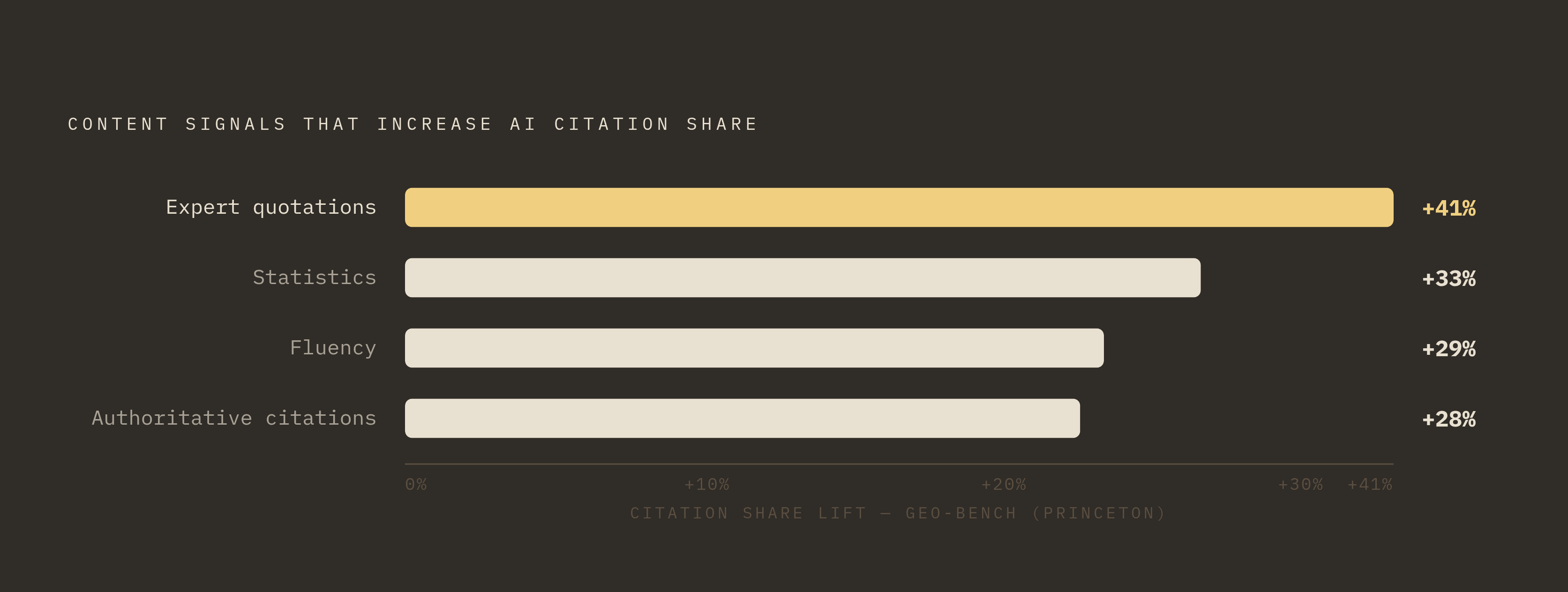
A 30-day cold-start test reported by Search Engine Land on 14 September 2026 found that third-party listicles generated 85.8% of source mentions for a brand, compared to 14.0% for the brand's own listicle content and just 0.2% for PR placements. A brand's own content accounts for only a small share of where citations come from. Being named credibly in someone else's coverage is. Content structured around specific signals also earns citations more reliably: Princeton's GEO-bench research found expert quotations lift citation share by 41%, statistics by 33%, fluency by 29%, and authoritative citations by 28% How to Use Perplexity for Marketing?. The takeaway for marketers is straightforward: content built around those properties earns citations rather than just ranking for keywords How to Use Perplexity for Marketing?.
This is the part of the Perplexity equation that's easy to miss while focused on using it as a research tool. Brands research their category inside Perplexity, and their buyers do the exact same thing, running their own queries to find answers about that category. If a brand isn't showing up in those answers, the research advantage it built on the input side doesn't compound on the output side. BrightEdge research confirms that 40–55% of Perplexity citations flow to fewer than 1,000 domains, and that an authority threshold matters, with sites having over 32,000 referring domains roughly 3.5x more likely to be cited by ChatGPT, a signal that likely transfers to Perplexity.
Measuring whether your brand appears in AI answers
The gap between where most marketing teams think they stand and where they actually stand tends to be wide. Branded query citation rates, meaning searches that already include the brand's name, can reach 97% in direct searches. But up-funnel discovery prompts, the ones where someone is still comparing options and hasn't landed on a brand name yet, see citation rates drop to just 10 to 15%, Hotel News Resource's 2026 reporting found. A brand can look thoroughly covered in AI answers while remaining almost invisible at the exact stage where buyers are actually deciding who to consider. The two numbers tell very different stories about how much work is actually left to do, so measure the distinction directly rather than assuming it. Letterstory, for one, tracks whether ChatGPT, Claude, Gemini, and Perplexity actually name and cite a brand, not just whether it ranks.
Sources
- Perplexity AI and Genspark for Market Research in 2026
- Perplexity AI for Marketing Research: The 2026 Guide - Eisterix
- How to Use Perplexity for Marketing Research 2026: Complete AI Search Guide | Distk
- How to Use Perplexity for Marketing?
- The Complete Perplexity AI Guide for 2026
- How to Use Perplexity for Marketing: 7 Workflows
- Generative engine optimization (GEO): How to win AI mentions