AI Tools for Marketing Agency Content Production
Agencies need function-based AI stacks, not scattered tools, to survive AI-driven discovery.
Marketing agencies in 2026 need AI tools organized by function, not by hype, because no single platform covers the whole content production lifecycle from research through publication. That's the core argument of this piece, and it matters because agencies have spent the last two years bolting AI onto old workflows rather than rebuilding around it.
The volume of content needed came first. Agencies are now expected to produce content across more formats, more platforms, and more markets than a traditional staffing model was ever built to absorb. Consistency breaks down right alongside volume: when production gets decentralized across freelancers, junior writers, and rushed internal drafts, brand voice drifts, and clients notice.
Then there's the measurement gap. Clients don't care how much content got made; they care whether it moved pipeline and revenue, and agencies have historically struggled to draw a straight line from content activity to those outcomes. Adding headcount was the old fix for volume problems, but headcount doesn't solve consistency or measurement, and it doesn't scale at the margin the way software does.
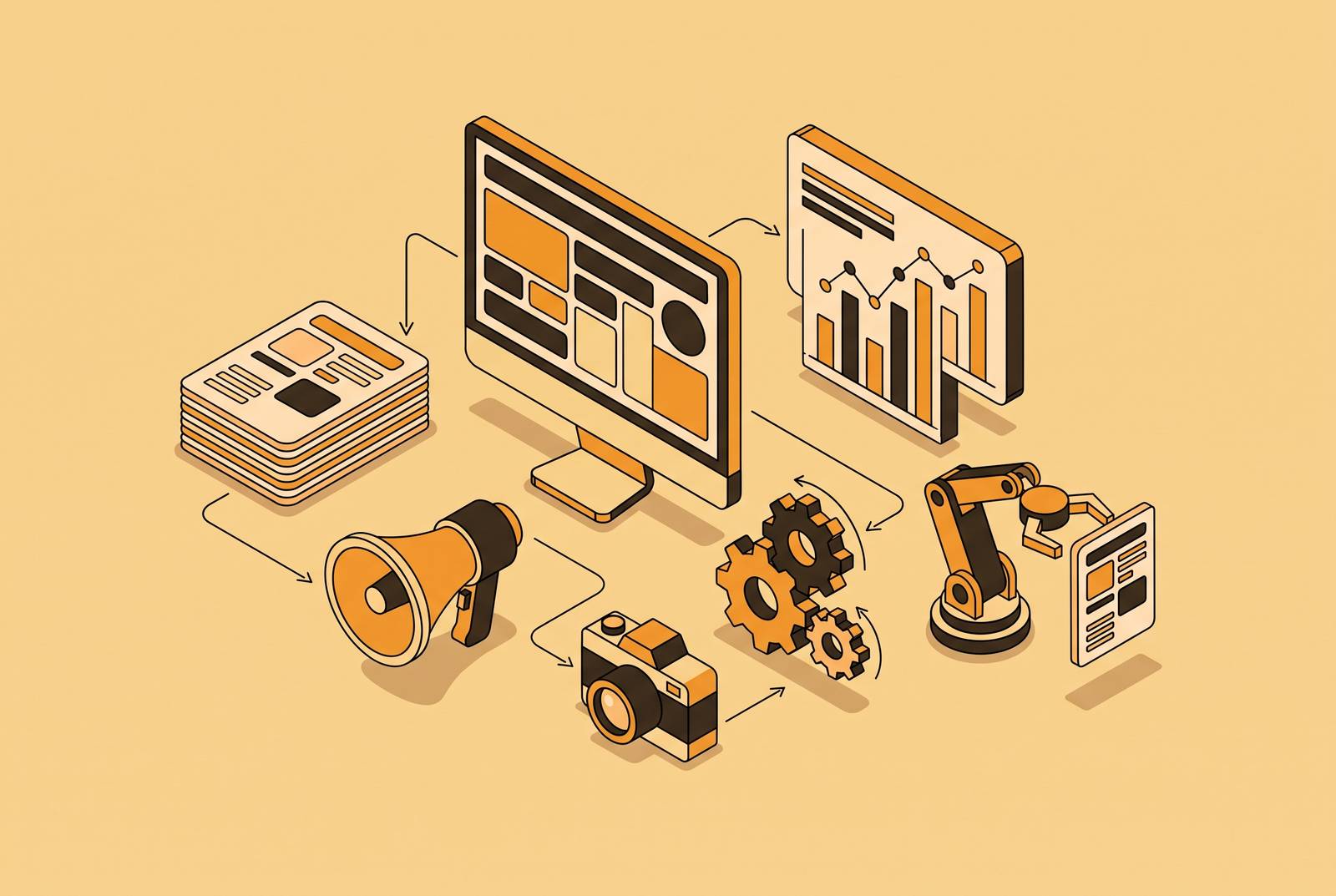
AI is the structural answer, but only when the tools are organized around how agencies actually work, not around what a single vendor happens to sell. Content production has distinct phases: research, drafting, creative, approval, distribution, measurement. The thesis this piece develops is straightforward: the right agency AI stack gets organized by function, built around multi-client governance and approval workflows, and evaluated against demonstrable client ROI. Not a list of favorite tools. A production lifecycle, mapped to what actually gets a client's content in front of buyers.
How fast adoption has moved and the 2026 baseline
Adoption didn't creep, it compounded. Inside content workflows specifically, Jasper's State of AI in Marketing report puts usage at 60% in 2026, up from 35% in 2024.
The efficiency numbers back up why. Teams using analytics AI report saving 30 to 40 hours a month on reporting alone, and content teams report time savings around 70% on production tasks. ALM Corp's 2026 guide to digital agency operations puts the average content production time reduction at 40% with AI assistance, a figure that lines up with the broader time-savings data even if the exact percentage varies by task type AI Tools for Digital Agencies: A Complete 2026 Guide to Scaling Opera…. And the cost delta is not subtle: the median cost per AI-generated article runs around $0.12, against roughly $150 for freelance content. When the economics move by three orders of magnitude, adoption isn't really optional anymore.
The growth trajectory ahead looks steep too. Industry estimates put the agentic-AI market above $10.9 billion in 2026, growing at more than 45% annually onbrandmarketer.com ALM Corp. Agencies are walking into this at the growth phase, not the experimental phase, which changes the stakes of getting the stack wrong.
Most agencies have individual AI habits, not coherent stacks. A copywriter uses ChatGPT for first drafts Best AI Tools for Marketing Agencies (2026 Stack). A strategist uses Perplexity for competitive research quickseo.ai. Nobody's connected the two, and nobody's measuring whether any of it changes what a client's buyers actually see when they ask an AI platform a question. That gap between adoption and structure is what an organized, function-based stack closes. Adoption has compounded rapidly, with 87% of marketers using generative AI in at least one workflow in 2026, up from 51% in 2024, per Salesforce State of Marketing.
How automated discovery changes what agencies must produce
Discovery itself is migrating away from the search bar. ChatGPT is reported at roughly 900 million weekly active users, and Google's Gemini at around 750 million monthly active users, which makes both platforms meaningful discovery environments in their own right, not niche experiments Best AI Tools for Marketing Agencies (2026 Stack).
Click behavior is changing right along with it. ChatGPT processes an estimated 2.5 billion prompts daily, and about 65% of those qualify as search-like queries, yet ChatGPT's click-through rate runs 96% lower than Google's jasper.ai. The AI answer often ends the search entirely; there's no click left to capture. Traditional search is shrinking in parallel: roughly 68% of Google searches ended without a click in early 2026, per SparkToro's analysis of Similarweb data from January through April of that year, and Gartner projects traditional search volume will drop by 25% as AI chatbots substitute for answer engines.
This creates a citation concentration problem that agencies can't ignore. The top 20% of cited domains capture 80% of all AI references, and yet more than half of brands still have no GEO strategy at all frase.io ALM Corp. The first-mover window is closing. What this means operationally is that content now has to be built to earn AI citations, not just search rankings, and those are genuinely different optimization jobs requiring different structural decisions in how content gets written.
For agencies with B2B SaaS or dev-tool clients, this isn't abstract. Nearly half of B2B buyers now use AI platforms for vendor research, according to Gartner, which makes AI visibility the primary channel shift those clients need addressed. Complicating things further, the platforms don't agree with each other. ChatGPT, Claude, Gemini, and Perplexity cite wildly different sources, with only about 14% overlap among their top-cited domains quickseo.ai. AI visibility isn't a single target agencies can hit once and walk away from. Discovery is migrating, as 62% of users now start their search journey with AI tools rather than traditional search engines (frase.io).
What GEO and AEO mean in practice
Two acronyms have taken over agency conversations, and each one describes something distinct and precise. AEO, Answer Engine Optimization, refers to securing prominent and accurate placement inside AI answers on platforms like ChatGPT, Google AI Overviews, Gemini, and Perplexity, achieved through a mix of technical and content optimization. GEO, Generative Engine Optimization, refers to something slightly different: influencing how AI tools use a brand's content to generate their responses in the first place, based on what's indexed across the web. One is about winning placement in an answer that already exists. The other is about shaping what the answer says.
No academic consensus separating these terms existed as of early 2026, and in practitioner circles they get used interchangeably, alongside other labels like AI SEO, AIO, and AI search optimization. The naming debate isn't just semantic housekeeping. Agencies that switch between the terms mid-presentation undercut their own authority on the subject. Pick one term, define it, and use it consistently across every client conversation.
None of this replaces SEO, and agencies that treat GEO as a separate discipline from search optimization are working from a false premise. The brands performing best on GEO in 2026 are, overwhelmingly, the same brands that already had strong traditional SEO foundations. GEO layers additional requirements on top: content structure that's easy for a model to parse, citation-friendly formatting, and data richness that gives an AI something concrete to quote.
Platform behavior varies enough that a single piece of content won't perform equally everywhere. Google's AI Overviews pull primarily from top-10 ranking results, so the practical move is to optimize for traditional SEO first and layer in snippable structure second. Microsoft's Copilot leans heavily on LinkedIn for B2B queries specifically, which matters enormously for agencies running B2B clients who've underinvested in LinkedIn content. Production workflows need to account for these differences upfront rather than treating one blog post as universally reusable across every AI surface.
The payoff for getting this right is measurable and growing fast. Citation has become a functional signal driving measurable traffic gains, at a growth rate that outpaces almost anything else in the channel mix. Andreessen Horowitz popularized the term GEO in May 2025, while Profound practitioners argue AEO is clearer to executives, and agencies should pick one term and define it consistently for clients. AI-referred sessions jumped 527% between January and May 2025, and AI platforms generated 1.13 billion referral visits in June 2025 alone, a 357% year-over-year increase, showing that the traffic value of citation is real and growing (frase.io).
Drafting and copy generation tools built for agency scale
The drafting layer is where most agencies start their AI adoption, and it's also where the wrong tool creates the most invisible damage. The core requirement here isn't output speed, it's multi-client brand governance. A tool that produces fast, generic copy doesn't save time, it just moves the time cost downstream into editing, and that editing debt compounds across every client account running through the same workflow.
ChatGPT Business and Enterprise tiers have become the agency workhorse for campaign concepts, messaging matrices, landing page variants, and first-draft outlines; OpenAI states it doesn't train on Business or Enterprise data by default, which matters for agencies handling sensitive client information, and the tool's real strength is fast iteration with a team working from a consistent output format. Claude occupies a different niche: longer context windows make it well suited to long-form drafts, structural editing, and synthesizing bulky research packs into something usable, and Anthropic has positioned Claude toward deeper, more agentic workflows going into 2026.
Jasper was built specifically for marketing teams that need fast, repeatable copy with brand voice controls baked in and multi-client governance as a first-class feature, not an afterthought; the platform reports more than 350,000 users and now emphasizes "AI agents for marketing" in its 2026 positioning, and it's a strong fit for agencies pushing high volumes of on-brand copy across many channels at once, though some platforms, like Letterstory, pair that publishing function with tracking whether ChatGPT, Claude, Gemini, and Perplexity actually cite the content once it's live. Further down the volume curve, tools built for short-form copy and headline generation handle ad copy iteration and social variants at scale.
Choosing among these comes down to a short set of practical questions. Does the tool support brand voice settings or accept a style document as a guide? Does it separate clients into distinct workspaces so one account's data doesn't bleed into another? And does its output land in a structured format an editor can actually work from, rather than a wall of text that needs restructuring before anyone touches it? Generation handles throughput. Brand voice, factual accuracy, and strategic positioning still need a human in the loop, every time.
Research tools that give strategy teams cited, verifiable evidence
Research deserves its own layer in the stack because content that earns AI citations tends to be content grounded in verifiable claims tied to named sources. The stakes reach well beyond writing quality: it's about whether an AI platform can point to a specific fact in a specific place and cite it with confidence. Ad hoc Google searches, or unverified outputs pulled straight from a chatbot, don't produce the sourced, authority-signal-rich content that GEO actually rewards.
Perplexity has become the default research assistant for this stage, largely because it includes citations and links back to original sources as a built-in feature, making it useful for market research, competitor scanning, and building recommendations that can survive a client's scrutiny; documented agency pipelines specifically place Perplexity before Claude or ChatGPT in the sequence, as the research step that feeds the draft rather than the other way around. Surfer SEO rounds out this layer as a content editor built with AI Search guidelines and one-click optimization, useful for agencies trying to keep on-page structure consistent while scaling output.
One documented pipeline, described in Gend.co's agency stack guide, lays the sequence out cleanly: brief intake happens in Notion, research runs through Perplexity with human verification layered on top, messaging and structure get built in ChatGPT or Claude, and on-brand copy production happens in Jasper. Research is a named, discrete step in that chain, not something that happens incidentally while a draft gets written.
Perplexity and tools like it surface sources, they don't validate them. A citation that looks authoritative can still be wrong, outdated, or misapplied to the claim it's attached to. For content that's about to be published under a client's name, someone still has to check the source actually says what the AI output claims it says. Semrush is an SEO and content strategy platform that delivers 3.5x faster topic research per benchmark data, covering keyword research, competitive content gaps, and topic authority mapping, with no minimum data volume required, making it best for content teams that need research and optimization in one workflow.
Creative production tools for visual and multimodal content at campaign speed
Visual and video production sit apart from the copy stack entirely, because writing tools don't make images, and the creative bottleneck is a genuinely separate constraint from the copy bottleneck. Agencies that solve their drafting problem and ignore their creative one just move the queue downstream.
Canva's Magic Studio bundles a set of AI features that move a team from idea to finished asset quickly across social posts, decks, and campaign creative, and it's widely represented across agency stacks in multiple 2026 sources as the rapid-production layer that avoids a heavy design bottleneck. Image generation tools like Midjourney, DALL-E 3, and Stable Diffusion handle custom visuals from text prompts, useful for concepting new creative directions or localizing a campaign across markets without commissioning new photography each time. On the video side, Runway and Pika Labs bring AI-powered editing and animation into reach for teams that don't have a dedicated video production budget, addressing rising demand for video content without a matching rise in production hours. Adobe Firefly rounds out the set for teams already inside the Adobe ecosystem, with commercial licensing built into its model specifically for client work.
None of this scales without a digital asset management layer. Creative tools generate files, but those files need tagging, search, and reuse across clients and campaigns, and without a DAM system in place, visual AI just produces file sprawl instead of genuine scale. Canto's 2026 guide frames an AI-powered DAM as the operational backbone connecting process, project, and people across a marketing and creative organization, and that framing holds up: creative output without an asset system behind it is a liability waiting to surface during the next client audit.
There's a GEO angle here too, and it's easy to miss frase.io ALM Corp. Gemini specifically analyzes video and image content in addition to text, so agencies trying to earn Gemini citations need structured multimodal assets, not text-only blog posts. Compliance matters as much as capability: commercial licensing and data usage policies differ substantially across image generation platforms, and agencies need to check output licensing before any generated visual goes into a client campaign.
Workflow automation tools that move content from brief to published without manual handoffs
Most of the real time loss in agency content production doesn't happen inside any single tool.
What's changed over the past year is how much of that handoff work agents now handle directly. Systems that were pilots a year ago are now routing finished assets to reviewers, auto-generating channel-specific variations from a single approved asset, flagging off-brand language before human review, and triggering campaign steps on approval. AI is increasingly responsible for the connective tissue between steps, not just for performing the steps themselves.
Make, formerly known as Integromat, handles visual orchestration of multi-step processes across a tech stack, and positions itself explicitly as a platform for building and running agentic workflows; typical agency use cases include converting a client email straight into a Notion brief, generating a draft outline and routing it into the content pipeline, or assembling reporting packs automatically from analytics sources. Zapier remains the easier entry point, connecting more than 8,000 apps with less setup complexity, and its Zapier Central product is specifically built out for campaign workflow automation for teams that don't want to build and maintain complex automation logic. AirOps is a no-code AI workflow builder aimed squarely at agency-scale pipeline construction, connecting AI steps to existing tools, data sources, and CMS platforms. Gumloop gets named alongside Zapier as a strong option for automating campaigns end-to-end, using trigger-based agents to move work from brief to launch with fewer manual handoffs along the way. And Notion AI functions less as a single tool and more as the operating layer that holds client hubs, briefs, SOPs, project trackers, and asset libraries in one searchable place; Notion describes it as a "built-in teammate" that draws on workspace context.
The architecture that separates real infrastructure from a collection of clever automations comes down to coordination. The leading systems run specialized agents, a researcher, a writer, a critic, a publisher, all operating against the CMS as a shared source of truth, with human review sitting at every meaningful boundary rather than only at the end. Running AI experiments and running AI infrastructure are not the same thing. Per Gend.co's stack analysis, the agencies scaling most effectively combine an AI assistant for drafting and iteration, a research engine that returns citations, and a design suite for fast creative production, tied together with automation rather than left as separate habits.
Measurement is where all of this either proves itself or doesn't. Content activity across every layer above means nothing to a client if nobody can show whether an AI platform actually names and cites that client's material when a buyer asks a relevant question. For agencies managing several clients through the same stack, that kind of measurement isn't a nice-to-have bolted onto the end of the process. It closes the loop back to the return on investment every client eventually asks about.