Website Redesign SEO Checklist for Content Teams
Protect your SEO and AI visibility during redesign with this two-surface checklist.

A website redesign has always put years of accumulated SEO equity at risk. What's different now is that the same rebuild can quietly erase a brand's footing in AI answer engines, a second discovery surface that runs on its own sourcing logic and does not forgive the same mistakes in the same way. Content teams planning a redesign are protecting two things now, and most checklists still only account for one of them.
Two Separate Forms of Visibility a Redesign Now Threatens
The two surfaces reward almost entirely different content. A page that ranks well in Google organic search and a page that gets cited by an AI answer engine are chosen by different criteria and measured against different signals, so work that protects one offers no guarantee of protecting the other. In practice this means content that never ranked in Google at all can be cited regularly by ChatGPT, while a page anchoring a category ranking in Google might be invisible to Perplexity. A redesign that deletes or restructures either kind of page, without first knowing which surface it was actually serving, loses value that won't show up anywhere in the site's own analytics, because the tool measuring the damage was never built to see it.
This matters now because AI answer engines pull from a brand's published content directly, the parts that are retrievable and clearly structured, and a redesign is exactly the moment when that content tends to get moved, renamed, thinned out, or cut, usually without anyone on the project raising a flag about what it costs in AI visibility. The checklist that follows is built around both surfaces for one reason: the teams that lose the most in a redesign are the ones that only thought to protect the one they could already measure.
Organic Search, AI Snippet Extraction, and AI Citation as a Dependency Chain
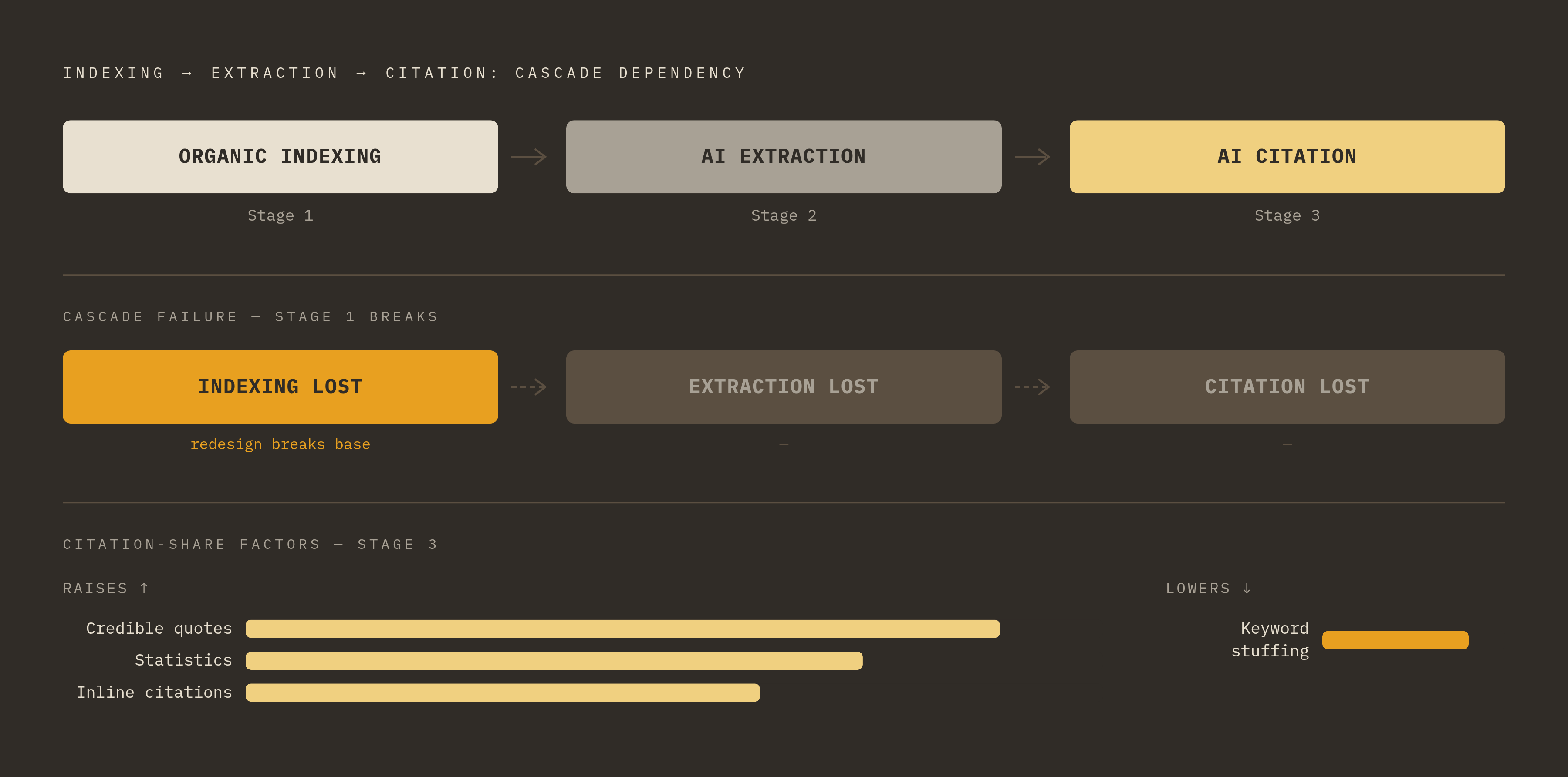
Treating organic search, AI snippet extraction, and AI citation as three separate boxes to check misses how they actually relate to each other. They form a chain, and each layer depends on the integrity of the one beneath it. A page has to be found and indexed before it can be extracted into a snippet, and it has to be structured clearly enough to extract before any AI system can cite it with confidence. Break the foundation during a redesign and everything stacked on top of it breaks too, even if nothing about the AI-facing content changed directly.
Research into what actually moves AI citation share gives some shape to that top layer. Adding quotations from credible sources, working in statistics, and including inline citations each raise a source's share of a generated answer, while keyword stuffing has the opposite effect and actually pulls citation share down. Readability improvements on their own showed little to no effect in that research, which runs against the instinct that cleaner prose alone should earn more AI attention.
That finding sits next to a real disagreement: Google has publicly advised against chasing what it considers GEO hacks, things like chunking content into AI-friendly blocks or publishing llms.txt files, and has said that many of the tactics circulating in that conversation aren't supported by how Google Search actually works. At the same time, the third-party research on quotations, statistics, and citations shows those specific tactics do move the needle on AI citation share. Both things can be true at once, and the content that satisfies both sides is the same content that was always worth building, written for the reader first and structured well enough that both a crawler and a language model can make sense of it.
For a redesign, the practical use of this chain model is simple to state and easy to skip.
The pre-redesign audit that surfaces what you cannot afford to lose on either surface
Everything that happens later in a redesign, every redirect, every content consolidation, every template change, is only as good as the baseline data collected before any of it starts. The pre-redesign audit is the point in the process where the cost of being careless is lowest and the cost of skipping it is highest, because mistakes made here get discovered months after launch, when they're much harder to trace back to a cause.
On the Google side, the baseline starts with a full site crawl, using a tool such as Screaming Frog, Ahrefs, or Semrush, capturing every current URL along with its status code, title tag, meta description, H1, canonical tag, word count, and internal link count. Save that crawl with a date-stamped filename so it stands as an unchangeable record of what the site looked like before anyone touched it. Pair that with a full year of Google Search Console data at the page level, sorted first by clicks and then by conversions. Most sites will find that a small number of URLs generate the overwhelming majority of organic value, and those specific pages need individual attention during the redesign rather than being left to whatever rule applies to their template. Build a keyword map that ties each URL to the terms it targets, so the team knows in advance which pages can't lose their core content or their URL without a redirect standing in the gap. Capture Core Web Vitals and server response times before launch too, because new sites tend to run heavier than the ones they replace, and a slower site carrying the same content will still underperform its old self on the very same URLs.
The AI side of the baseline needs its own process, run in parallel. Build a prompt library covering the category questions, comparison questions, and use-case questions a buyer might actually ask, then run them across ChatGPT, Perplexity, and Google AI Mode, logging which pages get cited, where they rank in the response, and how they're framed. That log is the AI-visibility snapshot the redesign is not allowed to degrade. Finally, identify any pages functioning as de facto grounding pages, fact-dense, encyclopedic content that AI models are already pulling from, because those pages need to survive the redesign structurally intact even if the visual design around them changes completely.
No design decision should be finalized until both of these baselines exist in writing. A redesign kickoff meeting that hasn't reviewed both documents is starting from guesswork on at least one surface.
URL structure, redirects, and template signals: the migration decisions that silently damage rankings
Search equity lives on URLs, not on designs. Years of backlinks, internal link signals, and user behavior data all attach to a specific address, and changing that address without a redirect in place orphans the entire history behind it. This is the single largest risk in any redesign, and also the cheapest one to control, since a redirect costs almost nothing and a lost ranking costs a great deal.
Treat the redirect map as a contract that cannot have gaps. Build a spreadsheet with every URL from the baseline crawl in one column and its destination in the next, one row per old URL, with no exceptions, including pages that earned backlinks over the years but never drove much direct traffic themselves. Test every redirect on staging before launch to catch broken ones before they go live. Once new URLs are live, update internal links to point to them directly instead of leaning on the redirects to carry link equity, since a direct link passes authority more cleanly than a redirected one. If the URL structure has to change at all, use short, descriptive slugs, skip special characters and underscores, and preserve the existing folder structure wherever that's possible.
Template-level regressions are quieter and, for that reason, more dangerous. A new product or service template that drops the H1 or stops outputting review schema will affect every single page built on it. Structured data deserves its own line item here too: redesigns routinely strip out schema markup for reviews, FAQs, and products, so it needs to be reimplemented on purpose rather than assumed to have carried over automatically from the old template.
The AI-surface consideration at this stage is narrower but just as consequential. Any page serving as a grounding or citation source needs to keep its fact density and structural clarity through the migration intact. A template change that pushes key definitional content below the fold, or breaks it apart into dynamically rendered sections, can remove that page from AI retrieval entirely without breaking a single redirect or tripping a single crawl error.
Content decisions during the redesign: what to keep, consolidate, or restructure for both surfaces
Content decisions made during a redesign are visibility decisions, not editorial cleanup, and they permanently affect which surface a given page is able to serve afterward. Teams that treat this stage as a chance to simply tidy up copy lose equity on one surface or the other that is not easy to win back.
On the Google side, the top tier of the organic baseline needs its core content, keyword focus, and URL structure preserved even as the design around it changes. Substance can't be thinned on these pages without putting their ranking at real risk. Use the keyword map together with Search Console data to confirm which URL should be the canonical target for each keyword cluster before making any consolidation call. No indexed page should be deleted outright without a redirect or a deliberate noindex behind it; archiving or redirecting is the safer default.
On the AI side, the most important concept to carry into the redesign is the grounding page: a fact-dense, encyclopedic, neutral page built so an AI model can anchor a claim to it directly during retrieval, with one fact per sentence, timestamps attached to claims, and language written so the model can reason from it rather than having to extract a snippet from a longer persuasive piece. Grounding pages already identified in the pre-redesign baseline need to be explicitly preserved through the rebuild. Content that earns AI citation responds to quotations from credible sources, inline citations, readable sentence structure, and specific statistics, and a redesign is the right moment to add those elements to pages that lack them, not simply reformat the pages visually and call the work done. Entity relationship pages, the ones explaining what the brand is, who it serves, and what it's known for, are high priority for AI citation and need to be written so they're unambiguous and consistent with how the brand is described everywhere else it appears online.
The sharpest tension in this stage occurs when a page tries to serve both surfaces at once and ends up serving neither well. A long, discursive piece of thought leadership can perform strongly in Google organic search, with high dwell time and a dense web of internal links, while being poorly structured for AI extraction, since its key facts are buried inside narrative paragraphs instead of being stated outright, and editing the one piece into something that tries to satisfy both audiences at once usually leaves it weaker on both.
Site architecture, internal linking, and information hierarchy as AI-retrieval signals
Site architecture tells both search crawlers and AI retrieval systems which content a brand considers authoritative. Pages buried deep in the folder structure, poorly linked from the rest of the site, or absent from the main navigation get deprioritized by search algorithms, and they're also less likely to be pulled in as evidence by an AI model doing retrieval.
Once URLs change during a redesign, every internal link needs to be updated to point directly at the new destination rather than relying on a redirect chain to carry the link equity through. Pages marked as grounding pages or entity pages for AI citation deserve prominent internal links from the site's highest-traffic pages and from the main navigation or footer, which signals their authority to crawlers and retrieval systems alike. Information hierarchy within a page matters just as much as the links pointing to it: content that answers a question directly in the first two or three sentences of a section is far more extractable for an AI system than an answer buried in the middle of a long paragraph, and the redesign's structural templates should make that the default pattern across the site rather than something editors have to remember to do manually each time.
Entity consistency belongs here too, since it's an architecture signal as much as a content one. The brand's name, description, founding context, and service definitions need to read identically across the website, LinkedIn, relevant industry directories, and any third-party platform that mentions the brand. Drift between how the old site described the brand and how the new site's rewritten copy describes it is a direct, documented cause of AI hallucination and lost citation, and it's a risk the redesign itself creates, simply because copy is being rewritten at exactly the moment this consistency needs to hold steady.
Off-site presence and third-party platforms: the AI-citation surface the redesign can accidentally break
A redesign confined to the brand's own domain can still damage visibility that lives entirely off of it. Branded mentions across third-party platforms correlate strongly with AI visibility, more strongly than backlinks do. A redesign workflow needs a cross-platform entity audit built in as a launch-gate requirement.
This risk belongs to the redesign moment itself. Copy gets rewritten on the main site, descriptions get tightened, service language gets updated to match a new positioning, and none of that automatically propagates to LinkedIn, industry directories, or any other third-party page where the brand is described. A redesign checklist that ends at the domain boundary leaves off-site mentions unaudited, and those mentions shape whether a brand gets cited, found, and described accurately once the rebuild goes live.