Topical Authority Building With AI Content Tools
Structure your AI content strategy before you write it, not after.

Volume without structure signals noise, not expertise
Publishing a hundred articles written with AI tools on a subject doesn't build authority. It builds a pile of pages. Google's crawlers, and the large language models now answering search queries directly, have gotten good at telling a pile apart from a real body of work, and that difference appears in the ranking data within months.
The failure pattern is familiar by now. A team feeds ChatGPT or Claude a list of topic ideas, generates dozens of articles in a few weeks, publishes at speed, and watches a short-lived traffic bump turn into a ranking collapse a few months later. The individual articles might read fine on their own. That's beside the point: Google's crawlers read topical signals across a site's whole content set, not article by article, so a batch of pages with gaps in it reads as incomplete expertise no matter how clean any single page is.
Ranking systems build something closer to a model of a site's expertise across a whole topic landscape than a scorecard for individual pages. Semantic relationships between pages, consistent use of terms and entities, and the pattern of what a site does and doesn't cover all feed that model. A page sitting by itself, one that doesn't link to or get linked from related content elsewhere on the site, passes none of that signal along. It just sits there, earning nothing for anything around it.
Topic dilution makes the damage worse. A site publishing across unrelated subjects makes it harder for any algorithm, human or machine, to say what that site is actually an authority on. Calling something a "Level 2 charger" on one page and a "home EV charging station" on another, without ever tying the two together, weakens the semantic signal further, because now the system can't tell if that's one concept or two. None of this comes down to writing quality. It comes down to whether the site's content connects to itself.
Google's E-E-A-T standard (experience, expertise, authoritativeness, trust) has become a more heavily weighted quality signal in recent core updates, and Thin AI-generated content, the kind that hits a keyword without showing real depth or credibility, faces compounding disadvantages: it tends to lack topical structure and the trust signals that would otherwise support it.
The AI answer engines make the same mistake more expensive, not less. When Google shifted AI Overviews onto its Gemini 3 model, a large share of previously cited domains dropped out of the citation pool, and the overlap between ranking in the top ten organically and getting cited inside an AI Overview fell sharply from where it used to sit. Ranking well in traditional search used to guarantee a mention in the AI answer above it. It doesn't anymore, and treating the two as the same problem is the fastest way to lose both.
None of this is an argument for using AI tools less. It's an argument for changing the order they get used in. Architecture has to come before production, not after, and most teams have that order backwards, chasing volume first and structure never.
The pillar-cluster architecture and AI production
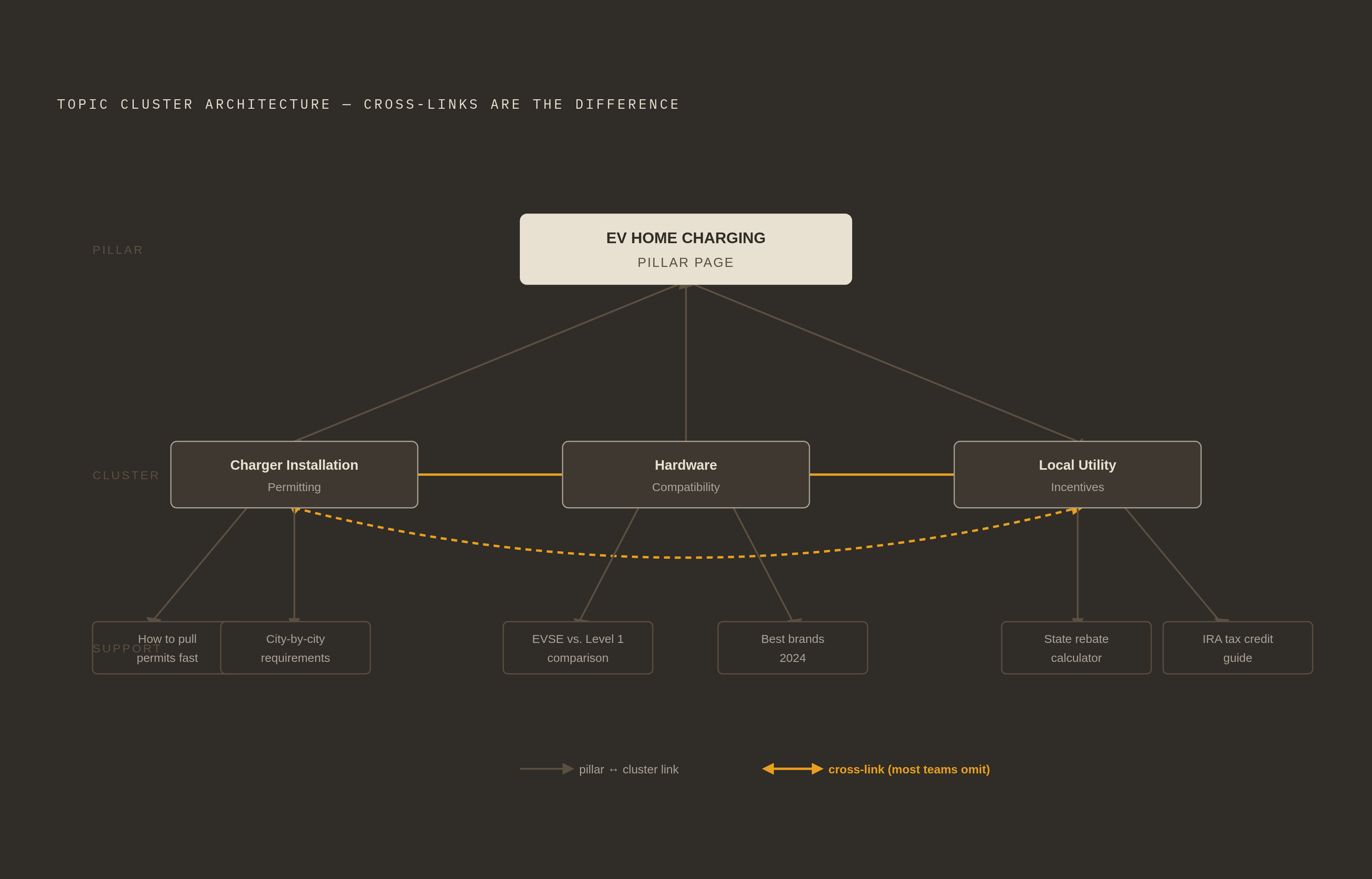
The pillar-cluster model, sometimes called hub-and-spoke, gives a site the shape search engines and AI answer systems are actually looking for. It runs on three tiers. A pillar page covers a broad, high-intent topic that defines an entire expertise area. Cluster pages sit underneath it, each covering a specific subtopic in depth, each linking back to the pillar with anchor text that describes what the pillar covers rather than something generic like "click here." Supporting content fills the edges: comparisons, how-to guides, answers to adjacent questions that catch longer-tail search intent, linking both to the pillar and to whichever cluster pages fit.
Internal linking is the mechanism that actually moves topical signal from one page to another. Internal linking is widely treated in SEO practice as a lever that redistributes ranking authority across a site, though its effect is difficult to isolate cleanly from a site's external backlink profile. Still, the directional logic holds: a page sitting inside a well-linked cluster behaves differently than the same page sitting alone with nothing pointing to it.
The clustering effect is visible in raw numbers, too. Ahrefs' keyword clustering research found that properly clustered content strategies produce an average of 40% more organic impressions per published page than a one-keyword-per-page approach. That gap exists because a well-structured cluster article answers several related questions in one place, instead of forcing a reader, or a search engine, to hunt across five thin pages for the same information.
Most teams get the linking direction wrong. In the classic hub-and-spoke pattern, every spoke points back to the hub and never to any other spoke, which throws away half the value of the structure. The stronger version lets an article on EV charger installation permitting link sideways to the article on local utility incentives, and to the one on hardware compatibility, because those topics actually sit next to each other in a reader's mind whether the site's architecture admits it or not.
Content calendars that get sequence wrong end up with cluster articles linking back to pillar pages that don't yet exist, which breaks the internal linking structure those articles depend on for authority. Pillar pages need to exist before cluster articles can link back to them in any way that means something, which sounds obvious until you look at how many editorial calendars get built purely by keyword priority with no regard for which piece needs to publish first. AI tools can map those linking dependencies and recommend a publication order, catching a planning step that keyword-first workflows skip almost every time.
AI tools fit this model well on the production side for a specific reason: human subject-matter experts tend to go deep in a narrow lane and lose the thread across a broad topic cluster, while AI systems are better suited to spotting relationships between concepts, checking for coverage gaps, and holding consistent terminology across a large volume of content. For a topic like EV charging infrastructure, full coverage spans hardware technology, installation and permitting, network operators and software, policy and incentives, and the actual experience of charging a car. None of that comes from mapping "EV charger" against "electric car charger." Those are the same subtopic wearing two names, not two different subtopics, and treating them as separate content opportunities is how teams end up with duplicate thin pages instead of one solid one.
The architecture is the strategy. Everything AI tools do at the production stage executes against it. It doesn't replace it, and a team that skips straight to drafting has already lost the plot.
Stage one: using AI to map the topic universe before touching a keyword tool
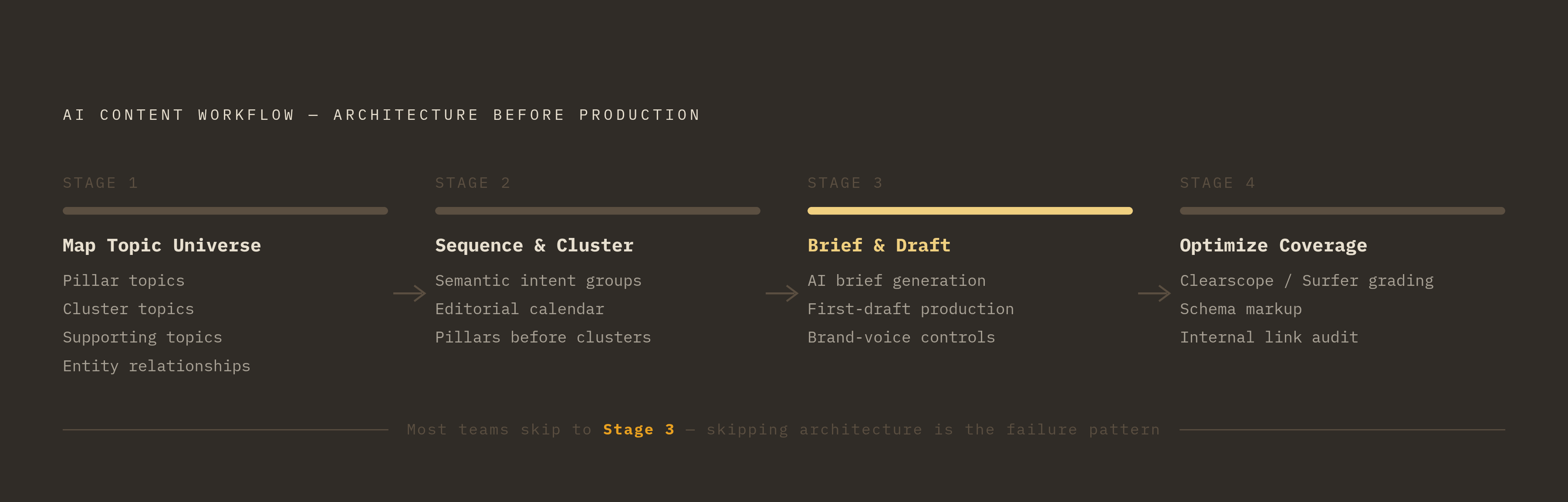
Start with a seed topic. AI tools trained on semantic relationships surface subtopics that keyword research tools miss entirely, because they're reasoning about intent and conceptual hierarchy, not search volume.
A complete topic universe map needs four layers. Pillar topics are the broad subjects defining the expertise area itself. Cluster topics are the specific subtopics supporting each pillar. Supporting topics are the adjacent questions, comparisons, and how-to material that catch longer-tail intent. Entity relationships are the people, companies, tools, and concepts tied closely enough to the space that a genuine expert would name them without thinking twice.
This is a knowledge graph exercise. The output should tell a content team what a truly expert source in that field would need to cover, independent of whatever people happen to be typing into a search box that month.
The distinction that trips teams up most at this stage is telling keyword variations apart from genuinely distinct subtopics. "Level 2 charger cost" and "home EV charger price" carry the same intent and belong in the same piece of content. "Level 2 vs Level 3 charger" and "how fast does a Level 2 charger work" are different questions from different readers at different points in a buying decision, and they deserve separate treatment. Getting this distinction wrong in either direction, splitting one topic into three thin pages, or cramming three distinct questions into one page, undoes the whole exercise.
MarketMuse's Topic Navigator fits this stage well. It clusters related keywords by intent and topical relationship rather than volume alone, and its Topic Authority score measures how well a domain covers a given topic across breadth and depth site-wide, instead of relying on a generic difficulty metric.
Build the visual topic map before pulling any keyword data. Doing it in the opposite order is how teams end up treating three keyword variants as three separate content opportunities.
The output of this stage is a structured topic universe map defining every subtopic a site needs to cover to be taken seriously as comprehensive. That document becomes the editorial blueprint for every stage that follows.
Stage two: clustering keywords by semantic intent and sequencing the editorial calendar
Clustering by semantic intent means grouping keywords by what a reader is actually trying to accomplish, not by which words happen to overlap. Some queries belong folded into a single article. Others, despite looking similar on the surface, represent different intents entirely and need their own coverage.
One-keyword-per-page thinking breaks down here because it throws away the compounding effect a cluster is supposed to produce. A well-structured article that satisfies several related queries at once earns broader indexing than five separate thin pages ever would, which is the mechanism behind that 40% jump in organic impressions per page that Ahrefs found in properly clustered strategies.
Publication order isn't a scheduling afterthought. Pillar pages go live first, because cluster articles need somewhere real to link back to before they publish. AI tools can map those linking dependencies and output a recommended sequence, catching a step keyword-first workflows routinely skip. Content gaps combining high commercial intent with low competition deserve priority early in the calendar, especially where they connect existing product or hardware content to pages built to convert.
Gap analysis adds a competitive layer once a team's own cluster map exists. Running AI-powered gap analysis against competitor content reveals which subtopics competitors have covered that a given site hasn't. In a lot of niches, informational topics like permitting or installation prep sit wide open while everyone crowds around the same handful of commercial keywords.
An editorial calendar built this way needs more than a title and a target keyword attached to each row. At minimum: the topic, its cluster assignment, the pillar page it links back to, which other cluster articles it should cross-link to, and guidance on the anchor text to use. Surfer SEO's multi-keyword analysis and internal linking suggestions help connect cluster content at this stage, and MarketMuse can generate briefs detailed enough to show what subtopics each article needs to hit to pull its weight in the cluster.
The output is a sequenced calendar with the linking architecture already attached to each entry, before a single word of the first draft gets written.
Stage three: brief generation and first-draft production with brand-voice controls
The brief is where the cluster architecture actually gets handed to the writer, or to the AI model doing the drafting. A brief missing subtopic specs and linking requirements produces an article that ignores everything built in the first two stages, no matter how clean the prose reads on the page.
A brief for a cluster article has to specify the pillar page it links back to and the anchor text to use, the other cluster articles it should cross-link to and why, the specific subtopics it has to cover to earn its place in the cluster, the questions and entities tied to the topic it needs to address, and the content type that fits the query's intent (a how-to, a comparison, a definition piece, or something more narrative).
For teams that need fast first-draft turnaround at volume while holding a consistent brand voice, Jasper is built for exactly that job. Its agents can score how ready a piece of content is for AI search, flag citation gaps, and generate FAQ blocks and schema markup, the structural elements answer engines look for when deciding what to extract and cite.
E-E-A-T adds a layer that can't get skipped at draft stage. Recent core updates have consistently rewarded pages that carry detailed author credentials. AI-generated drafts need a human expert to review them and attach credible authorship before anything goes live. Thin AI content without that layer is getting hit hardest in the update's aftermath, and no amount of clean prose fixes that on its own.
Brand-voice consistency at scale is an operational problem with real consequences: inconsistent terminology for the same entity across a site's articles weakens the semantic signal the whole cluster is trying to build. Structural brand-voice controls, the kind built into a tool like Jasper, catch this more reliably than an editorial team eyeballing every article for consistency.
What AI tools cannot manufacture is first-hand experience, original data, or direct quotes from people who actually know the subject. Research on generative engine optimization, the Aggarwal et al. study on AI citation behavior, found that quotations from credible sources raised AI citation share by roughly 41%, statistics by about 31%, and citations more generally by about 28%. A model doesn't invent that kind of material. It has to come from somewhere real. Someone still has to go get the quote.
Speed genuinely changes once the architecture exists. Research on content produced with AI assistance found that one or two specialists working with such tools can produce somewhere in the range of 100 to 150 pieces a month, output that would otherwise take a full content team working by hand. That speed only holds when the mapping and clustering stages happen first. Skipping them means the same tools just produce noise faster.
Stage four: optimization against topic coverage, not just keyword density
The real question at this stage is whether the draft covers its assigned subtopics deeply enough to add authority to the cluster it belongs to, and that's a different measurement than counting how many times a keyword appears.
Clearscope grades a draft on a scale from A++ down to F based on how its topic coverage compares to top-ranking competitors, and it's built for non-technical writers to use without a strategist standing over their shoulder. That ease of use comes at the cost of strategic depth, so it works best as a final polish layer, not a planning tool. It fits content agencies running distributed teams of freelancers, where holding quality consistent across a lot of different writers is the real challenge.
Surfer SEO covers different ground: real-time writing feedback and competitive SERP analysis, with integrations into Google Docs, WordPress, and Jasper that surface optimization suggestions inside the environment a writer already works in. It suits mid-market teams that want one tool doing real-time, all-around optimization rather than a specialized grading pass.
The gap analysis these tools run isn't about stuffing in more keywords. It surfaces terms and related concepts that top-ranking pages cover and a given draft doesn't, and that gap is a topical coverage signal.
Internal linking needs an audit at the individual article level, too. Does the draft actually link to its pillar page using the anchor text specified in the brief? Does it cross-link to the cluster articles it was supposed to? A missing internal link at this stage breaks the exact signal architecture built back in stages one and two, and it's an easy thing to miss in a final read-through focused mostly on prose quality.
Schema markup and FAQ structure belong here as well. Jasper's agents can generate both at this stage, and those are the structural elements AI Overview extraction favors when deciding what to pull and cite.
A short checklist earns its place before anything ships. Does the piece include statistics with sources attributed? Does it quote a credible outside source directly rather than paraphrasing everything? Is the brand, author, or organization named clearly, and named the same way across every other cluster article? Is the content structured so an AI engine parsing it can pull out a direct, extractable answer?
The internal linking layer's role in compounding authority
Every stage before this one produces individual pieces of content. Internal linking is what turns those pieces into a single signal that search engines and AI systems read as expertise, rather than as forty separate guesses at the same subject.
The mechanism runs both directions. Cluster pages link up to the pillar, telling a crawler the pillar page is a central hub worth trusting on its topic. But the pillar page needs to link back down too, and cluster pages need to link sideways to each other where subtopics genuinely overlap: the EV charger installation article pointing to the utility incentives piece, the incentives piece pointing back to the hardware comparison guide. That two-way, cross-cutting pattern is what separates a real topic cluster from a hub with spokes that never talk to each other.
Anchor text carries weight in this system that a generic "read more" link doesn't. Descriptive anchor text tells both the reader and the crawler what the destination page is actually about, reinforcing the entity and terminology consistency weak clusters tend to lose track of.
This is where the earlier stages either pay off or reveal their gaps. A brief that specified linking requirements up front produces a draft where those links show up naturally, in context, because the writer or the AI model knew where they belonged before writing the first sentence. A brief without that detail leaves internal linking as something bolted on after the fact, usually incompletely, and the resulting cluster reads thinner than the sum of its articles actually is.
None of this is a one-time setup, and treating it that way is the most common mistake teams make once the initial cluster ships. As new cluster articles publish, older ones need revisiting: new cross-links added, anchor text updated, gaps closed as the topic map itself grows more complete. A cluster is a structure that keeps getting denser over time, and that density is the thing search engines and AI answer systems are actually measuring when they decide which sources sound like they know what they're talking about.