Thought Leadership Content Strategy for B2B Brands
B2B buyers are mostly decided before talking to sales, and thought leadership fills that gap.

By the time a B2B buyer dials into a first call with sales, the decision has largely already been made. Research shows buyers are 60 to 70 percent through their evaluation before they speak to a vendor. The shortlist is set long before anyone from the sales team gets a word in. The pitch does not build the opinion. It confirms or disqualifies one that already exists. Buyers now consult peer networks, AI assistants, and industry publications on their own timeline, checking a vendor's credibility before they ever fill out a contact form. A vendor who treats sales conversations as the start of persuasion is showing up to a negotiation that ended rounds ago. Thought leadership exists to occupy that earlier window: the stretch of time between a buyer recognizing a problem and that buyer deciding who is worth calling. Product pages, spec sheets, and demo requests do nothing for a reader who hasn't yet decided whether a company understands their problem. Original insight, practitioner perspective, and evidence-backed argument are what fill that gap, and a brand that skips this phase and waits for the first sales call has already missed the only part of the buying journey it could actually influence.
Why Generic Content Has Stopped Working as a Trust Signal
The volume of available content has exploded at the same moment buyers have grown sharper about ignoring most of it. AI tools can now produce a lengthy article in seconds, and that ease of production has not made buyers easier to convince. It has made them warier. A 2026 marketing analysis points to a trust deficit taking hold across B2B buying: buyers are actively dismissing generic advice and templated messaging, and the authority that used to come from simply publishing consistently now depends on expertise that is harder to fake and harder to copy. The underlying mechanism is straightforward. When any brand can generate a competent how-to guide on command, the marginal value of one more how-to guide drops toward zero. What doesn't drop is the value of a claim nobody else could have made, a dataset nobody else collected, or an argument that takes a position sharp enough to depart from consensus. The failure here has nothing to do with whether a sentence was typed by a person or drafted by a model. The failure is sameness. Content that could have been written by any competitor, about any company in the category, earns no trust, and buyers conducting independent research can tell insight from filler within a paragraph or two. That is the credibility gap a real thought leadership strategy is built to close.
AI Answer Engines as the New Front Door to B2B Discovery
A growing share of B2B buyers now discover and vet thought leadership through AI tools instead of traditional search, and that shift changes what "visibility" actually means for a brand. Being cited inside an AI-generated answer now carries as much strategic weight as ranking on a results page, but the two outcomes don't come from the same work. Traditional search returns ten blue links and lets the buyer sort through them. Generative tools behave differently: they synthesize those sources into a single answer and attribute it to a handful of selected origins. The content that gets selected earns the credibility that comes with the citation. The content that doesn't simply disappears from the buyer's field of view, no matter how well it would have performed in a conventional search listing. This is what makes the shift structural rather than cosmetic: ranking on Google and being cited by ChatGPT or Perplexity are different outcomes driven by different signals, and a brand can hold the number-one organic position on a competitive keyword while being entirely absent from every AI answer its buyers actually see on that same topic. The two systems are not evaluating content the same way, and optimizing for one no longer guarantees any presence in the other. A thought leadership strategy built only around organic ranking is now, by definition, built around half the discovery layer.
What makes a piece of thought leadership citable by an AI system
AI answer engines consistently pull from content that is structured, grounded in evidence, and clearly attributable to a source. That is not a coincidence, and it is also not a separate standard from what makes content credible to a human reader doing the same research. The qualities that earn a citation from ChatGPT, Gemini, or Perplexity are largely the same qualities a skeptical buyer uses to judge whether a piece of writing is worth trusting at all: it says something specific, it can be traced to where the claim came from, and it holds up as a standalone fact.
Original research is at the top of that hierarchy. Original research generates more citations than generic guides because it offers something measurable and attributable, a fact or finding an AI system can point to and name, rather than a synthesis of points already available everywhere else online. A generic guide restates what a hundred other pages already say. A documented finding gives an AI system something new to cite, which is the entire function these systems are built to perform: surfacing attributable claims, not recycling consensus.
Named expertise compounds this effect. The same Ascend2 research found that marketers who frequently collaborate with outside experts and influencers report their research content performs far better than marketers who go it alone. A named individual with demonstrable credentials behind a claim is more citable than an anonymous brand voice making the same claim, because attribution is exactly the mechanism AI answer engines are designed to track and surface.
The most common objection to this standard is that it demands resources most B2B marketing teams don't have. Original research doesn't require a large-scale survey or a dedicated research arm. A documented client outcome, a genuinely novel synthesis of public data, or a clearly argued position that departs from industry consensus all qualify as the kind of information gain an AI system can attribute and a skeptical buyer can respect. What disqualifies content is the absence of a claim worth attributing.
Where AI systems pull their citations from, and what that means for content distribution
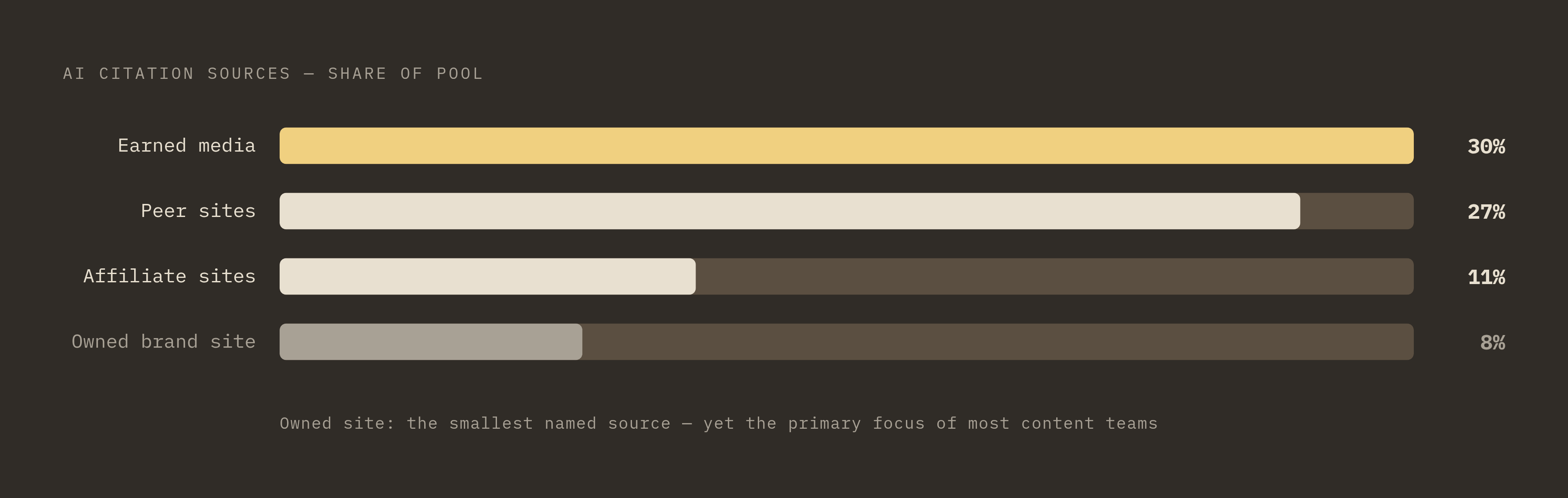
Content quality alone doesn't guarantee an AI citation, because these systems pull from a distributed ecosystem of sources that extends well beyond any single brand's own website. A brand's owned site accounts for a small share of AI citation source distribution, roughly 8 percent according to stats from UNBOUND cited by ABI Research, while earned media takes the largest share at 30 percent, followed by peer sites at 27 percent and affiliate sites at 11 percent. A thought leadership strategy confined to a company blog is, by that distribution alone, competing for a narrow slice of the citation pool no matter how strong the content is.
This is where two distinct layers of distribution architecture come into play. The first is what practitioners call the ground site: the canonical, definitional presence that AI models check against when verifying a claim or a company. That presence has to be complete, internally consistent, and readable by machines before anything built on top of it can compound. A brand's owned domain, its core pages, and its foundational claims about who it is and what it knows all live here, and if this layer is thin or contradictory, no amount of external distribution fixes it, because the models have nothing stable to verify against.
The second layer is what gets called the phantom-site layer: the deliberate spread of validated thought leadership across third-party surfaces that AI models already trust, including industry publications, YouTube, Reddit, and review platforms. Since earned media and peer sites together account for the larger share of AI citation sources, a strategy that only strengthens the ground site while ignoring this second layer leaves the majority of the citation pool untouched. The practical implication for a content team is that publishing is only step one. The same validated research, the same named expert argument, needs a second life on the external surfaces AI systems are already pulling from, because that is where most of the citation opportunity actually sits.
Running an AI-Assisted Content Pipeline Without Losing Editorial Integrity
Producing thought leadership at the pace AI visibility now demands is a production and workflow problem, not a question of having better ideas. The teams managing this well have settled on multi-stage pipelines where AI tools handle the time-consuming middle steps, drafting, structuring, formatting for machine readability, while human editors and subject-matter experts retain control over which claims actually get published. AI has already become standard infrastructure in B2B content production. CMI's 2026 B2B research, via Sota Media, found that nearly all B2B marketers already use AI tools somewhere in their workflow, shifting the real question to where exactly human judgment needs to sit inside that workflow.
The answer depends on the stakes of the content in question. Lower-risk, high-volume content, internal summaries, first drafts of routine updates, can run through AI-led production with a human check at the end. Most thought leadership belongs in a middle tier: AI assists with structure, synthesis, and formatting, but a human owns the final judgment calls about what to claim and how to claim it. The highest-stakes material, including anything resembling original research, regulated claims, or content attributed to a named expert, calls for a human-led process from the start, with AI used only to support research and drafting speed rather than to generate the substance of the argument.
What has to survive this pipeline, regardless of how much of the drafting AI handles, is the editorial judgment that decides whether a piece is worth publishing at all: whether it contains a genuine claim, whether that claim can be attributed and defended, and whether a named expert or a documented outcome actually stands behind it. A pipeline that speeds up production without preserving that judgment produces exactly the generic, interchangeable content that buyers have already learned to dismiss and that AI answer engines have no reason to cite. The speed AI brings to drafting is only valuable if it buys human editors and subject-matter experts more time to do the one thing a model cannot do on its own: decide what is actually worth saying.