Frase vs Surfer SEO for Blog Content Teams
Each tool excels at different stages of the content workflow, from research through optimization.

Blog content teams now face a search landscape that has split in two: pages still need to rank in Google, but they also need to survive being summarized, quoted, or ignored inside an AI-generated answer. Frase and Surfer SEO both sell tools for that new reality, but they solve different halves of the problem. Frase built its strength around research speed and brief generation, while Surfer built its strength around scoring the page while it's being written. Which one fits a given team depends less on feature counts and more on where that team's workflow actually slows down.
The stakes for getting this right keep rising. AI Overviews now show up in roughly a quarter of Google searches, up sharply from where they sat in early 2025, and one estimate puts the figure as high as 58% of queries when broader answer surfaces powered by AI get counted. Where an AI Overview appears above a result, the click-through rate for the page ranking first can fall by more than half. At the same time, traffic arriving from AI platforms has grown fast and started converting better than traffic from traditional search, a reversal from where things stood a year earlier. Ranking well and getting cited by an AI model are no longer the same job, even if they used to look like one.
What each tool is and how it got here
Surfer SEO was built as a content optimization engine from day one. Its core idea, a real-time Content Score built from NLP analysis of whatever pages currently rank on page one, hasn't changed since the product's early days, even as everything wrapped around it has grown. Surfer now counts more than 150,000 customers across upward of 159 countries, and its acquisition by Group Positive in October 2025 seems to have put a charge into its release schedule: over ten features shipped in January and February 2026 alone. The company has started talking about "AI Search Optimization" as its new banner, but the product still thinks in Google-first terms. Scoring a page against top-ranking competitors is still the thing Surfer does first and best.
Frase started somewhere else. It began as a research and content-creation tool, added SEO scoring later, and has now rebuilt its pitch around being an agentic SEO and GEO platform that handles the whole content lifecycle, not just the writing step. Frase counts over 200,000 users, with teams at Microsoft, Coursera, and Shopify among them, and it now claims to be the only platform scoring for SEO and GEO (optimization for AI-generated answers from ChatGPT, Perplexity, Claude, Gemini, and Google's own AI surfaces) at the same time, in the same editor.
Those two origin stories explain almost everything about how the tools feel to use. Surfer assumes there's already something to optimize, such as a draft, a URL, or a keyword with real competition to measure against. Frase assumes the opposite, that the harder problem is figuring out what to write and how to structure it before a single sentence gets typed. Neither one is some scrappy also-ran chasing a bigger competitor. Both have large, active paying user bases, and both have shipped serious upgrades through 2025 and into 2026.
Where the workflows diverge: research and brief generation
The real day-to-day gap between these tools appears before either one starts scoring anything. It's in how long it takes to go from a keyword to a brief a writer can actually work from.
Frase's process runs like this: type in a keyword, and an automated SERP analysis pulls headings, common questions, and topic coverage from the pages already ranking, which then assemble into a structured brief with a few clicks. The result is a meaningful compression of the time between keyword and usable brief. Frase also supports custom templates built around search intent, so a "best of" roundup and a how-to guide don't get forced through the same brief format. Its question-mining feature stands out in particular: it surfaces the actual questions audiences are typing into search, which matters more for editorial planning than most teams give it credit for. The whole interface assumes a writer starts from a brief.
Surfer takes a more manual road to the same destination. Its Outline Builder offers AI-generated heading and question suggestions, and it works, but a writer is still building the outline from scratch rather than assembling one from an automatic SERP pull. Surfer has nothing that functions as a true automated brief generator in the way Frase does; the Outline Builder is the closest analog. Where Surfer pulls ahead is earlier in the funnel: its content planner delivers topic clusters, keyword data, estimated traffic, and keyword difficulty scores, none of which Frase offers as a native feature.
Frase compresses the time between keyword and brief. Surfer gives a richer set of strategic keyword inputs upfront but leaves more of the brief-building work to the writer.
On-page optimization and content scoring during the writing phase
Surfer's Content Score is still the product's spine. It's a 0 to 100 number generated from NLP analysis across hundreds of on-page signals pulled from top-ranking competitor pages, and it updates in real time as a writer drafts, flagging word count, heading structure, specific NLP terms to include, keyword usage, and readability along the way. In 2026, that single score gained a split-bar display showing an SEO score and an AI Search score within one unified number. It's a meaningful update, and it goes a long way toward closing Surfer's gap with Frase on the GEO side, though the fix is a layer added onto the existing scoring engine rather than a rebuild around it.
Agencies get consistency out of this: a junior writer and a senior editor working from the same scorecard means output stays consistent across accounts, even when the people producing it aren't equally experienced. That consistency comes with a tradeoff: writers can start treating the score itself as the objective. Sources describe Surfer's heavy weighting toward keyword density and NLP term coverage as something that can tip into over-optimization, where writers start treating the score as the goal rather than a proxy for it. A high Content Score doesn't replace editorial judgment, even if it's tempting to let it.
Frase runs a dual-scoring model in its content editor, showing SEO and GEO scores side by side as the draft comes together, so a writer can see search-engine readiness and readiness to be cited by an AI model at the same time without switching tools. Available comparisons show that scoring system as less granular than Surfer's NLP-driven engine, but it's built for teams who'd rather move fast across both surfaces than get surgical on either one alone.
The AI writing tools built into each platform reflect the same split. Frase's AI writer is native and leans on the research layer underneath it, producing drafts grounded in the brief that was just assembled. Surfer's writing tool, Surfer AI (also called Surfy), drafts inside the Content Editor and now stands in for the Jasper integration Surfer used to lean on, which has since been discontinued. A team using only Surfer tends to come up short on research depth and GEO coverage; a team using only Frase tends to come up short on the kind of granular, real-time optimization feedback Surfer built its name on.
AI visibility tracking: where the tools make different bets on the future
Both platforms track AI visibility now, meaning both will tell a team whether their brand shows up when ChatGPT or Perplexity answers a relevant question. But the depth, the access model, and how tightly that tracking ties into the actual writing workflow differ enough to matter.
Frase tracks brand citations across ChatGPT, Perplexity, Claude, Gemini, and Google AI, updating daily and alerting on ranking changes. It shows prompt-level share of voice against competitors a team picks, and it displays the actual AI-generated answer text alongside a score summarizing it. GEO scoring lives inside the content editor itself, so optimizing for AI citation happens during drafting, as part of the writing process itself. GEO tracking is available starting on Frase's entry-level plan at $39/month billed annually, with platform coverage expanding at higher tiers.
Surfer's AI Tracker covers five surfaces: ChatGPT, Google AI Overviews, Google AI Mode, Perplexity, and Gemini. It reports a Visibility Score, Share of Voice, a Mention Gap metric (prompts where competitors get cited and the brand doesn't), sentiment analysis, and top sources. The result reflects the actual answers each platform generates. What shows up in the report reflects what a real user would actually see. An April 2026 update added a button that routes a visibility gap straight into the Content Editor for fixing, plus a Looker Studio export for client reporting.
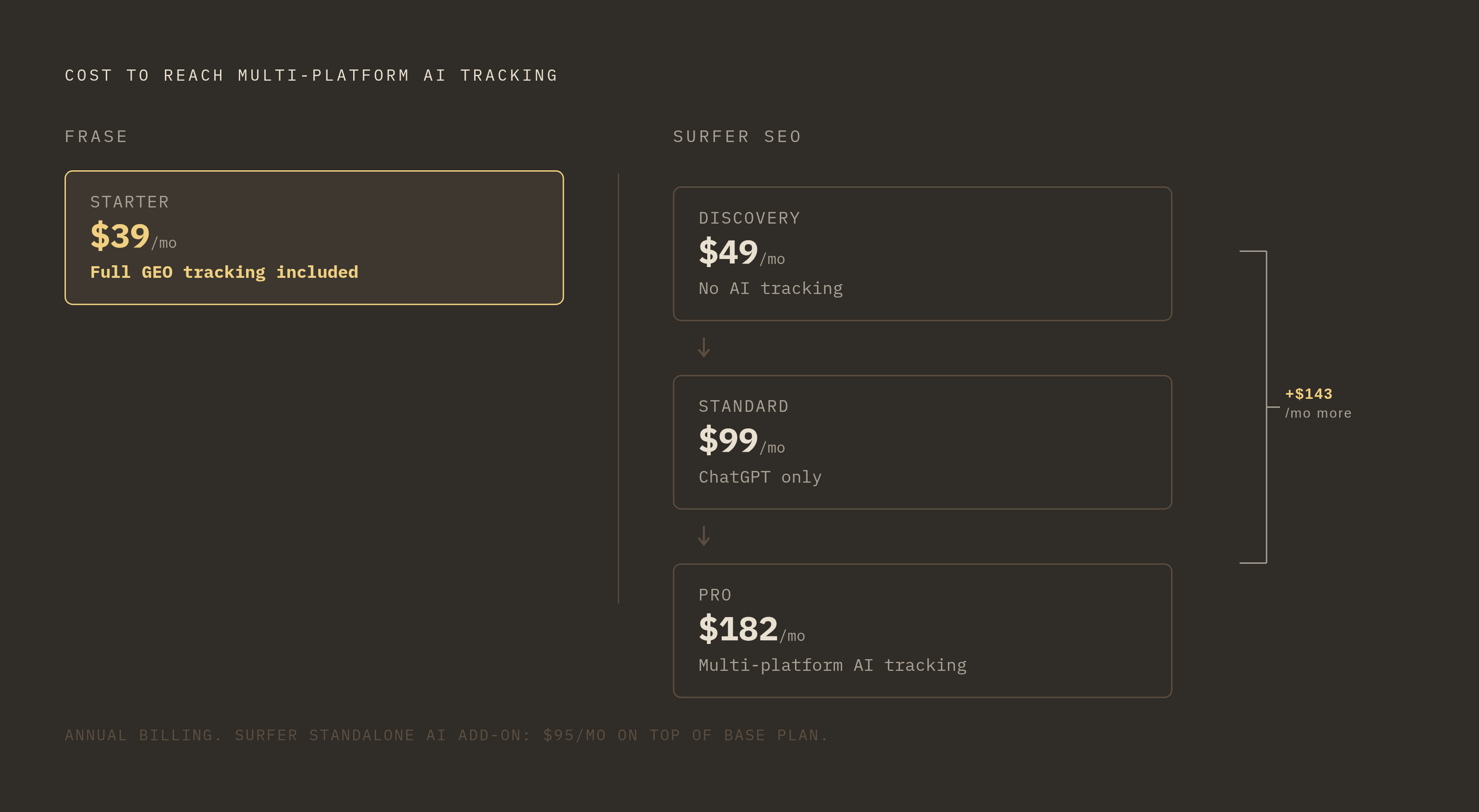
Getting to that tracking costs more on Surfer's side, and the gating matters. The standalone AI Tracker add-on runs $95/month for 25 tracked prompts, or a team can get it bundled into the Scale plan at $219/month. The entry-level Standard plan, at $99/month, only covers ChatGPT, and full multi-platform tracking requires either the Pro plan at $182/month or that same $95 add-on. Compare that to Frase's Starter plan at $39/month, which includes GEO tracking across a subset of AI platforms without an upgrade, and the price gap for feature-comparable tracking runs into the hundreds of dollars a month, which adds up fast for any team monitoring more than one client or prompt set.
But the price tag isn't what really sets them apart. Surfer's AI Tracker is a strong add-on bolted onto a content optimization tool. Frase treats GEO scoring as something native to the writing workflow itself. That's an architectural choice, not a feature checklist item, and it says something about which future each company is betting its product on.
Managing multiple clients and brands: workspaces, reporting, and white-label access
Roughly 40% of marketing agency clients are now asking their agencies about AI visibility, which turns multi-client AI tracking into a real commercial requirement rather than a nice-to-have.
Surfer handles multi-brand work through Workspaces, which keep client accounts fully separate, with each one keeping its own settings separate so nothing bleeds across accounts by accident. The Pro plan includes five brand workspaces and 50 AI prompts refreshed daily across ChatGPT, Perplexity, Google AI Overview, Google AI Mode, and Gemini, along with internal linking and cannibalization reporting. Scale adds more capacity for teams managing larger client portfolios. White-label access and SSO sit behind Enterprise only, starting at $999/month billed annually, a tier that also brings API access and a dedicated Customer Success Manager.
Frase's Scale plan, at $239/month annually or $299/month month-to-month, targets the same portfolio-management need, with Enterprise pricing available on request for larger setups. Its Starter plan, by contrast, comes with one seat and one site, so it isn't built for agency use without an upgrade. Direct publishing from Frase covers WordPress, Webflow, Sanity, and Wix, cutting out the manual export step for teams pushing content out at volume; Surfer publishes directly to WordPress through its own plugin, but anything else requires a manual export to Markdown or HTML. Frase also includes monitoring for published pages that watches for ranking and traffic changes, something Surfer's Content Audit doesn't fully match: Surfer will surface the opportunity, but a person still has to act on it. Frase also runs a read-write MCP server that connects into Claude Desktop, Claude Code, Cursor, Windsurf, and VS Code with GitHub Copilot, covering research, writing, optimization, auditing, monitoring, and fixes across one pipeline. Surfer doesn't offer an equivalent.
On reporting, Surfer's Looker Studio export, added in April 2026, gives agencies a cleaner path to client-facing dashboards. Frase folds reporting into its AI visibility dashboard and monitoring alerts instead of offering a dedicated export tool, which works fine for internal tracking but asks more of an agency trying to hand a polished report to a client.
Pricing structures and what they gate
Frase's pricing ladder runs Starter at $39/month annually ($49 month-to-month), Professional at $103/month annually ($129 month-to-month), Scale at $239/month annually ($299 month-to-month), and Enterprise at custom pricing. The detail is that Frase includes AI tracking on its entry-level tier, though the number of platforms covered scales with the plan.
Surfer's entry point, the Discovery plan, runs $49/month billed annually and covers 10 posts a month, but it includes zero AI visibility tracking. A team wanting that has to move up the ladder: the Standard plan covers a single model at $99/month, the Pro plan offers full multi-platform tracking at $182/month, or a team can add the standalone add-on at $95/month layered on top of whatever base plan it already runs.
That's the real fork in the road for a team choosing between them. A content team whose bottleneck is research and brief generation, or one that needs GEO tracking without paying agency-tier prices, has a clear case for Frase. A team whose bottleneck is the writing and editing phase, one that wants a granular, NLP-driven scorecard to keep multiple writers consistent, has just as clear a case for Surfer, especially now that its Content Score has absorbed an AI Search component alongside the one built for a search engine. Neither tool has fully closed the gap the other opened first. Choosing between them means being honest about which gap actually costs the team more time.