Content Brief Automation With AI Tools
AI agents now compress brief research from hours to minutes.

Content brief creation looks like a writing task from the outside. It's really a data-assembly job: pulling SERP results, reading what the top ten pages actually say, clustering keywords, mining People Also Ask boxes, mapping internal links before a single sentence of the article gets written. That assembly work is what eats the clock, and AI agents are starting to replace it outright rather than just assist with it.
What a research-first automated brief actually contains
A good automated brief is built from real research and shaped by editorial judgment, not an AI-written outline someone dropped into a shared doc. The strategist opens it and finds the research finished, not started.
At minimum, that means primary and secondary keyword clusters with volume and difficulty attached, a clear read on search intent (informational, transactional, comparison), and a breakdown of what the top-ranking pages are actually built like: common H2 and H3 patterns, average word count, where those pages leave gaps. It carries PAA questions and FAQ material pulled straight from live SERP data, internal link suggestions based on the site's actual architecture, and guidance on tone, audience segment, and calls to action, so ten different writers still sound like one brand. A draft title tag and meta description, written for click-through rather than keyword stuffing, rounds it out.
Most brief templates get intent classification wrong. They treat it as a label instead of a variable that reshapes the whole format. A definitional query should produce a brief that leads with a structured definition, not a listicle. A comparison query should flag a comparison format from the start, tables and all. That's the gap worth closing before anything else, and it's the one most tools skip entirely.
None of this replaces the writer. The brief is a specification, and the human review step between an agent's output and a writer's assignment isn't optional: agents can hallucinate a statistic, misclassify intent, or hand over a structure that looks tidy on the page but misses the strategic angle the campaign actually needs. A strategist still has to catch that before it reaches the writer's desk. There's a quieter payoff too. When every brief follows the same format, onboarding a new freelancer takes an afternoon instead of a week, because the template itself does part of the training.
How AI agents compress the research phase from hours to minutes
An AI SEO agent works toward a goal without waiting for a clever prompt each step. It plans and chains steps on its own: deciding which data sources to hit, in what order, how to fold the results into one structured output.
In practice, the pipeline starts small. A strategist feeds in a target keyword, an audience segment, two to four secondary keywords. From there the agent crawls SERPs, extracts the structure of top-ranking pages, pulls PAA questions, clusters related terms, then drops all of it into a standardized template: dropdowns for persona, numeric fields for word count, so every part of the brief is machine-readable for whatever comes next. Only then does it land on a human strategist's desk for reordering, angle adjustment, and a sanity check.
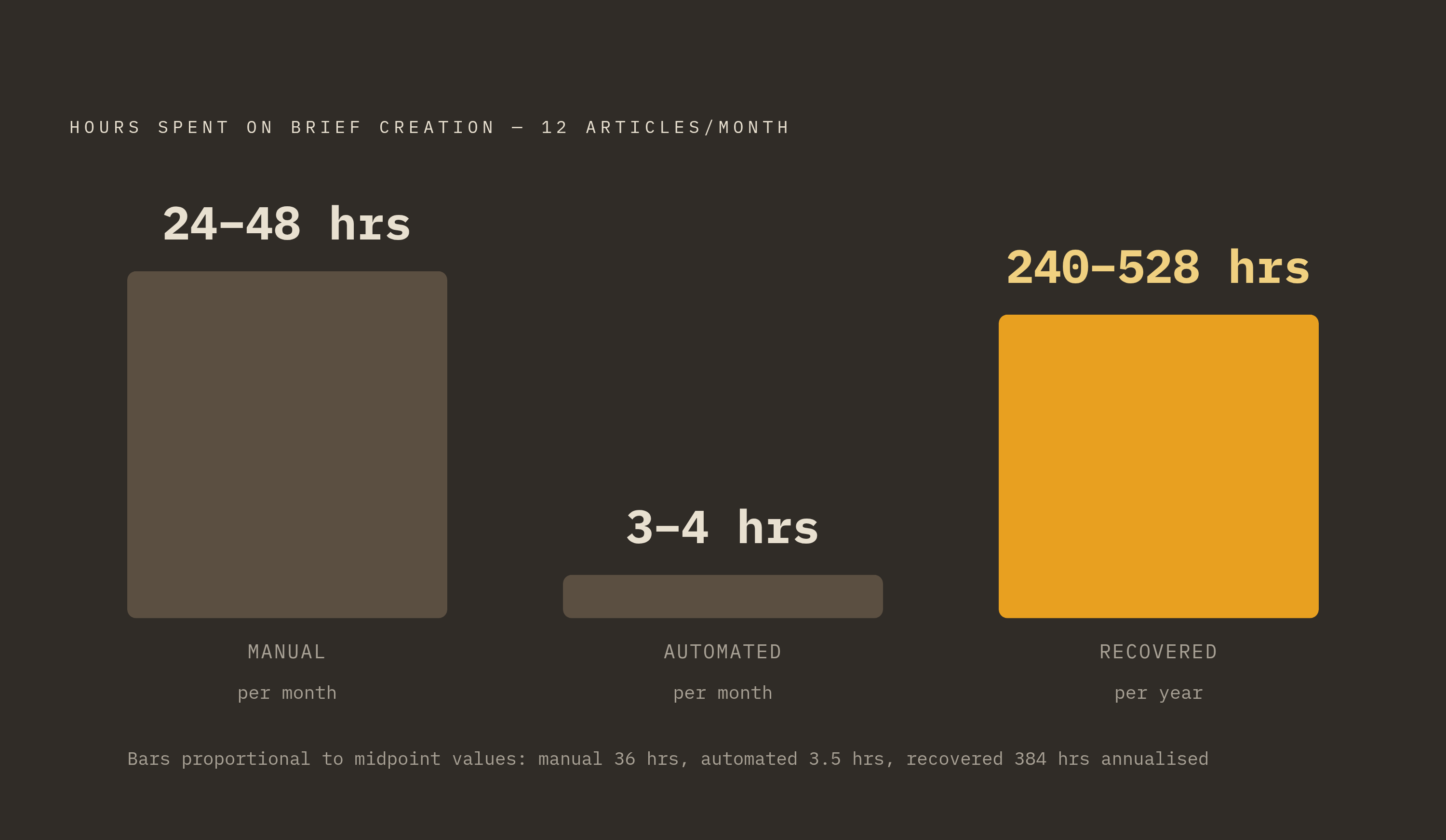
The time math is worth sitting with. Per Typeface's August 2026 reporting, a single manually built brief takes 45 minutes to two hours. Multiply that across a team producing 20 to 50 briefs a month and the bottleneck stops being writer capacity. It becomes the brief queue itself. Per thestacc.com, a team publishing 12 articles a month spends 24 to 48 hours a month on manual brief work; automation cuts that to 3 to 4 hours, which works out to 240 to 528 hours recovered a year from brief creation alone.
What that leaves for the strategist is judgment. Which competitor gap is actually worth targeting. Whether the agent's intent classification lines up with what the campaign is trying to do. Which angle turns a serviceable brief into one that wins the SERP.
Why briefs optimised only for traditional SEO rankings are now structurally incomplete
Most brief tools, automated or not, were built for a single audience: the search engine crawler ranking pages for organic position. That audience no longer covers the field, and treating it as the whole job is the mistake most teams are still making.
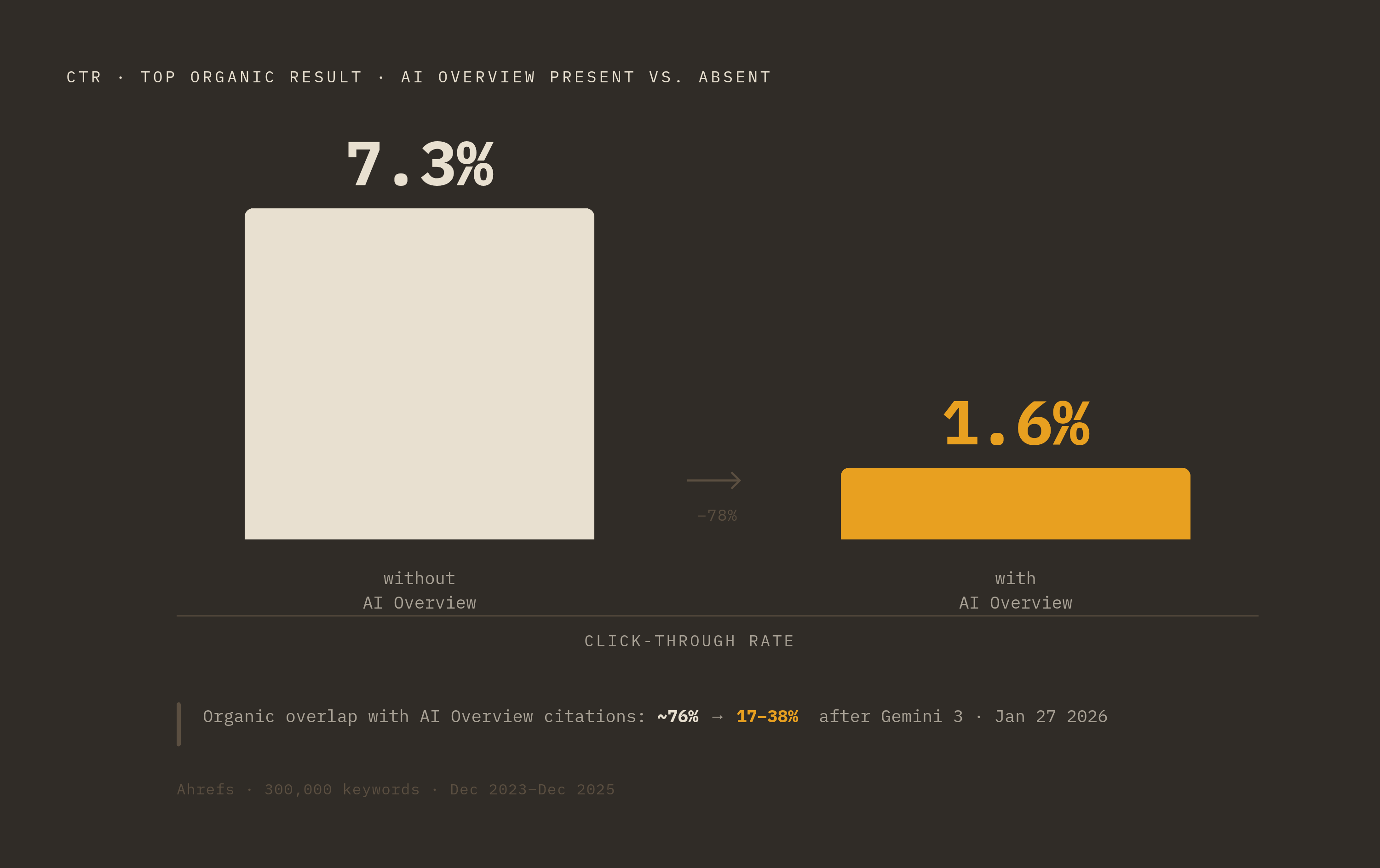
Ahrefs' analysis of 300,000 keywords, comparing December 2023 to December 2025, found that when an AI Overview appears, the click-through rate for the top organic result falls from 7.3% to 1.6%, and Ahrefs separately measures the reduction in CTR from AI Overviews at up to 58%. The queries themselves have changed shape too: Similarweb's 2025 GenAI Landscape report puts the average ChatGPT prompt at around 60 words, against 3.4 words for a typical Google search. Longer, more specific queries mean the citation inside an AI answer is now doing the work a blue link used to do.
The clearest evidence of how unstable this all is came on January 27, 2026, when Google switched to Gemini 3 for AI Overviews. Roughly 42% of previously cited domains got replaced overnight. The overlap between top-10 organic rankings and AI Overview citations, which had sat around 76%, collapsed to somewhere between 17% and 38% depending on the dataset, per Ahrefs and BrightEdge data cited by ALM Corp. A brief built to win organic rank is no longer a reliable brief for winning a citation. Those are two different jobs now, and pretending otherwise is how a brief goes stale before the writer even opens it.
This is where the vocabulary of Generative Engine Optimization (GEO) and Answer Engine Optimization (AEO) earns its keep. AEO is about being the single source a featured snippet or direct-answer box pulls from. GEO is about being the source a large language model cites when it synthesizes an answer across several documents. Per writer.com, GEO runs roughly 80% strategic (positioning, ecosystem presence, brand authority) and only 20% technical, which surprises people who assume GEO is a schema-markup problem.
A Princeton study on GEO (Aggarwal et al., 2024, presented at KDD 2024) ran 10,000 queries and found the largest citation gains came from adding machine-extractable provenance to content: direct quotations, statistics, and citations, collectively worth roughly 25 to 40% more AI visibility. These aren't edits made after publication. They're decisions that belong in the brief, specified before the writer starts. A brief tool that ignores this dual mandate, crawlers on one side, language models on the other, is playing half the game.
How content gap analysis against AI share of voice generates the next brief
AI share of voice analysis starts with a simple filter: which prompts are competitors getting cited on that a brand isn't? Read the actual answer text the AI produces for those prompts and patterns show up fast. Maybe the model consistently prefers comparison-style content for a category where a brand's own content is all definitional. Maybe it keeps citing sources with hard statistics or named studies, and the brand's content doesn't produce that kind of material at all.
Each of those gaps is a brief. Not a vague content idea sitting in a spreadsheet, but a fully specified brief with intent, format, and provenance requirements already built in.
A static template can't close this loop by itself. Without AI visibility data, brief generation optimizes for ranking signals while staying blind to something that matters just as much now: how often a brand gets cited on AI platforms. Tracking mentions across ChatGPT, Claude, and Perplexity supplies that missing signal layer. Skip it, and the brief queue gets built from half the available information, no matter how good the data-gathering side of the tool is.
Given the pace at which AI citations shift month to month, this loop can't run on an annual or even quarterly review cycle. A single model swap, like the January 2026 Gemini 3 update that replaced roughly 42% of previously cited domains overnight, can undo a quarter's worth of assumptions in one day. This is the gap Thrad's AI visibility platform is built to close: monitoring where a brand shows up across AI surfaces at scale, and feeding that share-of-voice data straight into gap identification and brief prioritization. It's the connective layer most standalone brief tools simply don't have.
The current tool landscape and what actually differentiates them for agencies
Output quality among the leading brief tools has largely converged, and picking a tool on features alone is the wrong way to shop now. Per nikoalho.fi's 2026 comparison, the gap between Surfer SEO, Frase, NeuronWriter, and Clearscope sits within a 10% band, close enough that switching costs now outweigh whatever marginal quality difference remains. The real question for an agency is which process turns a rough idea into something a client will actually sign off on: which tool fits the agency's workflow, its client structure, and how complete the underlying data actually is.
Search Atlas runs Starter at $99 a month, Growth at $199, Pro at $399, with a Content Genius plan at $49. It packages one-click brief export to Google Docs alongside SERP data, PAA questions, internal link suggestions, keyword research, and its OTTO SEO agent, built with agency and multi-site use in mind (G2 rates it 4.8 out of 5 across 91 reviews, Capterra 4.9 out of 5 across 63). Surfer SEO starts at $79 a month and suits SERP-driven editors who want on-page optimization paired with data visualization. Frase, from $38 a month, covers research, briefs, and drafts in one place, which fits solo marketers who need speed over depth. MarketMuse offers a free tier with paid plans from $99 a month and leans toward topic modeling deep enough for enterprise content operations. Clearscope starts at $189 a month with unlimited users, aimed at editorial teams working at scale. Dashword focuses on one-click brief automation specifically. Outranking starts at $19 a month and focuses on factual content with built-in citation recommendations. Rankability is positioned as a strong fit for agencies juggling multiple clients.
The cost reality most agencies run into: paying for Surfer and Frase side by side, then using neither past the first tenth of what either tool offers. Tool consolidation is the bigger problem for most shops now, not tool selection.
The differentiator that actually matters going forward is whether a tool accounts for AI visibility alongside traditional rankings. Tools that only optimize for organic rank are, as of the January 2026 Gemini 3 shift, producing briefs that are incomplete before a writer even opens them. Thrad fits into that stack at a specific point: where brief tools handle research and outline, Thrad handles AI visibility monitoring and client reporting, supplying the share-of-voice data that feeds brief prioritization and giving agency account teams something concrete to show clients across a whole portfolio.
Why the brief feedback loop determines whether automation compounds or plateaus
Speed fixes the immediate bottleneck. It doesn't, on its own, build a lasting edge, and that distinction should shape how a team builds its brief system. A lot of teams stop at speed and never notice they've plateaued.
A brief that leaves the strategist's desk and never comes back teaches nothing. Teams keep reusing familiar H2 outlines, keep trusting last quarter's structures, without ever finding out whether the published piece delivered anything. Per Datagrid's framework for closing this loop, the fix is to map specific brief decisions to measurable outcomes: keyword choices against ranking performance, outline and angle decisions against scroll depth and dwell time, CTA choices against conversion rate, tone and audience guidance against how often a piece gets sent back for revision. Tag each published piece by the brief elements being tested (heading style, CTA type, keyword difficulty tier) so patterns can be compared across similar pieces rather than judged one at a time. Run that correlation analysis monthly or quarterly, then feed what holds up back into the template: promote the structures that keep people reading, retire the keyword clusters that never move, update the CTA defaults that convert.
A single article doesn't prove anything, good or bad. Real patterns need a dozen or more comparable pieces before a template default changes, and outliers are just as often a distinct audience segment reacting differently as they are a universal signal.
AI visibility adds a second layer of proof on top of the usual metrics. If a brief specified quotations, statistics, and citations, and the published piece is now getting cited in AI answers, that's evidence the brief structure works for AI discovery specifically. If it isn't getting cited, the template needs adjusting for that channel too, separate from whatever the organic ranking says. In content operations, the feedback loop is the mechanism that turns adoption into payoff. Skip it, and automation just makes an incomplete process faster.
What the strategist's role looks like once the data-assembly work is automated
Take away the SERP crawling, the keyword clustering, the PAA mining, and what's left for a strategist is more meaningful work. It's different work, and arguably harder work.
Judgment calls move to the center: which competitor gap is actually worth chasing, which model-flagged intent classification doesn't match what the campaign needs, which angle turns a technically complete brief into one that wins. Reviewing agent output for a hallucinated statistic or a structure that looks logical but misses the point becomes a core skill, not a chore squeezed in before a deadline. And the feedback loop itself, correlating brief decisions with what happens after publication, tracking AI citation alongside organic rank, needs someone who reads both channels well enough to tell a real signal from noise.
The tools have gotten fast enough that assembling a brief in minutes is no longer the differentiator. What separates one agency's output from another's now is whether a strategist uses that recovered time to make sharper calls, or just churns out more of the same briefs, faster than before.