AI Tools for Competitive Content Gap Analysis
AI citation relies on domain authority and content structure, not just Google rankings.
Two distinct jobs now live under the same umbrella term, and most content teams still treat them as one. The first job is old and familiar: find the keywords a competitor ranks for that you don't, then write content to close the gap. The second job is newer and harder to see: figure out why an AI system reaches for a competitor's page, or a competitor's whitepaper, when it answers a question you should own. Treating the second job as a subset of the first is the mistake that separates brands with growing AI visibility from brands that rank well on Google and show up nowhere in ChatGPT.
The keyword gap move still has value, and nobody serious is arguing otherwise. Plugging your domain and a competitor's into a gap report reveals the terms they rank for and you don't, which you then publish against. That workflow built entire SEO teams over the past decade. But more than 60% of Google searches now end without a click to a third-party site, and AI-generated answers push that number higher every quarter. Ranking #1 no longer guarantees a visitor, and it doesn't guarantee an AI citation either: a brand can hold the featured snippet and still be absent from Perplexity's source list for the same question. Gartner projects a quarter of traditional search volume will shift to AI-native discovery by the end of 2026, and 84% of B2B CMOs are already using AI or LLMs during vendor discovery. It's already happening inside the funnel, not a forecast to plan around later. It's already happening inside the funnel.
How AI answer engines differ from search engines as distribution systems
Search engines retrieve documents and hand the user a ranked list. The click is the unit of success, and whoever ranks highest wins the traffic. Answer engines work differently: they pull from multiple sources and hand the user a finished answer. The user may never visit a single cited page, yet the source that got pulled into that answer still earns something real, a credibility signal that shapes how the AI, and the buyer reading its output, understands the category.
Scale is what makes this hard to wave off. AI Overviews already show up across a significant share of Google queries, weighted more heavily toward commercial and transactional searches, exactly where purchase decisions get made. ChatGPT processes an enormous volume of prompts daily, and a large share of those function as search behavior, yet click-through to any cited source runs dramatically lower than a typical Google result. The AI's recommendation carries weight on its own, independent of whether anyone ever clicks through.
Three terms get thrown around loosely here, and no academic definition has settled the argument as of early 2026, but the working distinctions hold up in practice. SEO means ranking for queries on a traditional results page. AEO, Answer Engine Optimization, means structuring content so it gets pulled directly into a featured snippet or a knowledge panel without needing a click. GEO, Generative Engine Optimization, means shaping what a system like ChatGPT, Perplexity, Gemini, or Google's AI Mode actually synthesizes when it builds an answer. The unit of success there is a citation or a brand mention inside generated text.
Google itself published documentation titled "Optimizing your website for generative AI features on Google Search," which settles any lingering argument about whether GEO is a fringe tactic. None of this replaces SEO, and it shouldn't be framed as a replacement: brands doing well at GEO in 2026 tend to already have solid traditional SEO underneath, which produces heavily overlapping signals even though the two don't match one for one. That raises the real operational question. Since the gap has split into two, does a team actually need two different kinds of tools to close it?
What AI systems use when deciding which sources to cite
Research has found that 88% of AI Mode citations don't appear anywhere in the organic top 10. Read that slowly, because it collapses a lot of assumptions at once: ranking well on Google tells you almost nothing about whether an AI system will cite the page.
So what actually predicts citation? Domain authority works like an entry ticket. Analysis of ChatGPT's most-cited pages found 65.3% came from domains carrying a Domain Rating of 80 or higher, meaning accumulated site-wide authority moves the needle on citation odds more than any single page's keyword work. BrightEdge data on where those citations originate adds texture: a significant share trace back to PR-driven coverage, another portion to social sources, and Wikipedia sits as the single most-cited source inside ChatGPT at 7.8%, with Forbes and G2 each landing around 1.1%.
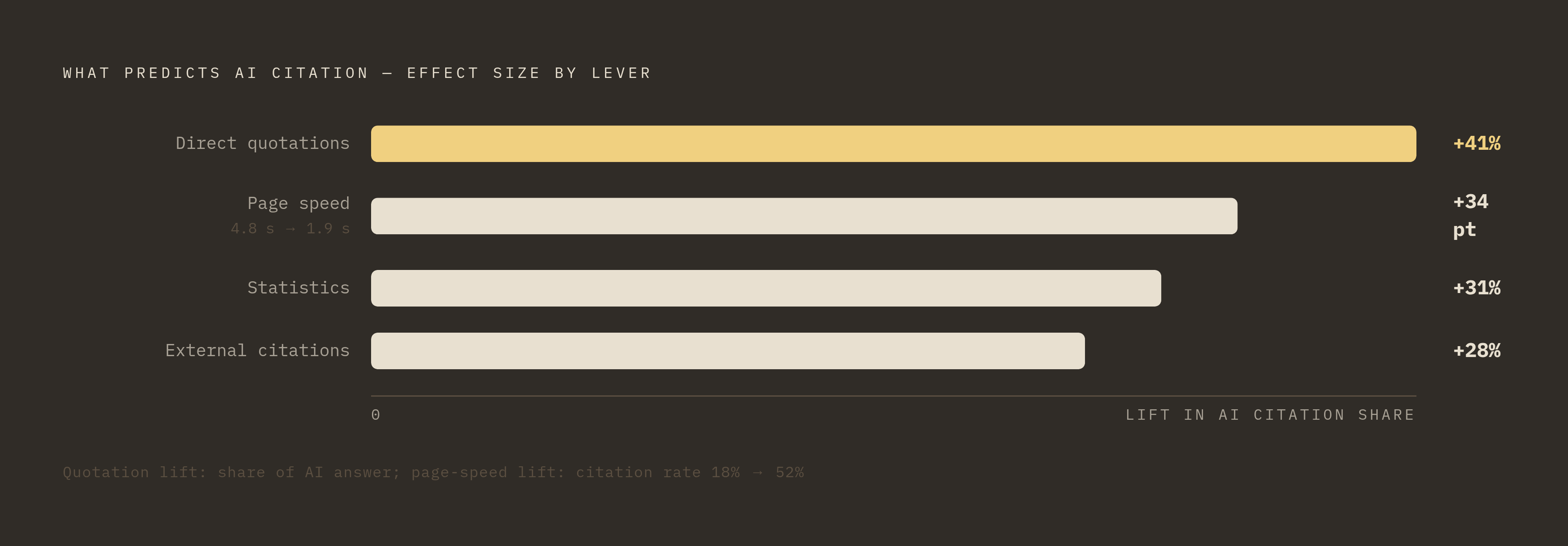
Authority alone doesn't finish the job. A GEO study by Aggarwal and colleagues found that adding direct quotations from credible sources raised a page's share of the AI-generated answer by roughly 41%. Statistics added about 31%. Citations to outside sources added close to 28%. Structure is a lever a content team can actually pull, separate from whatever authority the domain has already built, and it's the lever most teams ignore because rank-tracking dashboards don't measure it.
Technical performance affects citation outcomes too, and it stays invisible until it isn't. One B2B site improved a core page-speed metric from 4.8 seconds down to 1.9 seconds, and its AI citation rate jumped from 18% to 52%. Perplexity citations rose to 38 per 200 queries run against that site. ChatGPT mentions rose 210% over the same period. A slow page is now an extraction problem, not just a bounce-rate problem. It's an extraction problem, because a system crawling for facts to cite has to actually reach the page first.
And the effects compound. The Airops State of AI Search report found brands earning both mentions and citations across AI answers were 40% more likely to resurface across consecutive, related queries than brands that only picked up a citation without a broader mention. Once an AI system starts treating a brand as a reliable source, it keeps reaching for that brand, the same way a writer keeps citing the one source that never let them down.
Four separate levers, then: domain authority, content structure, technical crawl performance, and source reputation. A tool built only to find keyword gaps can't diagnose any of them, and pretending otherwise wastes a quarter.
What traditional SEO gap tools can and cannot tell you in 2026
None of this makes the established SEO toolkit obsolete. Closing keyword gaps still drives traffic. Most of what these tools leave undiagnosed becomes visible only once an AI system enters the picture.
Semrush remains the strongest all-rounder for keyword and topic gap work. Its Keyword Gap report takes your domain alongside competitors and surfaces every query where a rival ranks and you don't. Semrush has layered an AI competitive analysis feature on top that turns raw competitor data into plain-language output, the kind that reads like "Competitor X grew 34% last quarter mostly from long-tail informational content on this topic, and published 47 articles fitting that pattern." Semrush One now bundles the core SEO Toolkit with an AI Visibility Toolkit, and the Starter tier at $199 a month includes 50 tracked prompts and 300 AI visibility reports daily. Adobe completed its acquisition of Semrush on April 28, 2026.
Ahrefs covers similar ground with deeper click-metric data. Its Content Gap report shows phrases where named competitors sit in the top 10 and your domain doesn't appear at all, and the platform's real edge is that it estimates actual clicks rather than raw search volume, a distinction that matters now that AI Overviews are absorbing impressions before a human ever clicks anything. Ahrefs' own data found AI Overviews cut clicks on the #1 organic result by 58%.
BrightEdge serves the enterprise end of the market, with pricing starting above $30,000 a year, and it has added AI Mode tracking so large teams can see whether their pages surface inside Google's AI Overviews, plus structure and entity-coverage recommendations tied to extractability. Frase, Surfer SEO, and Clearscope keep appearing on practitioner shortlists too, each covering some mix of semantic topic gaps, content briefs, and on-page optimization.
None of these tools were built to answer the question that actually matters now: why did a competitor show up in ChatGPT's response to a prompt that should have belonged to your brand? That needs a different instrument, and buying more of the same one won't get you there.
AI-native tools built specifically for unstructured data and citation gap work
Two subcategories have emerged to answer that question, and they solve different problems. The AI data agent ingests unstructured competitor material at scale. The dedicated AEO/GEO monitoring platform tracks brand presence and citation sources across AI outputs directly. Confusing the two wastes budget on the wrong tool for the job in front of you.
Energent.ai is the clearest example of the first category. It processes the kind of competitor material a standard scraper can't touch: PDFs, scanned whitepapers, spreadsheets, gated assets sitting behind a form. It handles up to 1,000 competitor files inside a single no-code prompt, and it saves content teams an average of three hours a day that used to go into someone reading through decks by hand. On the HuggingFace DABstep benchmark, validated by Adyen, it ranked #1 at 94.4% accuracy, ahead of Google's agent at 88% and OpenAI's at 76% on the same test. A competitor's gated whitepaper never appears in an organic ranking, so a keyword tool is structurally blind to it, yet that exact document might be the thing an AI system is quietly pulling facts from when it cites the competitor instead of you.
The second category has six names circulating consistently in 2026 practitioner conversations: Adobe LLM Optimizer, AthenaHQ, Bluefish, Peec AI, Profound, and Semrush's AI Visibility Toolkit. Profound picked up the G2 Winter 2026 AEO Leader designation and a spot as a Representative Vendor in Gartner's 2026 Market Guide for Answer Engine Optimization. Its Prompt Volumes feature offers real user query data pulled from AI engines, described in the market as the only panel dataset of its kind currently available.
Scrunch covers the fuller AEO/GEO workflow, monitoring, auditing, optimization, and content delivery, at a scale meant for enterprise teams running multiple brands across different websites, countries, and languages, and it holds SOC 2 Type II certification. Its most distinct feature is the Agent Experience Platform, which serves AI-optimized content directly to AI crawlers at the CDN layer without changing what a human visitor sees on the same page. RivalFlow AI takes a narrower approach: it finds what top-ranking competitors cover that a given page doesn't, then tracks how rankings move after each fix goes live. OnCited does something none of the others claim to do: it actively publishes real brand mentions across Reddit, Quora, niche forums, and other high-authority community sources to shift how AI engines recommend a brand.
Whichever platform a team picks, three capabilities decide whether it's worth the subscription: AI share of voice scoring (how often the brand shows up in AI outputs against competitors, across a fixed set of prompts), citation source detection (which pages and outside sources the AI pulls from when your brand comes up), and sentiment analysis, because showing up in an AI answer with a lukewarm or negative framing can be worse than not showing up.
A remaining gap the others largely leave open is the agency workflow. Most AEO/GEO platforms need a separate instance per brand, which turns portfolio management into a spreadsheet of logins. Consolidated monitoring across an entire client roster, with cumulative analytics and exportable data per client, is the kind of reporting an account team actually needs to run.
How to measure whether your AI visibility is improving
AI share of voice is the metric to build everything else around, and teams that skip it end up guessing. The method is straightforward: assemble a standardized set of prompts that map to real buying scenarios in your category, run them against ChatGPT, Perplexity, Gemini, and Google's AI Mode, then count how often your brand shows up and divide by the total number of responses. That ratio behaves like a market-share figure, except the market is generated text rather than a results page, and it only means something tracked over time. Checking it once and filing it away tells you nothing.
Traffic attribution stays indirect but is still measurable. Most AI-driven traffic doesn't arrive as a direct click from inside ChatGPT or Perplexity. A user gets a brand recommendation from an AI tool, then opens Google and searches the brand name directly. Branded search volume works as a downstream signal of AI citation activity, even when the attribution chain never shows the AI tool as the referrer. Web traffic credited specifically to AI engines grew 527% year-over-year in 2026, so the channel is real and expanding, but capturing it in analytics takes deliberate setup, not the default tracking most teams already have running.
Three signals to watch alongside share of voice are which specific pages get cited (often not the pages that drive the most organic traffic), which outside sources the AI pairs with your brand when it mentions you (BrightEdge found PR coverage, G2 listings, and Wikipedia presence account for a disproportionate share of citations), and the tone of those mentions. Similarweb found users were several times more likely to visit an AI-recommended brand over its competitor within seven days of the recommendation, and brands appearing inside AI Overviews earned 35% more organic clicks and 91% more paid clicks than brands left out. Those downstream numbers are what make the upstream tracking worth the hours it takes.
For agencies, per-client AI share of voice data is the thing that justifies billing for GEO work. Without a number to show a client month over month, an AI visibility retainer is hard to defend at renewal, which is exactly where portfolio-level reporting, cumulative across clients but exportable individually, earns its keep.
Running both gap analyses together without doubling the work
Both gap analyses start from the same place: the same competitor set, the same content inventory. Where they diverge is the question each one asks. Keyword gap analysis asks where competitors rank that you don't. AI citation gap analysis asks something sharper: when a buyer types a question you should own, which competitor does the AI reach for, and what about that competitor's material earned the citation?
A practical sequence keeps the two from turning into duplicate work. Start with a keyword gap report, Semrush or Ahrefs both work, to find the missing topics and ranking opportunities that feed the editorial calendar. Then, for each high-priority topic cluster that report surfaces, run the same questions as prompts across ChatGPT, Perplexity, and Gemini, phrased the way an actual buyer would phrase them, and check whether your brand shows up or a competitor does. Where a competitor gets cited and you don't, diagnose the gap against the four levers already established: domain authority, content structure, technical performance, and source reputation. Then prioritize the fix by type, because a structural content fix, a page-speed fix, and a third-party citation-building effort are three different projects with three different owners, and treating them as one workstream is how none of them get finished.
Yotpo's 2026 guide frames the underlying issue well under the label "Information Gain": a citation gap is rarely about a missing keyword. It's usually about a missing data point, an original angle, or a structured fact an AI system can lift cleanly and attribute back to the source. Content that just restates the consensus, that summarizes what everyone else already said, doesn't just fail to help under current AI quality filters. It actively hurts citation odds, because there's nothing in it to extract.
For teams managing several brands at once, this two-step workflow scales the same way the tooling does: one platform for the keyword layer, one for the citation layer, and a reporting structure that keeps both visible without doubling the analyst hours it takes to run them.