AI Content Editors vs AI Content Generators
Generators draft fast but editors decide whether content actually works.

AI content generators and AI content editors get shopped for like they're the same category with different logos. One writes; the other rewrites. That distinction sounds almost too obvious to write down, and yet the confusion between the two is costing marketing teams real money and worse content, which is exactly why it's worth writing down.
The market backdrop makes the confusion more expensive. The AI writing tools market was valued around $3.2 billion in 2024 and is projected to hit $17.6 billion by 2033, growing at roughly 23.1% a year. That's a lot of vendors chasing a lot of budget, and most of them get evaluated on one question: can it write? That's an incomplete question. The right question is whether the bottleneck is a blank page or a mediocre one, because those are different problems with different tools and different price tags.
What AI content generators are actually built to do
A generator's job is to go from nothing to something. Feed it a prompt, a template, or a brief, and it produces raw text where there was none a moment ago.
Two flavors dominate here. General-purpose models like ChatGPT, Claude, and Gemini offer maximum flexibility and zero built-in structure. Give one a clear, specific prompt and it'll produce something genuinely useful; give it a vague one and you'll get vague output back, because the model has no opinion about your content strategy. It just completes the pattern you started. Marketing-focused generators, Jasper being the best-known example, layer templates, content briefs, SEO scaffolding, and workflow logic on top of that same underlying model. Letterstory takes a different approach, pairing AI-assisted drafting with editorial monitoring across the full content lifecycle rather than stopping at generation. The structure does some of the thinking so the user doesn't have to reinvent a blog-post outline every single time.
What generators are actually good at: breaking blank-page paralysis, producing draft volume fast, spinning out variations for A/B tests or ad copy, and giving an unstructured brief some shape. Marketers using these tools save an average of 3 hours per piece of content, which is a real number and a real gain.
Here's the catch, though: none of that is the same as producing something ready to publish. Generators don't enforce brand voice. They fail to catch factual errors on their own. Nor do they check whether a topic has been covered thoroughly enough to compete in search results. Generative AI adoption broadly jumped from 33% in 2023 to 71% in 2024, with reported productivity gains averaging around 40%. Those numbers are real, but they measure drafting speed, not publishing readiness, and that gap is where the next section lives.
What AI content editors are actually built to do
An editor's job is to take something that already exists and make it better. That's a smaller, humbler job than generation sounds like, and it's also the one that decides whether content actually performs.
"Editing" isn't one job; it's at least three, usually split across different tools built for different purposes. Grammar, clarity, and style tools like Grammarly and Hemingway Editor work at the sentence level: correctness, readability, tone. SEO tools like Surfer SEO, Clearscope, and Frase work at the structural level, scoring a draft's topical coverage and keyword use against whatever is currently ranking for that query. And then there's brand voice and strategic alignment, the piece of editing that decides whether a draft actually sounds like the company and serves the goal it was written for, which is still mostly a job for a human editor with judgment, not a scoring algorithm.
Grammarly checks grammar, suggests synonyms, adjusts tone, and flags plagiarism; it now has generative features bolted on, but its center of gravity is still refinement. It starts at $11.51 per member per month. Hemingway Editor does something narrower and, in its way, more useful: it highlights long sentences, passive voice, and needless complexity, and hands back a grade-level readability score. The Plus version adds AI rewrites for $10 a month, which is one of the better deals in this entire market if readability is actually your problem.
SEO editors work on a completely different axis. Clearscope and Surfer look at what's already ranking for a target query and score a draft against those competitors on topical coverage and keyword use. Neither one writes the article; they simply tell you, with some precision, where it's thin.
What editors are good at is fast: raising a draft's readability score, flagging gaps a reader or a search engine will notice, and keeping an experienced writer honest about structure. What they can't do is produce an original draft or make a strategic call about what the content should even be about in the first place. That's still, stubbornly, a human job.
The hidden cost that makes generators more expensive than they appear
Here's the arithmetic nobody puts on the pricing page. A generator can spit out a thousand words in under two minutes. Genuinely impressive, and genuinely misleading, because that raw output almost never walks straight to publication without a stop in editing first.
Consider what actually happens after the draft lands. A significant share of users report spending more than three hours a week revising AI-generated content, and very few AI outputs need no revision at all. The "instant draft," in practice, marks the start of a second, less glamorous project.
Accuracy is where this gets genuinely uncomfortable. Research into AI-generated content has found that a substantial share of responses contain accuracy problems, including hallucinated details and outputs that don't trace back to anything real. This isn't hypothetical. Documented cases have emerged of professional deliverables containing fabricated quotes and references to sources that don't exist, with real professional and financial consequences following. That's reputational damage with a client's name attached to it. Separately, knowledge workers report spending an average of 4.3 hours a week just verifying AI output, a cost that rarely shows up on anyone's dashboard because it's buried inside "editing time" rather than billed as its own line item.
So the subscription fee for a generator is almost never the real cost of using one. The editing and fact-checking hours that follow are the real cost, and they're the ones that don't show up when a vendor quotes "3 hours saved per piece," because that figure measures drafting time, not the total trip from prompt to publish. Teams that treat raw generator output as done aren't saving time. They're just moving the expensive part of the job downstream, to a stage where mistakes are harder to catch and more embarrassing to fix.
Where the two categories are converging — and where the line still holds
The boundary between these two categories is getting blurrier, and it's worth naming that honestly. Grammarly has added generation features. Jasper has added an editorial layer. General-purpose language models are showing up embedded directly inside Notion, Google Docs, and Microsoft Word, quietly available at the point of writing rather than as a separate destination.
Usage patterns back this up. The share of content marketers using AI specifically for editing tasks jumped from 19% in 2025 to 38% in 2026, doubling in a single year. That's a real shift, and it suggests the industry is drifting toward AI-augmented editing as its own discipline, rather than treating generation as the whole story.
But convergence at the feature list doesn't erase the difference at the workflow level, and this is the part worth sitting with for a second. A tool built around prompts, templates, and output volume will handle creation better than a tool that added a "generate" button as an afterthought. A tool built around scoring, flagging, and refinement signals will handle quality improvement better than a generator instructed to "make it better," because "better" isn't a prompt, it's a judgment call the model has no real way to check itself against.
So the useful question isn't which features a tool has bolted on. It's what the tool assumes about your starting point: does it assume you have nothing, or does it assume you have something already on the page? Hybrid platforms exist, and more are coming, but most still lean one way or the other. Knowing which way a given tool leans tells you exactly when to reach for it.
Matching tool to job: a practical decision map for content teams
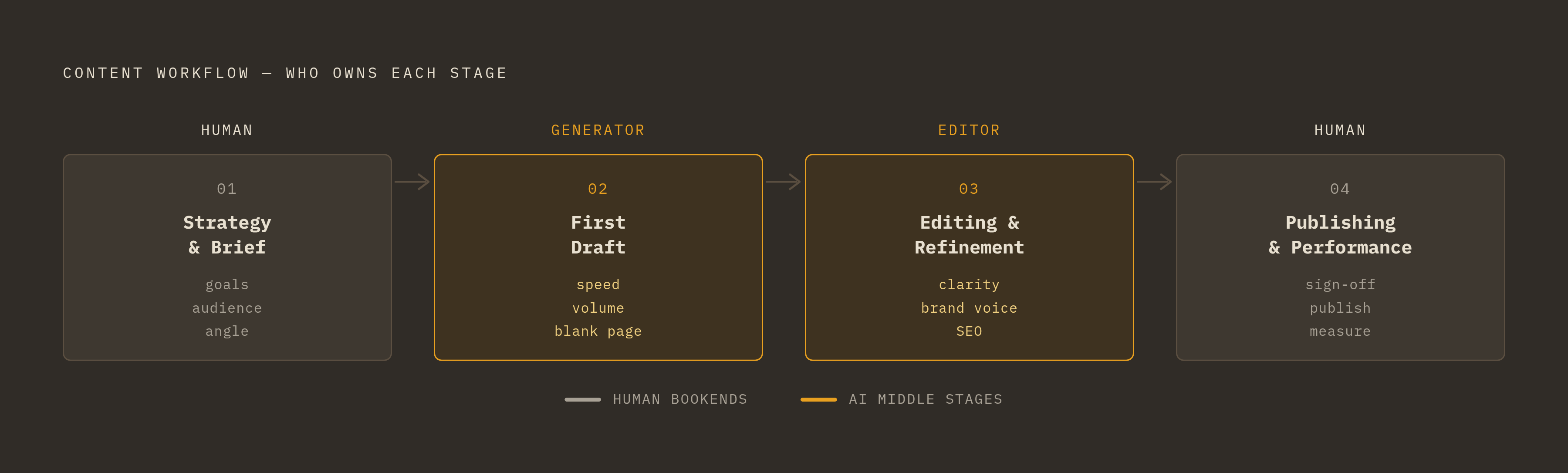
Start with the stage of work, not the name on the tool. There are roughly four stages, and only two of them belong to AI at all.
Stage one is strategy and brief. Neither a generator nor an editor replaces this step; it's where content strategy actually lives, and it still needs a human making judgment calls about audience, angle, and goal. Stage two is the first draft, and this is the generator's stage: speed, volume, getting past the blank page. Stage three is editing and refinement, the editor's stage: clarity, brand voice, accuracy, SEO coverage. Stage four is publishing and performance, which belongs to neither tool alone; it needs a human signing off that the thing is both correct and strategically right.
Reach for a generator when the problem is volume: publishing calendars that need more content per month than the writing team can produce by hand, rapid variations for ad copy or subject lines, or a team simply short on writers relative to its publishing cadence. AI-assisted production has been shown to support meaningfully higher monthly output, on the order of 40% more, for teams that adopt it seriously.
Reach for an editor when the problem is quality: draft tone is inconsistent, brand voice keeps drifting between pieces, SEO coverage is thin even though publishing frequency is fine, or content keeps going out the door but conversion isn't following the volume up.
Most teams publishing at any real scale need both, and that's the honest, unglamorous answer. The generator handles velocity. The editor handles quality. A human connects the two with strategic judgment neither tool has. Reported speed gains in content creation, in some cases as high as 93%, are only worth anything if editing doesn't quietly become the new bottleneck that swallows the time saved upstream.
That handoff between generator and editor is exactly where a lot of teams lose the thread: velocity goes up, quality control doesn't scale with it, and the gap between the two tools becomes its own hidden project. Strategy-first platforms that combine brief, generation, and editorial checks into a single workflow exist specifically to close that gap. Strategy-first platforms in this space pair AI-assisted writing with editorial quality controls built into the same workflow, so the trip from generation to publication doesn't require standing up a second tool and a second process just to catch what the first one missed.
What to evaluate before buying either type of tool
The market is projected to grow from roughly $1.07 billion in 2025 to $2.74 billion in 2026, a 16.8% compound annual growth rate. More options are arriving every quarter, and more options do not automatically mean clearer choices; if anything, evaluation criteria matter more now than they did when there were three tools to pick from instead of thirty.
For a generator, ask a few concrete questions before signing anything. Does it produce output that already sounds like the brand, or generic copy that needs a rewrite anyway? What does the editing burden actually look like once real content runs through it, and has anyone tested that on the actual content type in question rather than a demo? Does it plug into the existing brief and strategy process, or does it generate into a vacuum with no context about what the piece is supposed to accomplish?
For an editor, ask whether its feedback is prescriptive, meaning it tells you what to fix and why, or merely diagnostic, meaning it flags a problem and leaves the fix to you. Ask whether it scores a draft against actual named competitors ranking for that query, or against some generic benchmark that doesn't reflect the real competitive set. Then ask whether "correct" can be calibrated to the brand's actual voice, or whether the tool's idea of good writing defaults to a bland, generic standard that isn't really the brand at all.
Price doesn't map cleanly to value in either category, and it's worth saying that plainly. SEO editing tools range from about $49 a month at the entry tier up to $129 for something like Clearscope's mid tier and $399 for its business tier. Generation platforms like Jasper start around $59 a month with enterprise pricing well above that. A $10-a-month readability tool can outperform a $99-a-month generator, if the actual problem sitting in front of the team is readability rather than volume. Price tells you what feature tier you're buying. It tells you nothing about whether that tier fixes the problem you actually have.
The single most useful test before buying either kind of tool: does it fit the workflow that already exists, or does the team have to rebuild its whole process around the tool's assumptions? Teams that buy first and design the workflow second are, reliably, the same teams still logging three hours a week revising AI drafts and wondering, out loud, in a meeting, why the return on investment hasn't shown up yet.