Brand Voice Training in AI Writing Platforms
A three-stage process beats prompting alone for keeping AI output true to your brand.

AI writing platforms fail at identity: ask one to write "in your brand voice" and it produces something fluent, correct, and completely unrecognizable as yours — a grammar problem this is not. This piece walks through why that happens and what actually fixes it, which turns out to be a three-stage process (input, calibration, reinforcement) rather than a clever prompt. Most teams have never been shown this process, which is a big part of why so much AI-generated marketing copy reads like it came from nowhere in particular.
What brand voice actually consists of, and why it's harder to encode than it looks
Ask five people at a company to define their brand voice and there's a decent chance you get five different answers, none of them operational. "Friendly but professional" is a mood board rather than a voice. Real brand voice is layered: tone register (does the brand sound like a person leaning in, or one standing at a podium), vocabulary patterns (words it reaches for, words it's banned since the 2019 rebrand and nobody remembers why), sentence rhythm, point of view, and, maybe most tellingly, what it never says.
That last one matters more than most teams give it credit for. Negative space defines a voice the way rests define a piece of music; a brand that never uses exclamation points is saying something just as loud as one that uses three per paragraph. Most organizations have brand guidelines on paper. Far fewer actually consult them day to day, which means the real voice often lives in the heads of two or three senior writers who've internalized it over years and could not fully explain it if asked.
That's the tacit knowledge problem, and it's worth sitting with for a second. An experienced writer knows when to break the style guide, how to handle a sensitive announcement without sounding either cold or saccharine, when a sentence fragment lands and when it just reads as lazy. None of that is written down anywhere, which means it's exactly the material an AI system has no access to unless someone does the work of making it explicit.
There's also a vocabulary problem baked into the term "brand voice" itself, since people conflate voice, tone, and style constantly. Voice is the persistent personality; it doesn't change whether the brand is announcing a product launch or apologizing for an outage. Tone is the emotional register, and it should change depending on context; a security breach and a holiday sale don't get the same energy. Style is mechanical: Oxford comma or not, sentence case headlines or title case, how numbers get written. Confusing these three is how teams end up specifying almost nothing useful. If a team can't articulate its voice in precise, operational terms, no platform, however sophisticated, is going to reproduce it. The work starts with the brand, not the software.
The three-stage structure of brand voice training: input, calibration, reinforcement
Here's the misconception that trips up nearly every team on day one: treating brand voice as a single prompt, typed once, that somehow sticks. "Write in our brand voice, which is friendly but professional" describes a wish, not a training process.
Prompting alone has a hard ceiling, and it shows up in a predictable pattern. The longer the generated output runs, the more it drifts back toward generic assistant language, because a prompt describes a voice in the abstract while training demonstrates it concretely, and abstraction fades fast under generation pressure. Prompts also don't persist. Without some architectural layer holding the instruction in place, every new session starts from zero, which means every writer on the team is re-explaining the brand voice to a machine that forgot it overnight.
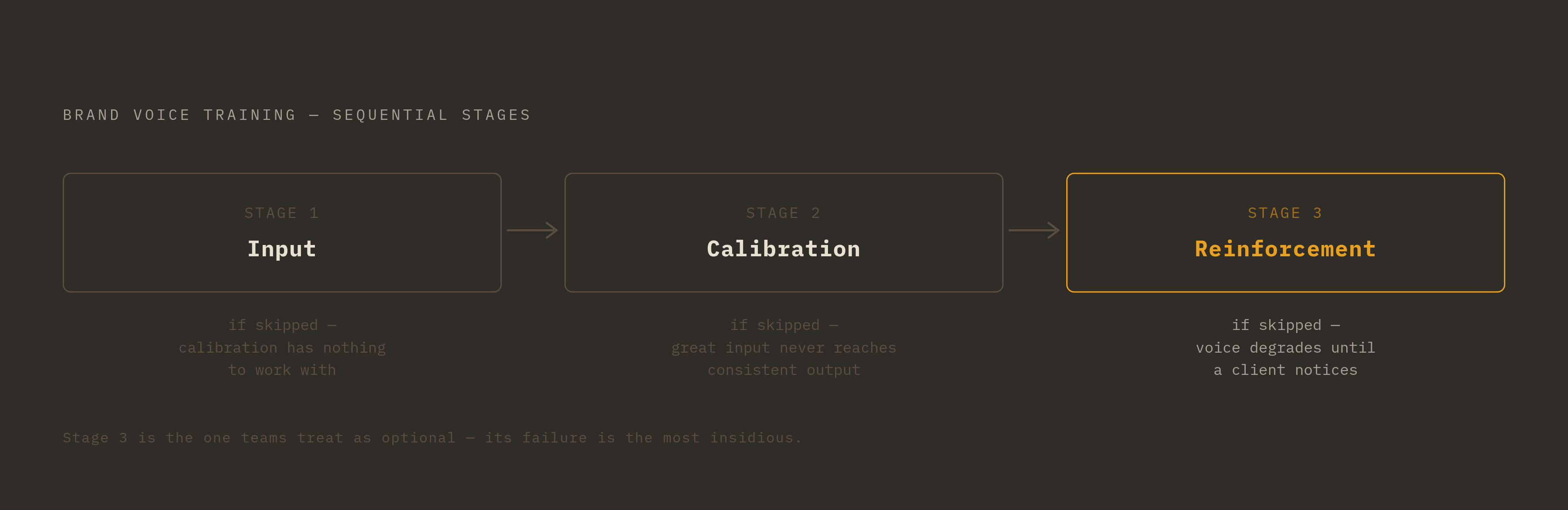
The fix is structural, and it breaks into three distinct stages. Input is the work of gathering and curating the material that actually represents the brand at its best, not everything the brand has ever published. Calibration is the technical and editorial process of getting a platform to internalize that material and reproduce it reliably. Reinforcement is the ongoing loop that catches drift as the brand evolves and as output volume climbs.
Skip or rush any one of these and there's a different, specific way things break. Skip input and calibration has nothing good to work with. Skip calibration and even great input material never makes it into consistent output. Skip reinforcement and voice degrades slowly enough that nobody notices until a client points it out. This framework holds regardless of vendor; it describes the process itself, and the next four sections unpack each stage in the order they actually happen.
Stage one — assembling input material that actually represents the brand's voice
AI systems learn from examples, not descriptions. That single fact makes the training corpus the actual voice model, which means curation at this stage is arguably the most consequential editorial decision in the entire process. Choose the wrong examples and everything downstream, no matter how well engineered, inherits the mistake.
What belongs in the corpus: content that's been approved, published, and represents the brand operating at full strength, not early drafts and not the piece that got rushed out under deadline. A range of formats matters too, since a blog post and an email subject line ask the voice to do different things, and the training material needs to capture that range rather than flattening it. Content from the writers who most embody the voice deserves more weight than content from every contributor who's ever touched the brand's CMS.
Equally important is what gets left out, and teams tend to underinvest here. Anything predating a rebrand or a voice shift should go. Anything written under heavy client edits or off the original brief should go. And if the internal team ever looked at a published piece and said, out loud, "this doesn't sound like us," that piece should go too, however well it performed.
Volume matters, and it varies by platform and format. Some platforms set explicit minimum word counts for long-form training before the system has enough signal to work with; fall short of that threshold and the system lacks sufficient signal to generalize reliably. That number isn't arbitrary. It reflects how much variation a model needs to see before it can separate a brand's actual patterns from noise.
One underused move: building a "do not use" list. Banned phrases, competitor-adjacent language, tonal patterns the brand actively avoids. It sounds like a small thing. It functions as the negative space that sharpens every boundary the model has to work within.
The deliverable at the end of stage one is two things together, not one or the other: a curated corpus, and a written voice brief that spells out how tone shifts by channel, audience, and content type. Skip the written brief and the AI has no way to infer context it was never shown examples of.
Stage two — how platforms actually internalize voice, from style guides to knowledge graphs
Different versions of "brand voice training" produce different fidelity, for technical reasons rather than marketing spin. There's a real hierarchy here.
Prompt engineering sits at one end: fastest to set up, lowest fidelity, and the most vulnerable to drift the longer an output runs. Retrieval-Augmented Generation, or RAG, keeps the underlying model unchanged and instead retrieves relevant brand material at the moment of generation, augmenting what the model knows without retraining it. As a rule of thumb, RAG mostly augments a model's knowledge, while fine-tuning mostly changes its output behavior. Fine-tuning sits at the other end: highest fidelity, but it needs large training sets and real budget, and most industry guidance treats it as an enterprise-scale decision requiring dedicated ML resources, not something a five-person marketing team spins up quickly. The strongest implementations tend to combine the two, orienting a model toward brand voice through fine-tuning while using RAG to pull in current style guide rules or product details at the moment of writing.
How this shows up in actual products varies. Jasper lets users paste in existing content, analyzes tone, vocabulary, sentence length and formality from it, and supports multiple defined voices per workspace for sub-brands or agency clients, enforced at the Pro tier without re-instructing the model every session. Grammarly Business works differently: it functions as a real-time enforcement layer rather than a generative model trained on a corpus, so a company uploads its style guide and gets inline feedback while writing rather than AI-drafted copy. Some enterprise platforms train on ingested brand content and can hold multiple distinct individual styles at once, generating channel-adapted output that keeps each person's style intact.
Here's the part that's easy to skip past: none of this fixes bad input. If the corpus from stage one is inconsistent, or the voice brief is vague, no amount of technical sophistication in stage two corrects for it. Garbage in, garbage out is a literal description of how these systems behave.
One data point worth flagging on the business case: a documented enterprise deployment reported a 42% decrease in editorial turnaround time alongside near-perfect brand voice alignment within three months. That's not a claim that every deployment produces those numbers. It's evidence that structured calibration, done properly, produces measurable operational gains rather than just a vague sense of "it sounds better now."
Stage three — reinforcement loops that keep voice consistent as output volume scales
Calibrate a model well and the job still isn't done, which surprises people who assumed brand voice training was a one-time setup task like configuring email signatures. Voice drifts even after solid calibration, for reasons that are pretty mundane once you list them out.
The model itself is a snapshot, not a living document; it doesn't know the brand adopted a slightly warmer tone last quarter unless someone tells it. New contributors, whether freelancers or a new agency partner, bring their own prompting habits, and those habits leak into output in ways that are hard to trace back to a single cause. And volume itself is a multiplier: more content means more edge cases, more channel variations, more small inconsistencies that don't matter individually but compound quietly and then all at once.
The mechanism that prevents this is a feedback loop, worth being precise about. Editors quietly fixing tone issues one piece at a time and moving on doesn't capture drift by itself. The loop requires capturing those corrections as training signal: documenting what got changed and feeding it back into the corpus or the style guide so the next generation doesn't make the same mistake. Regular voice audits, sampled weekly or monthly depending on output volume, catch drift before it compounds rather than after a client or a sharp-eyed reader notices. Prompt libraries need maintenance too; deprecated examples should come out, new exemplars should go in, and nobody should be running a six-month-old prompt against a brand voice that's since evolved.
None of this happens automatically, and none of it happens without an owner. A feedback loop with no accountable person attached to it tends to quietly stop functioning, even when every piece of the technical infrastructure is still sitting there, fully capable, doing nothing. According to Gartner's 2025 Content Technology Forecast, 68% of enterprise marketing departments already run AI writing assistants alongside human editors. At that scale, reinforcement becomes the actual difference between an organization using AI well and one using it in a way that quietly erodes its own brand every week.
Channel adaptation within a trained voice — where most teams underinvest
Here's a tension worth sitting with: brand voice is supposed to stay consistent, yet the register that works in a press release falls flat on Instagram, and prose that reads well in a 1,200-word article turns bloated the second it's forced into an email subject line. So which is it? Consistent, or constantly changing?
Both, and that's not a dodge. Voice consistency doesn't mean tonal rigidity. The personality stays constant; the way that personality gets expressed adjusts by channel, the same way a person doesn't become a different human being depending on whether they're texting a friend or presenting to a board, even though the register shifts substantially between the two.
Failure modes here are specific and recognizable once you know what to look for. LinkedIn copy often over-formalizes, sanding off exactly the conversational edge that made the brand distinctive in the first place. Email tends to slide into generic newsletter voice, losing specificity in favor of safe, bland phrasing. Short-form ad copy over-explains, cramming in context that a tighter format doesn't have room for. Executive communications are maybe the trickiest: AI often flattens an individual leader's actual voice into something polished, correct, and utterly interchangeable with any other executive's LinkedIn post.
The fix needs two layers working together, not one. Channel-specific examples in the training corpus, so the model has actually seen what "this brand on Twitter" looks like versus "this brand in a whitepaper." And channel-specific prompting conventions, since examples alone don't encode hard format constraints like character limits or subject-line conventions. Platforms that can hold distinct individual styles separately within the same system offer a decent model for how this gets institutionalized rather than reinvented ad hoc every time someone needs a LinkedIn post on short notice.
There's a consumer-facing reason this matters beyond internal consistency. A large share of consumers, in various industry surveys, report being able to spot and reject AI-generated marketing on sight. What they're often detecting isn't AI use itself; it's the tonal flatness that shows up specifically when channel adaptation was skipped. Nobody's allergic to AI-assisted copy. People are allergic to copy that sounds like it was written by no one in particular, for no one in particular.
What to look for when evaluating a platform's brand voice capabilities
Wrong question first: "does this platform support brand voice?" Every vendor says yes, because the feature has become table stakes, listed on every pricing page next to "collaboration tools" and "SEO optimization." The better question is how, specifically, that support is implemented, and that's where real differences show up.
Input depth is worth probing hard. Does the platform accept curated content examples for training, or only a written description of the voice? Example-based training tends to produce meaningfully higher fidelity than description-based prompting, for the same reason showing a tailor a jacket you like works better than describing "medium-fitted, kind of structured but not stiff."
Enforcement architecture matters just as much. Is voice checked at generation time, or only after, as a separate review step someone can skip under deadline pressure? Is it auditable, meaning can someone actually see where a violation got caught and why? Persistence is another one: does a voice setting carry across sessions and across every user on the team, or does each writer have to re-establish it by hand every single time they open a new document?
Multi-voice support separates platforms cleanly. Can the system hold distinct voices for sub-brands, product lines, or individual executives, or is it one voice, one workspace, take it or leave it? And update mechanics: when the brand evolves, does updating the voice model mean a manual re-ingestion project, or does the platform support ongoing correction feedback the way stage three requires?
The last criterion, workflow integration, is probably the one teams underweight most. Is brand voice enforcement built into the actual brief-to-publish workflow, or bolted on afterward as a separate style check that gets quietly skipped the week before a launch? That distinction is where strategy-first platforms tend to separate from generation-first ones; a tool that enforces voice as part of production, rather than as an optional post-generation filter, closes the exact compliance gap that opens up whenever a team is moving fast and cutting corners feels harmless in the moment.
On pricing: most mid-market plans with brand voice features run somewhere between roughly $49 and $129 per seat per month, while enterprise-grade platforms typically operate on contact-sales contracts that land in five or six figures annually. The right tier depends on output volume and on how costly voice inconsistency actually is for a given organization, not simply on what the budget line allows. And it's worth resisting the pull to evaluate purely on generation speed. Plenty of early adopters report real productivity gains from AI content tools, but speed only helps if what comes out the other end is actually on-brand. Fast, off-voice output is a bigger mess, produced more efficiently.
Getting the process started — what a realistic first 90 days looks like
Ninety days sounds like a long runway for what's essentially teaching software to sound like your company. It isn't, really, once the work gets divided across the three stages, and treating it as a single 90-day sprint rather than three sequential mini-projects is probably the most common way teams sabotage themselves early.
The first month belongs almost entirely to stage one, and it's less glamorous than it sounds. Someone has to sit down and actually pull together the corpus: the best-performing blog posts, the email campaigns that got forwarded internally as "yes, more like this," the landing pages nobody argued about in review. Equally, someone has to build the exclusion list, the pieces everyone privately agrees don't sound like the brand anymore. This is editorial work, not technical work, and it's tempting to rush past it to get to the "AI part." Resist that. The corpus is the foundation everything else sits on.
Weeks four through eight shift into calibration, choosing and configuring whichever platform fits the team's scale and budget, whether that means a RAG-based setup, a fine-tuned model, or a lighter enforcement layer. This is also where the written voice brief from stage one gets tested against real output, exposing gaps nobody noticed on paper. Expect friction here; the first round of generated content rarely nails it, and that's not a sign of failure so much as a sign the process is working as intended.
The final month is where reinforcement infrastructure actually gets built, not just planned. Someone gets named the owner of voice integrity, audits get scheduled, and a system gets set up for capturing editorial corrections as usable signal rather than letting them evaporate into a Slack thread nobody revisits. By day 90, the realistic goal is a working loop rather than a perfect, drift-proof system: input feeding calibration, calibration producing output, reinforcement catching what slips through, and a named person accountable for keeping that loop turning. Everything after day 90 is refinement, not construction, and that distinction is worth holding onto when the results in week six look messier than anyone hoped.