GPU Cloud Providers Compared for AI Inference Workloads
Latency and interconnect matter more than GPU price when choosing inference infrastructure.

Choosing a GPU cloud for inference is a different exercise than choosing one for training, and the industry's habit of treating them as the same decision produces expensive mismatches. This article lays out the framework that separates the two problems, then applies it across the providers that matter for production inference in 2026.
Why inference workloads need a different selection framework
Training workloads need contiguous multi-node clusters, with high-bandwidth fabrics stitched together for days at a stretch, and they need storage that can checkpoint enormous state without losing progress. Inference workloads carry no such slack. They have to answer requests in real time, continuously, and the metrics that matter are p50 and p99 latency, how fast a cluster can autoscale under a traffic spike, whether the model server supports the serving pattern in use, and whether regional capacity exists where the users actually are.
The gap between "GPU allocated" and "model serving production traffic" is where most of the real cost lives. Teams that price a GPU cloud purely on its hourly rate routinely underestimate this operational layer, and it often costs more in engineering time than the compute itself costs in dollars.
For any workload serving a model at 70 billion parameters or larger across multiple GPUs, the interconnect decides throughput as much as the GPU model does. The question to ask before anything else is not which GPU a provider sells, but how its GPUs talk to each other.
The four dimensions that determine inference workload fit
A GPU cloud's fit for an inference workload depends on four dimensions: provider architecture, pricing model, egress shape, and reliability profile. None of them, alone, tells the whole story, and a provider that scores well on one can still be the wrong choice if it fails on another.
Architecture asks whether the infrastructure is bare metal or virtualized: bare metal removes the hypervisor tax and gives a team control over drivers and kernel tuning, but virtualized instances trade some of that performance for faster provisioning and less operational overhead. Others supply pre-built model-serving stacks, OpenAI-compatible API endpoints, or community model libraries that cut the distance between provisioning and production traffic.
You have to ask whether the workload fits on-demand, reserved, or spot capacity. On-demand works if traffic is variable, reserved commitments lower the per-unit cost at scale, and spot pricing can cut costs sharply, but only if the workload can tolerate preemption. You also have to ask whether billing runs per-second, per-minute, or per-hour, because idle capacity billed by the hour quietly inflates the cost of bursty inference. And it asks about minimum purchase size, because an eight-GPU floor can cost more in total than a higher nominal per-GPU rate when the workload only needs one card. The real comparison often turns on that floor, not on the rate printed on the pricing page.
Egress shape asks what it costs to move data out of the provider's network, because that cost can dominate the bill when a workload streams large payloads or serves traffic across regions.
Reliability profile asks about availability first: B200 supply remains constrained globally through mid-2026, most raw-GPU providers run waitlists, and a real-time inventory check belongs in the evaluation before any commitment gets made. It asks about SLAs, monitoring, multi-region capacity, and the quality of enterprise support, since those separate a provider built for production from one built for experimentation. And it asks about API stability: an application already built on OpenAI-compatible APIs avoids a rewrite if the provider serves its models through that same format when the team moves from API-based inference to self-hosted.
How B200 and H100 pricing varies across the market
B200 on-demand pricing varies by more than 4x across the market, a spread wide enough to shift a budget meaningfully on its own. Lambda Labs, often assumed to be the cheapest route to a B200, is not the price leader. The spread is not a market failing to settle on a fair price. It appears in what each provider folds into that rate: support, compliance certification, regional footprint, and managed tooling all cost something, and that cost is visible in the hourly figure.
H100 pricing tells a similar story with sharper numbers attached. Nebius charges around $3.85 per hour for on-demand H100 and near $2.15 per hour for preemptible capacity, as of August 2026. AWS's P5 instance, built on H100, runs around $6.88 per hour for an eight-GPU instance and requires a quota process before a team can even provision it; CoreWeave, checked at the same time in April 2026, charges $6.16 per GPU-hour on-demand on its eight-GPU minimum.
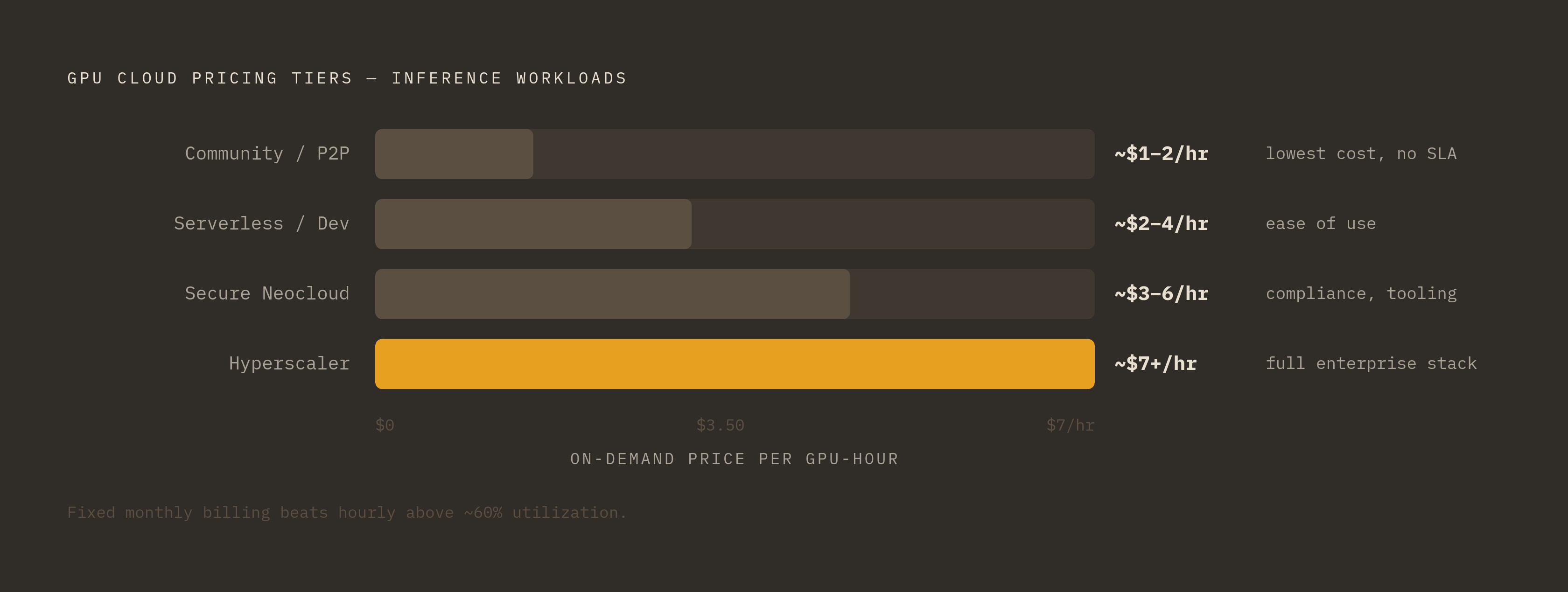
Laid out across the market, the structure is consistent: community-tier and marketplace GPUs price well below secure-tier neoclouds, secure-tier neoclouds price well below hyperscalers, and fixed monthly billing beats hourly billing once utilization crosses somewhere between 55% and 65%, with the exact crossover equal to one minus the discount percentage on offer. None of this says which provider is "best." It says that the price a provider charges is a readout of what it bundles, and reading the provider profiles that follow requires holding that in mind.
Providers built around raw GPU access: Lambda Labs, CoreWeave, Nebius, and Spheron
Lambda Labs built its reputation on simplicity: a team can SSH into a machine with ML frameworks already installed and start training or serving within minutes. Lambda fits teams that want bare GPU access at a strong on-demand price and have no need for managed orchestration.
CoreWeave is the largest GPU-native cloud, publicly traded on Nasdaq under CRWV, and backed by long-term supply agreements tied to OpenAI and Microsoft. In 2025 it acquired Weights & Biases and OpenPipe, extending its reach into training observability and fine-tuning. Its reserved pricing requires an annual commitment, and GPU, vCPU, and RAM bill separately rather than as a bundle, which adds a layer of accounting complexity relative to Lambda. The combination of Kubernetes infrastructure, InfiniBand networking, and reserved pricing makes CoreWeave the natural fit for enterprises running large distributed inference jobs that need networking at that grade, committed capacity, and a compliance certification already in hand. It asks more of a small team than Lambda does, and its minimum node size and à la carte billing are the tradeoff for that scale.
Nebius emerged in 2024 from the restructuring of Yandex's international assets, founded by Arkady Volozh, and now trades on Nasdaq with Nvidia holding a direct equity stake. Its five-year Microsoft deal has a base contract value near $17.4 billion, it can rise to roughly $19.4 billion with optional additional capacity, and its Meta agreement is worth approximately $2.9 billion. Nebius fits you if you want hyperscaler-scale contracts and balance-sheet transparency without routing through AWS, Azure, or Google Cloud, but you have to live with a company that still carries the shape of a recent reorganization.
Spheron aggregates bare-metal GPU capacity from multiple providers behind a single console, offering full VM access, root control, and pay-as-you-go per-minute billing without a virtualization tax added on top. It fits teams that want bare-metal performance and full kernel control with cost predictability and no minimum node floor forcing them into capacity they don't need.
Providers that bundle inference tooling on top of GPU access: Inworld AI, Together AI, io.net, and Fireworks
If your constraint is time-to-production rather than the price of a GPU-hour, you're better served by providers that bundle serving infrastructure, routing, and API compatibility directly on top of compute. The platform handles the GPU underneath an API, so it disappears as a line item your team manages.
Inworld AI positions itself as an inference layer on top of GPU infrastructure, not a raw GPU rental service. Its core differentiator is the Inworld Router, which gives access to over 100 third-party LLMs, including models from OpenAI, Anthropic, Google, Mistral, DeepSeek, xAI, Meta, Groq, and DeepInfra, all through a single OpenAI-compatible endpoint. Its Realtime Inference product serves Inworld-optimized open-source models, among them Gemma 4, DeepSeek V3.2/V4, and GLM-5.1/5.2, on first-party infrastructure with sub-second time-to-first-token, using vLLM, FlashInfer, speculative decoding, and KV cache management. Its voice AI bundle pairs first-party Realtime TTS with the Router, STT, and the Realtime API as a full pipeline rather than a single piece of the stack, and its acquisition of Ultravox extended that work into speech-to-speech research and voice agents. Inworld fits you if you're building voice AI or multi-model pipelines, and you want one managed endpoint instead of a set of separate vendor relationships to maintain.
io.net aggregates thousands of GPUs across more than 130 countries into a single on-demand compute layer, and it's built on a Decentralized Physical Infrastructure architecture that sources capacity from independent data centers, mining operations, and enterprise partners. Clusters deploy in under two minutes, and its FlashBoot technology brings cold starts below 200 milliseconds for nearly half of all requests, and below 500 milliseconds consistently, so it matters if your inference is latency-sensitive. Its io.intelligence product gives you access to more than 25 AI models through an OpenAI-compatible API, its Agent Cloud gives you infrastructure for deploying autonomous agents at scale, and it supports confidential computing if a workload needs to run on encrypted hardware. Billing runs per second, and serverless workers scale to zero so idle time costs nothing. io.net fits teams deploying AI agents at scale, workloads with bursty traffic, or privacy-sensitive work that needs confidential compute.
The same logic that favors a pre-built serving stack over a bare Kubernetes node favors a managed platform, because then a team can focus on what gets served to an end reader, or in Letterstory's case, what an AI answer engine sees and cites, instead of on GPU allocation and interconnect topology.
Where hyperscalers fit for inference workloads
Hyperscalers rarely win on GPU cost or provisioning speed, and they don't try to. Their value is ecosystem lock-in and compliance coverage, and for a workload that has to sit beside enterprise data, identity systems, and compliance infrastructure already built on one of these platforms, they become the default choice, sometimes the only one that clears procurement.
AWS offers P5 instances built on H100 and P6 instances built on B200, priced at the top of the market in a way that reflects the breadth of its ecosystem. For a workload that cannot leave the AWS perimeter, that breadth is the whole point, even at the highest price in the market.
Google Cloud runs A3 and A3 Mega VM families on H100 SXM GPUs, alongside TPU v6e, with tight integration into Vertex AI and GKE. It's the strongest option for a team already operating on GCP, and HIPAA compliance is available in certain regions. Azure runs ND H100 v5 and ND MI300X v5 GPU VM families, it carries an enterprise sales cycle typical of Microsoft, and it offers a HIPAA BAA if you're a regulated buyer already inside the Microsoft ecosystem, where switching costs would otherwise be prohibitive.
Serverless and marketplace options for variable or experimental inference loads
Workloads that are bursty, experimental, or tightly cost-constrained are better served by serverless GPU platforms and peer-to-peer marketplaces, which trade SLA guarantees and predictable availability for a lower cost floor and zero idle spend.
Vast.ai runs a peer-to-peer marketplace of third-party hosts with variable, host-set pricing. It consistently offers the lowest rates available anywhere in the market, paired with variable quality and no production SLA to back it up. It fits researchers and teams still in a prototyping phase who want the cheapest possible access to a GPU and can tolerate the reliability variance that comes with it.
Paperspace, part of DigitalOcean, is competitive on L4 and A100 instances, with a developer-friendly interface and the global footprint DigitalOcean already operates. DigitalOcean's Inference Engine brings serverless, batch, and dedicated inference together over GPU Droplets in a single stack, with hardware ranging from the RTX 4000 Ada up through the NVIDIA HGX B300 and AMD's MI350X and MI355X. The production risk that comes with that model is cold-start latency, which varies significantly across platforms: sub-500-millisecond cold starts are achievable on the stronger platforms but not guaranteed across the board.
Hetzner fits a narrower case: always-on inference at L40S class or below, where fixed monthly billing beats hourly billing once utilization crosses roughly 60%. If you're a European team running predictable, steady traffic, it's the right choice, because egress allowance and billing predictability outweigh any need for H100-class hardware.
Applying the framework: workload archetypes mapped to provider fit
No single provider answers every inference workload, and the framework above resolves into four recognizable archetypes.
Multi-model or multi-provider inference built around managed endpoints fits the Inworld AI Router for teams that want one OpenAI-compatible endpoint across more than 100 models without rewriting application code per provider, and Together AI for teams that want compute, fine-tuning, and inference consolidated from a single vendor.
Regulated enterprise inference, in healthcare, finance, or government, fits AWS, Google Cloud, or Azure wherever HIPAA BAA, FedRAMP, or GDPR-certified regional requirements determine the provider outright, with CoreWeave's SOC 2 Type II certification standing as an alternative when Kubernetes-native infrastructure is preferred and the compliance bar is already met.
Bursty, variable, or experimental inference fits io.net's serverless offering for workloads that need fast cold starts and scale-to-zero economics, including agent-scale deployments and confidential compute, DigitalOcean and Paperspace's serverless tier for teams that want a managed, developer-friendly experience without signing a neocloud contract, and another vendor's low-cost marketplace for prototyping work where reliability matters less than minimizing cost.
Before any of these choices gets locked in, the egress cost for the specific workload deserves its own model. A provider can look competitive on GPU rate alone, but once production traffic hits an unbundled, ungenerous egress policy, it can turn expensive, and you rarely see that number on the pricing page next to the GPU rate.
AI visibility strategy and publishing in this market
The buyers reading comparisons like this one increasingly research GPU cloud providers through AI answer engines rather than a straight line of Google searches, and that shift creates a discovery contest that most infrastructure brands have not yet started measuring.
Comparative, technically specific content, the kind this article represents, is what those engines cite most readily. Measuring whether a brand shows up in an AI answer to a GPU cloud query is a separate task from tracking a Google ranking. The overlap between the top links in Google and the sources an AI engine actually cites has declined sharply, and organic search strength is becoming a weaker predictor of whether a brand gets named in an AI-generated answer.
Letterstory runs content engines built for B2B SaaS and developer-tool companies, so they can hold a citation presence across those four engines over time. That includes standing watchers that draft content the moment something relevant shifts, a new GPU SKU, a pricing change, a provider acquisition, paired with a measurement layer that shows whether those engines are actually naming and citing the brand once the content goes live. For a market moving as fast as GPU cloud pricing does, that kind of standing infrastructure matters more than any single comparison piece.