Inference vs Training Infrastructure Cost Breakdown
Training is capital; inference is operating expense that scales with success.

Most AI infrastructure budget failures trace to one root cause: treating training and inference as two line items in the same expense category. They are not. Training behaves like capital expenditure, a bounded project with a finish line. Inference behaves like operating expenditure: it scales with product success and never stops. If you understand that structural distinction, you can plan, optimize, and control AI infrastructure spend as production workloads scale.
Why training cost and inference cost are not the same kind of expense
Training is a bounded compute event. A team runs it, it finishes, and the spending stops. Its cost drivers, model size, dataset size, and number of runs, are all estimable in advance, because the inputs are set before the run begins. The hardware operates at high intensity for days or weeks, then sits idle until the next training cycle. Inference is the opposite in every dimension. It starts the moment a model ships and continues as long as the product stays live, with no natural endpoint. Its cost drivers, query volume, context length, output length, and concurrency, are tied directly to product success. The better the product performs, the more inference costs.
The structural comparison is stark. Spending pattern: training is a bounded one-time or periodic capital outlay, while inference is a continuous operating expense that scales with usage. Cost driver: training depends on model size, dataset size, and training runs, while inference depends on query volume, context length, output length, and concurrency. The 2026 share of AI infrastructure spend tells the same story: training sits under 45 percent and falling, while inference stands over 55 percent and rising.
How the inference share of AI spending grew from a minority to the majority
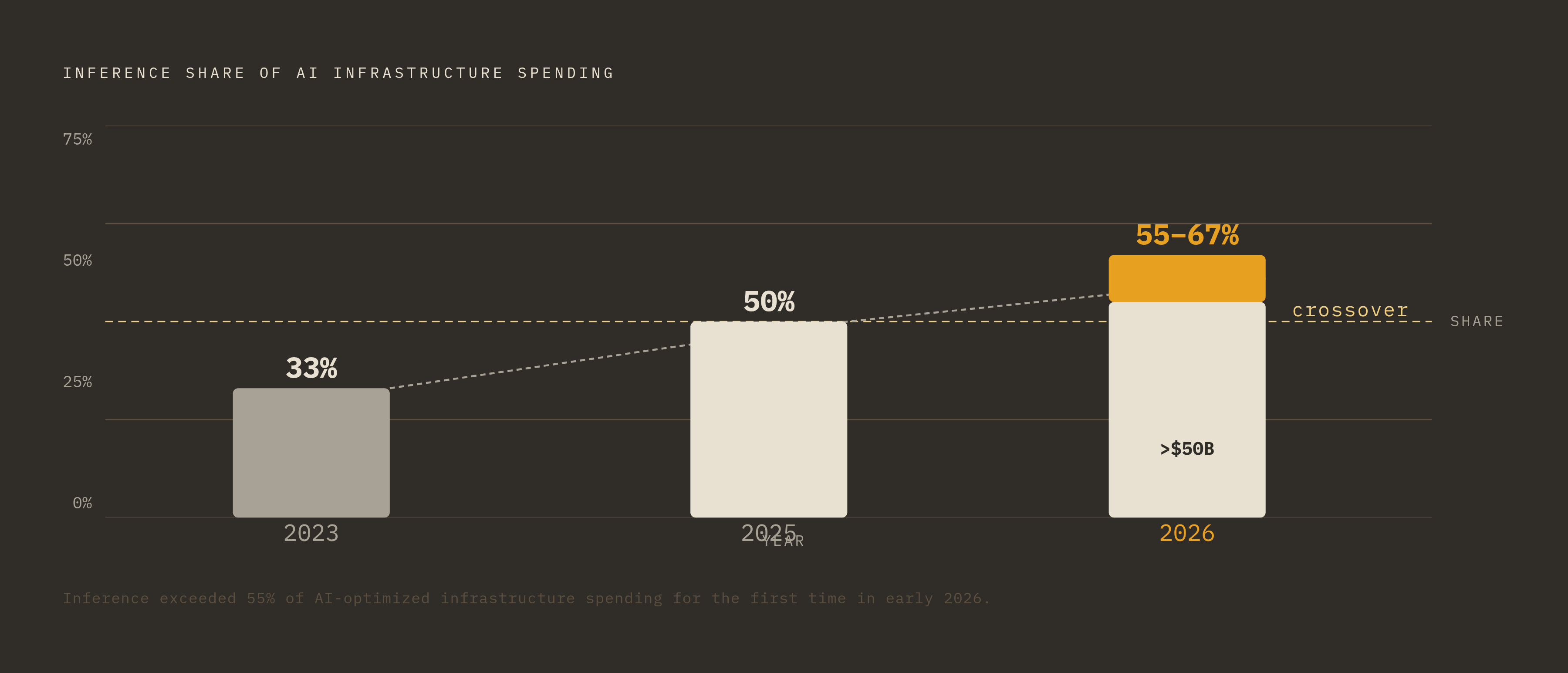
The shift from training-dominated to inference-dominated AI infrastructure spending is already complete. It is not a future projection. The trajectory remains upward, and the crossover already happened. Inference accounted for roughly one-third of AI compute in 2023. By 2025, that figure stood at roughly half. By 2026, it reached roughly 55 to 67 percent depending on whether the measure is infrastructure spending or compute cycles. Both figures are real. They count different things, and the spread between them reflects the distinction between dollars committed and cycles consumed.
The threshold was crossed in early 2026, when inference exceeded 55 percent of AI-optimized infrastructure spending for the first time, with more than $50 billion spent on inference in that year alone. Some organizations have seen the split flip entirely: budgets that were roughly 20 percent inference and 80 percent training in 2023 have reversed to as much as 85 percent inference by 2026. Across a model's full lifecycle, inference accounts for roughly 80 to 90 percent of total compute dollars, because a frontier training run is enormous and happens once, but serving the model to users happens continuously for years. ChatGPT's cumulative inference costs outpaced that total within the same year.
What drives training costs and why they are estimable in advance
Training cost is large but tractable. The inputs that determine it are knowable before the run begins, which is what makes it plannable as a capital event. The core cost drivers are model parameter count, dataset size, cluster size, measured in GPUs or TPUs, training duration, and number of runs. All of these are set or estimated before the run starts. Cost overruns in training are a project-management problem, not a demand-growth problem.
The hardware profile reinforces this. Training gravitates toward the most powerful GPUs available, arranged in large multi-node clusters, connected by high-bandwidth networks, running uninterrupted for weeks or months. Throughput is the optimization target. Speed per batch matters, not per-user latency. The workload is bursty and high-intensity, places substantial strain on infrastructure, and then stops. The benchmarks illustrate the scale: GPT-4 used approximately 25,000 NVIDIA A100 GPUs for several months at roughly $78 million in compute. DeepSeek V3, by contrast, cost approximately $5.6 million in compute, so efficiency improvements can dramatically reduce training cost even at frontier scale. Managed ML platforms add surcharges of 25 to 40 percent on top of base GPU rates. Training should be budgeted as a project with a scope, a finish line, and an estimated cost, the same way one budgets a capital build, not a subscription.
What drives inference costs and why they resist the same kind of estimation
Inference cost resists the same estimation because its primary driver is usage. That is the variable every product team is actively trying to maximize. Cost-per-token is the foundational metric: cost per million tokens equals GPU dollars per hour divided by tokens per second times 3,600, divided by one million. The formula normalizes GPU price and throughput into a single comparable figure across hardware configurations. For a Llama 3.1 70B model at batch size 256 running on vLLM, the figures from April 2026 on Spheron tell a precise story. An 8x H100 costs $19.20 per hour, delivers 2,800 tokens per second, and lands at $1.90 CPM. The A100 has the lowest CPM at this batch size because its lower per-GPU price offsets its lower throughput.
At scale, the numbers compound quickly. A 70B model with 1,000 daily active users averaging 1,000 requests at 500 tokens each produces 500 million tokens per day. Inference hardware optimizes for latency, not throughput. Users wait for responses, and delays are measured in milliseconds. This permits smaller models and more affordable GPU-CPU combinations. A 7B-parameter model needs 16 to 24 GB of VRAM and can run on consumer GPUs. Hidden costs compound the problem. Egress charges are structurally invisible at development stage, but they become significant at production scale. The next section explains why it is not.
Why agentic workloads and reasoning models are multiplying inference volume faster than price reductions can offset
The Jevons paradox is playing out in AI infrastructure. Per-token inference prices have fallen dramatically, but total inference spend keeps rising because volume is growing faster than unit cost is falling. Agentic workloads are the primary accelerant. The cost to query one model in this class fell from approximately $20.00 to roughly $0.07 per million tokens between late 2022 and late 2024, more than a 280-fold reduction in under two years. Cheaper inference makes previously uneconomical use cases viable, so query volume rises.
Agentic workloads multiply this effect. A single user request that would once have been one model call now becomes a plan, several tool calls, a critique, and a revision, each with its own prefill and decode step. One task generates many model calls instead of one, and per-token pricing improvements cannot offset that multiplication. Reasoning models compound it further. In a demo at GTC, NVIDIA showed that a reasoning model like DeepSeek's R1 answered with substantially more tokens using a much larger amount of compute than a traditional model for a complex problem. The common mistake is celebrating a falling per-token price as evidence that inference costs are under control, but total spend climbs because volume growth is not being tracked alongside unit cost.
How training and inference demand different hardware, and why using training-optimized infrastructure for inference wastes money
Training and inference optimize for opposite performance dimensions. The best hardware for one is actively wasteful when applied to the other. More affordable GPU-CPU combinations become sensible, and the AMD Instinct MI300A is cited as a sensible inference choice.
The competitive landscape for inference is broader than it ever was for training. NVIDIA dominated AI training, but inference presents a different and more competitive market. Google TPUs deliver substantially better performance-per-dollar and markedly lower power consumption for inference workloads, and Anthropic, Meta, and Midjourney have shifted workloads to TPUs. The energy profile diverges as well. On-premise inference evaluation must account for electricity TCO separately from the bundled rates in GPU cloud pricing. The build-versus-buy threshold for inference sits around 100 million tokens per month, and below that managed API pricing is generally more economical once you factor in operational overhead. Letterstory's approach to content publishing treats the research, drafting, and rewriting pipeline as an inference-driven operation where per-post costs depend on query volume and model passes, not a fixed training cadence, making the budgeting logic transparent and tied directly to publishing velocity.
The four optimization layers for inference cost, and the order they should be applied
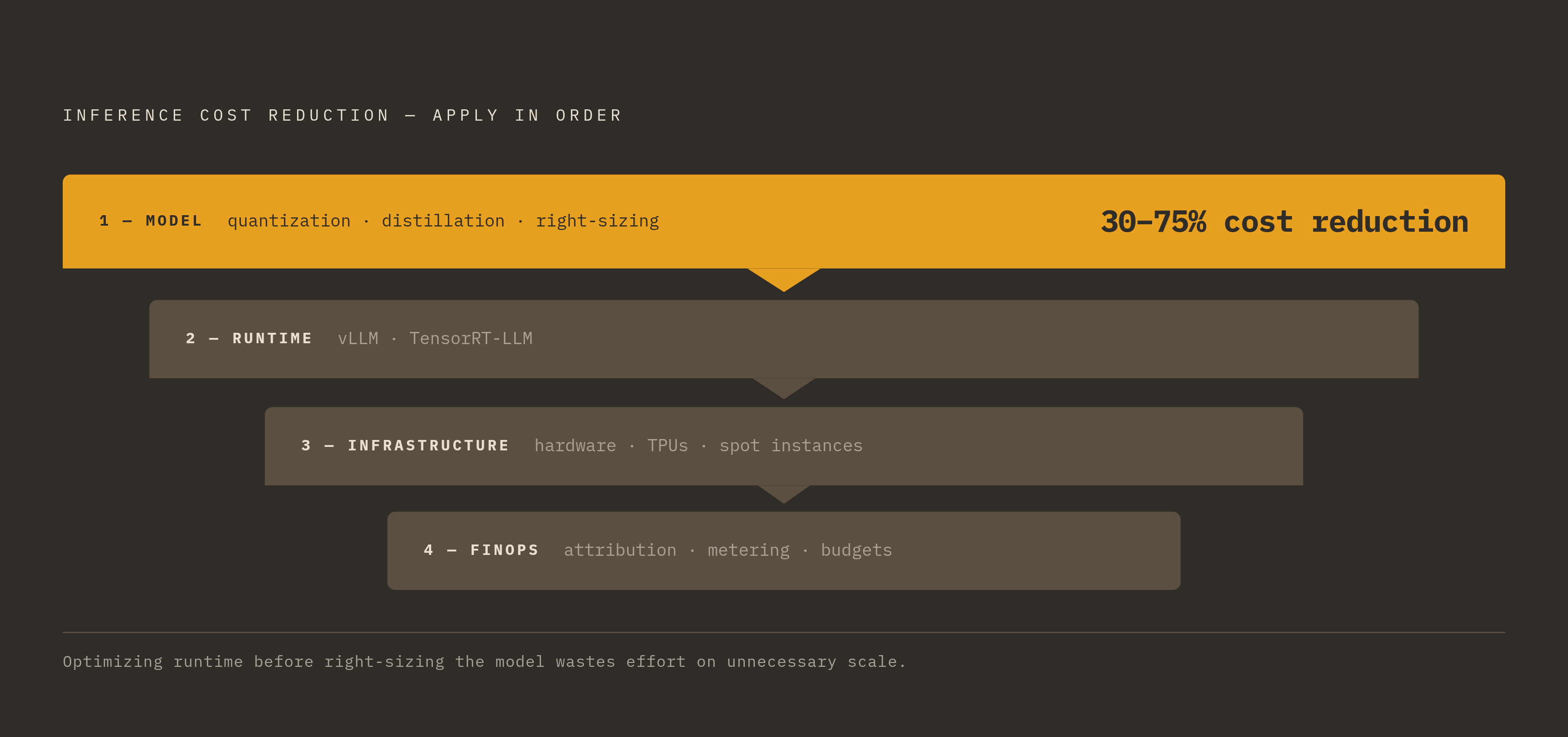
Inference cost reduction is not one technique applied once. It is four distinct optimization layers that compound on each other, and the order in which they are applied determines how much of the savings stack. The model layer, covering quantization, distillation, and right-sizing, delivers 30 to 75 percent cost reduction. The FinOps layer, covering attribution, metering, and budgets, prevents waste accumulation on a continuous basis.
Order matters because model changes affect every subsequent dollar spent. Optimizing the runtime before right-sizing the model wastes the optimization on a larger model than necessary. FP8 quantization on H100, natively supported by vLLM, provides a meaningful throughput gain over FP16 at under 2 percent quality loss on instruction-tuned models, with no perceptible quality difference in production for conversational AI, summarization, and code generation. FP4 on B200 via TensorRT-LLM adds a further meaningful gain over FP8, but with more quantization error, and should be tested against an eval suite before production. The FinOps layer is not optional at production scale. Because inference never stops, optimization effort here compounds indefinitely in a way that training optimization never can. As inference spending has come to consume 80 percent or more of total compute dollars, teams face a critical measurement problem: knowing whether that inference investment actually delivers measurable business outcomes. Letterstory addresses this by measuring whether a brand's content, produced via inference-heavy LLM pipelines, actually lands inside AI-generated answers from ChatGPT, Claude, Gemini, and Perplexity, converting inference spend from an invisible operating cost into attributable, trackable expense.
How to budget training as capex and inference as opex without conflating the two
A unified AI compute line item is not a simplification. It is a forecast error built into the model from the start. Training belongs in the capital budget. Estimate the run cost in advance using known inputs: cluster size, duration, and GPU rate. Treat cost overruns as a project-management problem, not a demand-growth problem. Expect the spending to stop when the run finishes, and plan for periodic retraining as a discrete capital event rather than a continuous line. Because training costs are determined by inputs set before execution begins, they are plannable as a capital project, but inference costs remain fluid and tied to real-world demand. The same principle holds for teams running content at scale through multiple LLM inference passes: pre-computing the resource envelope of a content run requires knowing query volume and model-pass frequency in advance, but actual costs still scale with production velocity once the pipeline is live. Letterstory's multi-stage AI pipeline architecture with human review gates is designed to constrain token spend at each stage, so unbounded agent loops do not compound costs uncontrolled.
Inference belongs in the operating budget, as a unit economics problem tied to growth. Establish cost per unit of usage, whether per query, per million tokens, or per active user, and multiply by growth projection. A flat inference budget number is close to meaningless once usage is the actual driver. Build in the agentic multiplier: if the product uses agents or reasoning models, each user-facing request generates multiple model calls. Include egress, managed platform surcharges, and idle-GPU waste in the model, because they are structurally invisible at development stage. The common mistakes this framework avoids include forecasting next year's AI infrastructure budget as a percentage increase over this year's combined training-plus-inference number. Because the two scale on entirely different drivers, that produces a forecast that is structurally wrong regardless of the percentage chosen. Another mistake is treating a falling per-token price as evidence that inference costs are under control while ignoring volume growth. A third is planning around training budgets and treating inference as an afterthought until the production bill arrives. Human review gates function as natural inference circuit-breakers: work does not proceed to the next, more expensive stage until a human approves it, preventing runaway token consumption on flawed drafts. That is engineering discipline applied to content: instrument the pipeline, measure cost per published piece, and adjust on evidence.
The measurement obligation is inescapable. GPU utilization, cost per token by workload, egress charges, and managed-platform surcharges all need attribution at the team or product level, not just at the account level. This is the FinOps layer from the optimization framework, extended into budget governance. You cannot manage what you do not meter, and most teams are not yet metering the right things.