LLM API Cost Optimization for High-Volume Content Pipelines
Track cost per accepted outcome, not per request, to stop blind optimization.

Per-token prices for large language models have fallen for years, but monthly bills for high-volume content pipelines keep going up. That contradiction is the subject of this piece, and the explanation is structural: most teams are measuring the wrong unit. A single API request is not a stable cost unit. One request might carry a short classification prompt of a few dozen tokens; the next, to the same endpoint, might carry a massive system prompt plus retrieved documents, tool definitions, and a full conversation history running into the thousands. Counting "requests" as if they were interchangeable hides the actual driver of spend, which is token composition, not call volume.
Agentic and multi-stage pipelines make the problem worse. Every loop turn in a research-draft-review workflow re-injects tool descriptions, parameter schemas, and retrieved chunks, adding token weight at each step in ways that single-call benchmarks never surface. If a team benchmarks model pricing per call and extrapolates linearly, it's measuring a number that has little to do with what it will actually pay once the pipeline runs at production volume.
The right cost model tracks uncached input, cached input, cache writes, output, reasoning, and modality units, broken down by request class, not by requests per second. That reframing matters because it shifts the unit of analysis from "how many times did we call the API" to "what did each call actually cost to compose and complete." Falling sticker prices on frontier models can coexist with rising total spend precisely because the sticker price was never the variable driving the bill. The spiral is a measurement failure that has to be corrected before any optimization technique can be evaluated honestly.
Cost per accepted outcome versus cost per request
A single substitution drives every lever in this piece: replace "cost per request" with "cost per accepted outcome. An accepted outcome is content that clears review, publishes, and does the job it was commissioned to do, not merely content that was generated. This denominator matters because it absorbs the costs that a naive per-call calculation leaves out: retries, escalations, rework, and the review time spent catching what a cheaper decision let through.
A full accounting of spend has to include model inference, split by uncached input, cached input, cache writes, output, and reasoning tokens; tools and retrieval, covering search, grounding, embeddings, vector storage, and data transfer; agent execution, covering planning calls, tool calls, retries, loop length, and failed runs; quality, covering evaluation runs, review, escalation, and rework; and lifecycle costs, covering observability and migrations. Each of these categories can move independently, and a win in one can be erased by a loss in another. A weak first attempt followed by escalation can cost more and respond slower than starting with the model that meets the quality threshold from the start.
None of this is measurable without observability built in from the start. Cost monitoring has to break spend down by feature, model, and query type before anyone touches a lever, because the first move in any optimization effort is visibility: before cutting anything, the spend has to be attributable, or the cuts are guesses. Once cost per accepted outcome is the standing metric, the four levers that follow, caching, routing, compaction, and batching, can each be tested against it directly. If a technique lowers cost per request but raises cost per accepted outcome, you don't have an optimization. You have a shell game instead, and the measurement discipline exists to catch it before it ships.
Prompt Caching as the First Lever
Prompt caching comes first because it asks nothing of the architecture, and it delivers the single largest return of any lever you have in a content pipeline. The mechanism is straightforward: stable content, a system prompt, brand voice rules, tool definitions, a knowledge-base preamble, gets written to cache once and read back at a fraction of the base input price on every subsequent call that reuses it. For any pipeline that reuses a large system prompt or a standing knowledge base across many generations, the savings are close to free money, and the canonical candidates, content generation, data enrichment, summarization pipelines, and overnight batch jobs, describe most of what a high-volume content operation actually runs.
The structural rule that makes caching work is simple to state and easy to violate: the stable part of any prompt goes first, and the variable part goes last. If you run research tasks once a week on a system prompt built for daily cache hits, you end up paying for a cache that sits unused.
Caching has to come before routing and batching for a reason beyond raw savings: it establishes the stable prefix shape that the later levers depend on. If a team builds its routing classifier first and bolts caching on afterward, it will likely end up with inconsistent prefix structures across request types, which drags down cache hit rate and, with it, the economics routing was supposed to produce. Order is a dependency here, not a stylistic preference.
Model routing: matching prompt complexity to model tier after the prefix is stable
Model routing is the second lever, and it only pays off once the first lever has done its work. A router sits between the application and the LLM API, reads each incoming prompt, classifies its difficulty, and sends it to the cheapest model capable of handling it, reserving the frontier model for the requests that genuinely need it. If the prefix is unstable, the classification step itself becomes an added expense that erodes the savings it exists to produce; if the prefix is cached and consistently shaped, classification runs cheaply and the routing decision becomes close to free overhead.
Most of what happens inside a multi-stage content pipeline is not hard in the sense that matters to a router. Brief generation, outline structuring, SEO rule checks, and brand voice validation can all go to budget-tier models. Synthesis, nuanced argumentation, and compliance-sensitive output are the stages that need frontier-level reasoning, so routing has to draw that line correctly instead of defaulting everything to the most expensive option out of caution.
The objection that a cheaper model produces worse answers is answered by evaluation, not by assumption: if the budget model passes the tests built for a given query type, it isn't worse for that job, just cheaper for it. The operational discipline that keeps routing honest includes tracking the share of first-pass outputs that get accepted, the rate of escalations, instances of false confidence, retries, latency at the high percentiles, and cost per accepted outcome, while keeping a direct route to the stronger model open for the request classes where it reliably wins. Because model families, quality, and pricing shift continuously, the discipline worth building is the classification framework itself, not a loyalty to any particular model name.
Context compaction as the lever that stops token costs from compounding across pipeline stages
The third lever addresses a problem unique to multi-stage pipelines: compounding. A coding agent, or a content pipeline agent performing research, drafting, and revision in sequence, does not make a single API call. It makes dozens of calls per task, and each one re-sends the full conversation history built up so far. You pay again for every unnecessary token in that history on each turn, so context piles up in a way that makes cost grow close to exponentially across a long pipeline run.
Compaction is distinct from summarization, and that distinction has real quality consequences for content work. Summarization rewrites content to shorten it, which introduces a hallucination risk: invented details, altered numbers, lost specifics that a human reviewer will have to catch downstream. Compaction instead removes tokens through verbatim deletion, so every sentence that survives the process is character-identical to the original. When factual accuracy and brand-specific phrasing are non-negotiable, you want compaction, because if you summarize a research brief before drafting, you risk an error that costs more to fix at review than it saved in tokens.
The same discipline applies to retrieval. A leaner retrieval context tends to improve quality as well as cost, because the model isn't distracted by irrelevant text competing for attention alongside the material that matters. So a tighter retrieval cap works as a cost lever and a quality lever at the same time. Compaction and retrieval discipline together are what keep a five-stage pipeline from silently tripling its token footprint between the first call and the last.
Batching as the final lever and the one that stacks multiplicatively with the others
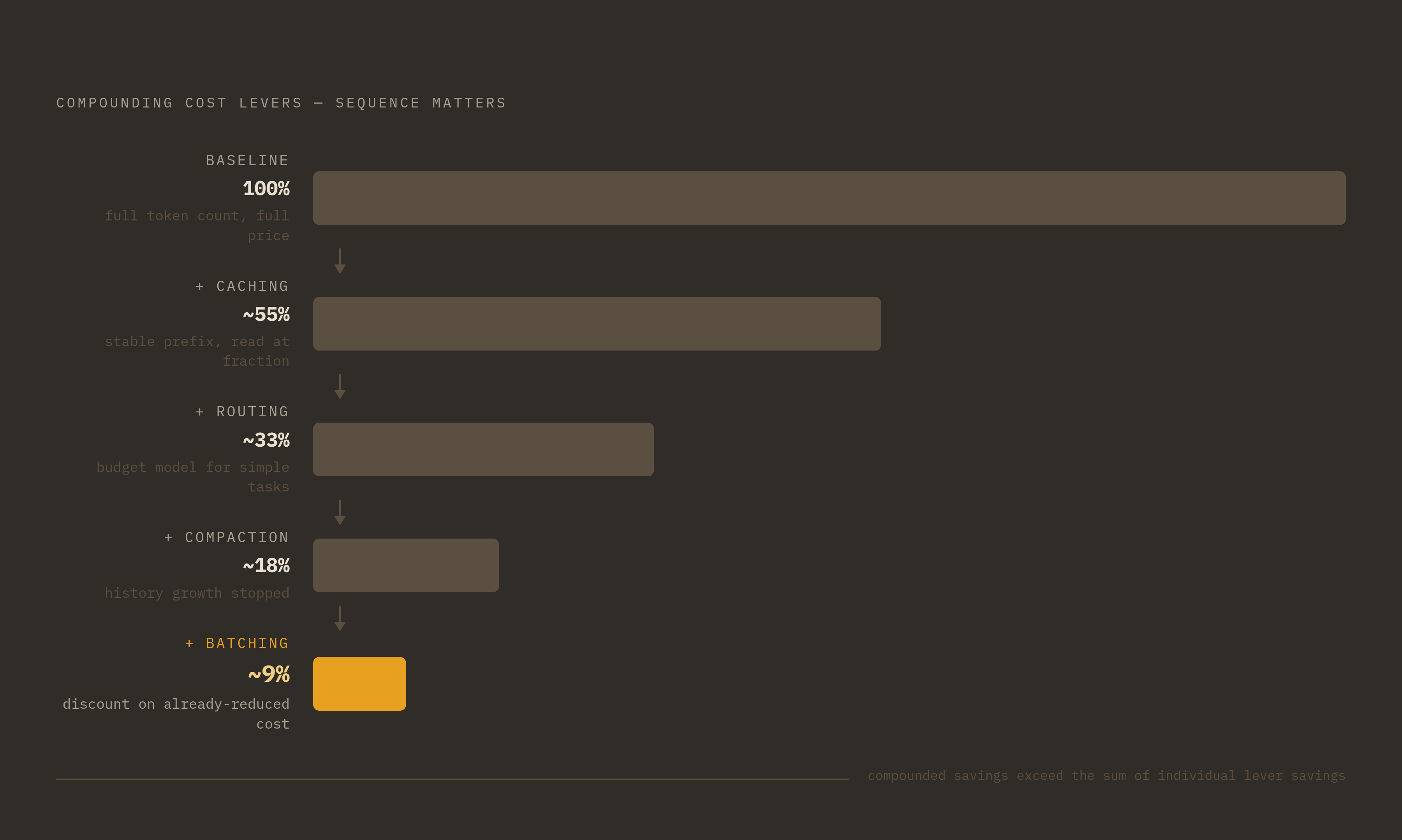
Batching comes last in the stack because its savings multiply what the first three levers have already built. If a request has already been routed to the correct model tier, carries a cached prefix, and has had its context compacted, it still qualifies for the batch discount on top of all three prior reductions, and that is what produces compound savings no single lever reaches alone.
The canonical candidates for batching are the same workloads named for caching: content generation, data enrichment, summarization pipelines, and overnight jobs, all standard stages in a high-volume content operation. The trade-off is latency: batch results return within hours rather than seconds, and that cost is close to zero in practice for pipeline stages that are not user-facing, including research aggregation, outline generation, SEO rule checks, and scheduled publishing queues.
Batching is not unconditionally cheaper once the full cost model is applied. A sound workload audit compares batch, flex, standard, priority, and reserved-capacity options against current provider terms, and accounts for queue delay, failed records, retries, storage, monitoring, and deadline risk, since those operational costs can erode a discount that looks attractive on paper. The sequencing argument carries real financial weight: a team that batches first, before caching and routing are in place, pays the batch discount on inflated, unoptimized token counts, while the same batch request applied after caching and compaction costs a fraction of what the naive version would have. The total reduction achieved by applying all four levers in sequence is larger than the sum of each lever's individual savings, and that compounding is the engineering discipline this piece is arguing for: order each lever so it inherits the gains of the one before it.
Human Review as a Cost Lever
Everything above concerns token-level mechanics. Pipeline architecture determines how many expensive LLM calls a pipeline ends up making, depending on where a human review gate is placed. A misplaced review gate forces rework loops you could have avoided, but a gate placed correctly catches errors before they propagate into downstream stages that cost more tokens to redo.
The principle is straightforward: every error that passes a review gate uncaught gets paid for again at each stage that follows it. Each one sits at the point where letting an error pass forward costs the most.
Automated first-pass quality checks, covering brand voice, preferred terminology, compliance standards, and detection of generic AI phrasing, run before a human ever reads the piece, and they reduce both human review time and the number of pieces that require an expensive revision loop. This stage is the one most teams skip, and skipping it is why their review process doesn't scale as volume grows. A five-stage review model, SME assessment, editorial, fact-check, SEO review, and director approval, is built as a quality structure, but it also has a cost implication: front-loading automation reduces the share of pieces that ever reach those later, more expensive stages. That is where a well-placed review gate produces its real savings.
Why AI visibility measurement determines the optimized pipeline's payoff
A pipeline that applies all four levers correctly, caching, routing, compaction, and batching, still hasn't proven anything if nobody is measuring whether the content it produces actually earns citations in AI answer engines. A cost-optimized pipeline that skips that measurement is just a cheaper way to produce content that may not be doing its job. You have to apply that same discipline to the pipeline's actual output, not just to token spend.
The parallel to the opening argument is direct. If teams measure requests instead of tokens, they misread their costs; if they measure traffic or search rankings instead of AI citations, they misread whether their content pipeline works at all, in an environment where AI answer engines are increasingly the first point of discovery for a reader's question. Getting cited inside an AI-generated answer and ranking on a traditional search results page are different outcomes, built on different signals, and content optimized for one does not automatically win the other. That means visibility has to be tracked separately for each, not inferred from the other.
AI visibility needs to be tracked across the specific engines that matter: ChatGPT, Claude, Gemini, Perplexity, and Grok, among others including Google AI Overviews and Copilot, because citation behavior differs from one engine to the next, and a brand that's visible in one is not automatically visible in the others. Freshness adds a hard constraint that ties pipeline cadence directly to citation outcomes: content that ages past a given threshold loses citation priority, which gives a well-optimized, cost-efficient pipeline publishing on a sustained schedule a structural advantage over a cheaper pipeline that publishes irregularly. Cost per accepted outcome, the denominator introduced at the start of this piece, can only be evaluated in full once "accepted outcome" is defined as content that earns citations, not merely content that gets published. A pipeline with no visibility into its AI citation performance is optimized on the cost side and unmeasured on the side that was the point of building it.