Content Differentiation Strategy in AI-Saturated Niches
Being named in AI answers now matters more than ranking first in Google.

Content differentiation in AI-saturated niches no longer comes down to publishing more. It comes down to producing the specific signals, original data, clear expertise, and structural clarity, that make an AI answer engine choose to name you instead of the undifferentiated mass of content surrounding you.
Why volume stopped working as a content strategy
Generative tools made it cheap to produce readable, technically accurate content on nearly any topic, and that cost collapse is the whole story. A brand can now generate hundreds of articles in the time it once took to write a handful, and the output will pass a basic read-through: correct facts, reasonable structure, a clear thesis stated up top. Every competitor's content can do the same, on the same topics, built from the same source material, arriving at the same conclusions. The web has filled with pieces that are competent and interchangeable at the same time, and competence stopped being a differentiator the moment it became free to manufacture.
Search engines and AI platforms have responded by raising the bar to meet the flood. Google's helpful content updates have steadily penalized pages built primarily to capture search traffic instead of serving a reader's actual need, which means the content that used to rank on volume and keyword coverage now gets filtered out before it reaches anyone. The middle tier, content that is better than bad but short of genuinely excellent, is where most of that filtering lands, and it is disappearing as a place a business can safely operate.
The discovery layer itself has shifted underneath this. Most searches now end without a click at all, and when an AI Overview appears above the results, the click-through rate for the page sitting in first position drops sharply. Attention is increasingly consumed and resolved inside the answer itself, not on the page a brand built to earn it. That changes what a successful outcome even looks like: being named inside an AI-generated answer now carries brand value on its own, whether or not anyone follows a link out. Citation has become the new click.
How AI answer engines decide what to cite
AI answer engines do not reward the largest volume of content on a subject. They select sources that offer something specific and extractable: a number nobody else has published, a credential that reads as real expertise, a structure that lets the system pull a clean answer without having to interpret ambiguity. Ranking first in Google's organic results and showing up inside ChatGPT, Perplexity, Claude, or Gemini are different achievements, built on different mechanics, and a brand can win one while remaining invisible in the other.
The gap between category leaders and everyone else is not small. In measured studies of generative engine optimization, the brands that lead their category hold a Share of Model (how often an engine names them in relevant answers) well above the average brand competing in that same space. That is a gap in actual citation behavior, not just a gap in search rank.
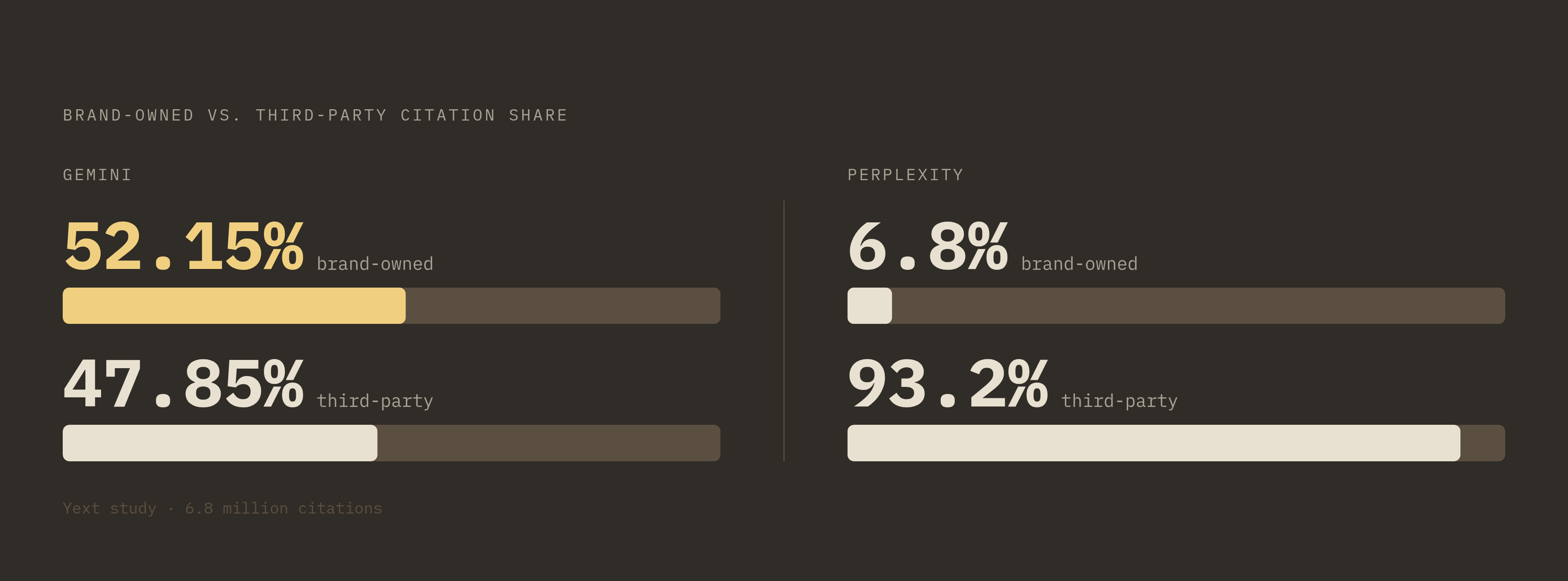
The engines also do not behave the same way as each other, and the divergence is sharper than most brands assume. Yext's study of 6.8 million citations found that 52.15% of Gemini's chat citations come from brand-owned websites, the highest share of any major engine, while Perplexity draws only 6.8% of its citations from brand-owned domains, leaning instead almost entirely on third-party sources. Gemini's behavior tracks closely with Google's own index and its E-E-A-T signals (experience, expertise, authoritativeness, trustworthiness), so content that is well-indexed and clearly authoritative on Google tends to perform well inside Gemini too, with freshness acting as a moderate tie-breaker. Perplexity simply is not playing that game, and optimizing for one engine's logic will not automatically carry over to the other.
Google has said directly that many of the formatting tactics marketed as "AEO" or "GEO" hacks, chunking content into fragments, publishing llms.txt files, do not move the needle on Google Search, and the company advises brands to focus on sound SEO fundamentals instead. That guidance is accurate as far as it goes: it addresses surface-level tricks and Google's own search surface specifically. It says nothing about ChatGPT, Perplexity, or Claude, which do not run on Google's index or Google's ranking signals. The case for deliberately optimizing content for those surfaces stands on its own, independent of what Google says about its own results page.
The four signals that make content citable when everything else is generic
When a niche fills with AI-generated content that all reads roughly the same, differentiation comes down to four signals. Each one is hard to replicate at scale by design, and each maps directly onto what citation systems are built to reward.
Original data and proprietary research sit at the top of the list because they cannot be faked or generated after the fact. A survey built from a brand's own platform data, its own customer base, its own transaction records, produces findings that exist nowhere else on the internet. No AI model can synthesize that data because it was never in any training set, no journalist can write about the findings without citing the source, and no competitor can reproduce the piece without doing the underlying work themselves. The research does not need to be large in scope to earn this kind of leverage: a focused survey of a few dozen highly qualified respondents in a narrow niche can produce more citable, specific findings than a broad industry report assembled from material that was already public.
Practitioner voice and first-person expertise work differently, but they aim at the same end. Content written by someone who actually does the work reads differently from content that describes the work from a distance: it carries specific details, counterintuitive observations, and honest acknowledgment of what fails in practice, the exact markers that AI-generated content tends to flatten out or omit. Building this kind of content means putting real practitioners at the center of the piece as genuine contributors, not as quotes dropped in to decorate a draft written around them. It is slower to produce than keyword-driven output, and it produces the kind of content that AI systems cite.
Narrow audience focus and use-case depth form the third signal, and the logic here cuts against most teams' instincts. Content built for a specific, well-defined audience and written deep into that audience's actual situation outperforms broad content that gestures at several audience types without fully serving any one of them. Narrower focus tends to produce wider reach over time: content that is genuinely excellent for one specific group gets shared inside that group's own channels, earns links from people who recognize its relevance, and compounds into real topical authority. An AI-first content approach extends this same logic from the audience level down to the individual prompt: the operating question shifts from "what topic should this cover" to "what exact question does this specific reader need answered right now."
Editorial position and original thinking round out the framework. Taking a clear, defensible position on a genuinely contested question, and backing it with evidence and reasoning rather than hedging, is something AI-generated content rarely does well, since model output tends toward balanced, noncommittal framing that avoids taking a side. Content that commits to a position, explains the reasoning behind it, and takes serious counterarguments seriously stands out precisely because that kind of commitment has become rare. This is not about being provocative for its own sake. It requires enough real expertise to hold a view and defend it against the strongest version of the opposing argument.
These four signals sit in real tension with the scale that AI tools make possible, and that tension should not be smoothed over. The same tools that let a brand produce content quickly also let competitors copy whatever works just as quickly. The resolution is not to abandon AI in content production but to redirect it: use AI for research aggregation, structural drafting, and distribution, and reserve human time for original analysis, first-person perspective, and editorial judgment, the work that cannot be generated on demand.
Building a citation architecture beyond your own domain
Owning a strong domain is necessary, but it is not sufficient on its own. Generative AI systems pull information from across the web when constructing an answer, and a substantial share of the citations a brand earns in AI responses come from sources other than the brand's own site. A brand is more likely to be cited through a third-party source, a community platform, an industry publication, a review site, than through a page it published itself, and those third-party categories collectively account for more total citation volume than owned pages do.
The engines concentrate their trust in a relatively small set of sources. Wikipedia, Reddit, YouTube, LinkedIn, top-tier publications such as Forbes and Reuters, and category-specific review platforms like G2 and Capterra all function as recurring citation sources across generative engines. A brand's presence on these surfaces, even indirectly through mentions, reviews, or discussion, can produce citations inside a synthesized AI answer even when the brand's own website is never directly cited.
The practical architecture follows: publish on owned properties to build topical authority and the structural signals engines look for, then seed the same distinctive material, the original data, the practitioner perspective, the specific editorial position, into the trusted third-party surfaces the engines already draw from. Wikipedia carries particular weight in that mix given its citation share, but it also carries real risk: the platform's editorial standards actively police promotional editing, and content inserted there primarily to manufacture a citation rather than to document verifiable fact tends to get reverted and can damage a brand's credibility on the platform.
Depth matters as much as placement. Where the material sits on a page matters too: a disproportionate share of citations drawn by large language models come from a piece's opening section specifically, and the framing and positioning at the top of an article functions as an active citation signal. None of this replaces the four signals covered above. The distribution layer determines how far differentiated content reaches the surfaces where AI engines go looking, and that reach only pays off when the production system behind it generates material worth citing.
The production system that makes differentiation sustainable at scale
A content pipeline that runs AI through a single pass, prompt in, draft out, publish, produces volume without the differentiation signals that earn citation. The production system has to be built so that original analysis, practitioner voice, and editorial judgment survive every stage of the process rather than getting smoothed out of the draft somewhere along the way.
Most AI content programs fail in the same pattern: a brand publishes a large volume of AI-generated output, sees an initial bump, then watches rankings flatten or decline because the content never carried the signals that would separate it from everything else in the same category. The alternative is a multi-stage pipeline that assigns AI to specific, scoped roles, research aggregation, structural drafting, formatting, distribution, while reserving human time for the work AI cannot do on its own: original analysis, first-person perspective, and final editorial judgment.
Each stage of that pipeline needs its own handoff artifact and its own evaluation rubric, not a vague sense that the draft "looks good." The research stage should hand off a thesis supported by sourced evidence, not a pile of undigested links. The writing stage needs to be scored against a defined voice standard before it moves forward. The QA stage has to clear a minimum fact-check pass rate before anything reaches an editor's desk. A human editor oversees the whole system, steps in on anything flagged for review, and continually retunes the rubrics based on what actually performs once published, so the system gets more accurate over time and moves away from a generic average.
Not every piece carries the same risk, and review should scale with the stakes. If content touches healthcare claims, financial advice, legal guidance, or anything with direct brand reputation exposure, it needs review from a subject-matter expert and a senior editor before it ships. Lower-stakes volume content built to support broader topical authority just needs a fast, efficient editorial spot-check. Applying the heavier review standard to everything wastes editorial time without making the lower-risk content any better, and applying the lighter standard to high-stakes content is how factual errors reach publication.
A well-run AI-augmented team can be benchmarked directly: strong brand-voice compliance at the point of publication, factual hallucination rates held well below a defined low threshold, and editor rework on first AI drafts kept within a manageable range, so human review functions as light editing. Built correctly, the system should free up meaningful human time per piece for the differentiation work that nothing else can generate: original research, practitioner interviews, and the editorial positions covered earlier. Reversibility has to be a built-in requirement of the system, not an afterthought. Every AI-generated suggestion needs to be reviewable and stoppable before it ships, because a team should never lose the ability to simply say no to a draft. That single safeguard is what keeps a differentiated content program differentiated instead of drifting, piece by piece, back toward the generic mean it was built to escape.
Measuring whether your differentiation is earning AI citation
Rank tracking built for the search-results era cannot see the thing that matters most in an AI-saturated market. What's needed is a measurement layer that shows directly whether ChatGPT, Claude, Gemini, and Perplexity are actually naming and citing a brand, and surfaces why when they are not.
Few marketers currently track AI and LLM citation visibility at all, despite a large share naming AI optimization as a stated priority for the year ahead. That gap between stated priority and actual measurement is itself a competitive opening for any brand willing to close it first.
Standard analytics tools compound the blind spot. GA4 tracks referral traffic reliably, but it is built around the click, and it is largely blind to zero-click AI interactions by design. A brand can be actively and repeatedly cited inside AI-generated answers and see none of that activity reflected anywhere in its standard analytics dashboard. Since AI search sessions end without a click at a very high rate, the citation inside the answer is often the only impression a brand receives from that interaction, whether or not any platform reports it.
Closing that gap requires tools purpose-built for it. Platforms such as Sight AI, among others now operating in this category, track how ChatGPT, Perplexity, Gemini, and Claude reference a brand across live queries, measuring mention rate, sentiment distribution, and which specific content assets are driving the citations that do occur. That measurement layer turns the four signals and the production system behind them from a reasonable theory into a program that can be checked, tuned, and defended with actual evidence of whether the content is earning the citations it was built to earn.