Audience Research Methods for AI Content Strategy
Find where AI engines struggle to answer questions before you write.

Audience research for AI content strategy starts with a different question than the one most marketing teams are trained to ask. Instead of asking what people search for, the work is to find where AI engines already answer with confidence and where they don't, because that gap is what decides whether a piece of content ever gets cited.
What decides AI citation for audience research
Google ranks pages. A page can rank well in Google and still never get pulled into an AI answer, because the engine weighs whether a specific chunk of text answers the specific question in front of it cleanly enough to quote or paraphrase with confidence.
That changes what "audience research" is supposed to produce. The old question, what does the audience search for, assumes that visibility is a matter of matching demand. The better question is narrower and harder to answer from a keyword tool: where does the engine currently lack a confident, retrievable answer? Content that fills that gap gets pulled in. Content that competes with an answer the engine is already satisfied with doesn't, no matter how well it's written or how much search volume the topic carries.
Conductor's 2026 AEO/GEO Benchmarks Report describes this as a parallel surface of visibility, separate from organic traffic and governed by its own logic for which brands make it into the answer, a logic that makes it distinct from a sub-category of SEO. A brand that shows up reliably in Perplexity answers may be invisible in Gemini, because the engines differ in how they weigh freshness, structure, and source diversity. A content strategy built for one engine's citation habits will quietly underperform on the others unless the research accounts for that divergence from the start.
Form carries weight in this system too. AirOps's 2026 AEO/GEO strategy roadmap reports that structured content gets cited at a meaningfully higher rate than unstructured equivalents. That's not a production detail to handle after the research is done. It tells you that the research brief itself has to specify not just what question to answer, but what shape the answer needs to take before an engine will trust it enough to lift it out.
What traditional keyword and persona research gets wrong
Keyword volume and persona work still have a place in marketing, particularly for driving organic traffic and understanding broad buyer behavior. Neither tells you where an AI engine is currently struggling to answer a question with confidence, and that struggle is the only thing that predicts citation.
The sequence most teams still run goes: find a keyword with volume, write content around it, hope an AI engine eventually cites it. A topic can carry enormous search volume and still be a bad target for AI citation, because three well-sourced, well-structured competitors already own that answer in the engine's retrieval pool. Chasing volume in that case means competing for a seat that's already filled.
There's also a decay problem that keyword research doesn't account for. Evergreen content, in the traditional SEO sense, doesn't behave the same way in an AI retrieval system. Staying cited takes active maintenance, not a one-time publish.
Persona research has a parallel limitation. A persona describes a type of reader: a VP of Marketing at a mid-market SaaS company, say. That description tells you nothing about the specific, narrow questions that VP is typing into ChatGPT, or where ChatGPT's answer to one of those questions currently falls short. It won't tell you that ChatGPT gives an incomplete answer when that same VP asks how to measure AI citation share of voice against a named competitor. That second question, specific and narrow and tied to a retrieval gap, is the one that actually produces a citation-worthy content brief. Finding it requires a different method than persona work was ever built to deliver.
Prompt mapping: auditing what AI engines already answer before writing a word
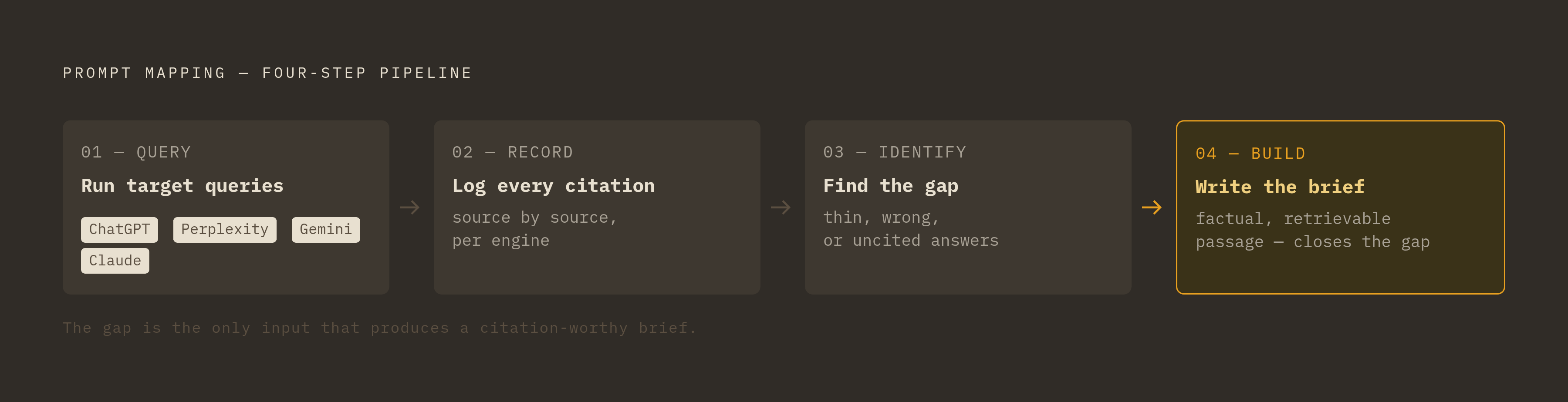
The method that replaces keyword-first planning is prompt mapping: an audit of what AI engines already say, run before a single sentence of content gets written. The logic is straightforward. Take the questions your audience is likely to ask and run them across ChatGPT, Perplexity, Gemini, and Claude; the answers that come back thin, wrong, or missing a cited source mark the gaps. Those gaps are the content brief.
The practical sequence, drawn from AirOps's roadmap, breaks into a few concrete steps. Run a set of target queries across all four major platforms and record what gets cited in each answer, source by source. The content brief gets built around closing that particular gap with a factual, retrievable passage, not around chasing the original query for its own sake.
Prompt mapping does double duty. Alongside showing where an engine doesn't have a good answer, it shows which brands are currently sitting in the answer it does have, and what those brands are being cited for. That's direct intelligence on where the competitive field already stands inside a given engine's citation pool, which should shape both what to prioritize and how to position against the entities already there.
One caution is built into the method: AI answers are not deterministic. The same question, run once, tells you almost nothing, because the engines vary their output across sessions. Running a fixed set of prompts on a repeating schedule and watching the trend across repetitions is what makes the audit usable. A single run is noise. A pattern across a dozen runs over a month is signal.
Mining conversational sources for the questions audiences ask AI
Prompt mapping needs real questions to run, and the best source for those questions is the conversations an organization already has with the people it sells to, along with the public conversations happening elsewhere without that organization's involvement.
Sales call transcripts and customer support tickets are underused here. A support ticket that reads "I can't figure out how to track whether ChatGPT is actually citing us" is close to a verbatim prompt that a buyer might type directly into ChatGPT, which makes it one of the highest-specificity inputs available to a content team, and it costs nothing extra to collect since the conversation already happened.
Outside the organization, Reddit threads, Quora discussions, and niche industry forums carry a similar value, especially where a poster opens with something like "I am struggling with…" Those openers tend to mark complex, multi-part problems that a person has already tried and failed to solve on their own, which is exactly the kind of problem someone turns to an AI engine to untangle next. Google's "People Also Ask" boxes serve a related function, clustering questions around high informational intent, which is a reasonable proxy for where AI engines are also getting queried.
First-party data has started to close part of this gap directly. Microsoft introduced an AI Performance report for Bing in early 2026, giving teams visibility into the actual questions and phrases that drove a visitor to a site by way of an AI answer, a direct record of real AI-mediated queries that makes it one of the more reliable inputs available once a team has access to it.
Every question pulled from these sources needs to pass one test before it earns a place in the content plan: can the organization answer it with something specific and verifiable that the AI engine can't currently produce on its own? If the answer is yes, it belongs in the brief. If an engine already answers the question well and cites a solid source doing it, competing head-on there is a poor use of effort, and the research is better spent finding the next gap.
What makes a piece of content retrievable once published
Good research doesn't guarantee a citation. A piece can be built around exactly the right gap and still go uncited if it isn't written in a form an engine can lift cleanly out of the page, because citation happens at the level of the passage, not the page as a whole.
A few structural habits follow directly from that fact. AirOps's roadmap reports that structured content along these lines gets cited at roughly twice the rate of unstructured equivalents, and treats schema markup and answer-first formatting as baseline requirements.
Consistency across sources matters just as much as structure within a single page. A company's name, description, founding year, and services need to match exactly across its website, LinkedIn, relevant industry directories, and, where applicable, Wikipedia and Wikidata. When those sources disagree with each other, an AI engine has no clean way to resolve the conflict, and the likely outcome is that it cites neither source.
Freshness operates as its own signal, separate from structure or consistency. AI search tools draw from URLs that are meaningfully more recent than what shows up in a traditional organic search results page. Content needs ongoing maintenance to stay in the retrieval pool rather than a single publish date and years of neglect.
A grounding page is an encyclopedic, fact-dense page written in neutral, verifiable prose, one fact per sentence, dated where relevant. That gives an engine something concrete to reason from. It's a different kind of asset than a marketing narrative, and different too from the kind of self-authored "AI instructions" page some sites have started publishing, which tends to read as a brand talking about itself rather than offering the engine anything it can verify.
The citation surface that on-site content leaves uncovered
Even a site that gets every structural detail right is only playing for part of the field. Most AI responses cite third-party sources rather than a brand's own domain, which means a company's website, however well built, can only compete for a fraction of the available citation surface. The rest of that surface sits on other people's platforms.
Third-party mentions carry disproportionate weight in how engines decide what to cite. A mention on a trusted review site or a well-regarded industry directory can do more for citation odds than a traditional backlink, because the engine reads that mention as independent confirmation.
Internal architecture compounds this effect once a presence exists. Content hubs built with bidirectional internal links, where related pages reference each other in both directions, show meaningfully higher citation rates than standalone posts published in isolation. That's a reason to think about a site's internal linking structure as part of the retrieval signal itself, not just as a navigation convenience for human readers.
The practical consequence for audience research is that the questions surfaced through prompt mapping and conversational mining should decide where an answer gets published, not just whether it gets written. A question your audience is asking on Reddit deserves an answer placed on Reddit, because that's where the engine is likely to find corroborating, independent discussion of the topic. The same answer, published only on a company blog, serves a narrower citation function, since it lacks the third-party weight that the forum version would carry.
Measuring whether the research-driven approach is working
No platform hands out a unified, first-party report on AI citation performance, so none of this works without measurement. Building that measurement layer is part of the strategy itself, not a report generated after the fact.
A small set of metrics does most of the work. Mention rate tracks how often a brand's name shows up at all in AI-generated answers to a fixed set of target queries. Answer share tracks what fraction of the fixed prompt set returns any brand presence at all, watched as a trend across engines over time. Sentiment and accuracy round out the set, checking whether the brand is being described correctly and favorably when it does show up.
Tracking has to stay separated by platform, because the underlying data behaves differently on each one. ChatGPT has historically been harder to track, since most mentions carried no clickable link at all, but a May 7, 2026 update introduced prominent clickable brand links directly in ChatGPT answers, which significantly increased the volume of trackable referral traffic from that platform.
Before any of this gets optimized, a manual baseline has to exist. Run a fixed set of prompts across ChatGPT, Perplexity, Gemini, and Claude, write down exactly where the brand stands today, and repeat that same check on a set schedule. A single check tells you almost nothing. A trend across repeated checks tells you whether the work is moving the needle.
The tooling for this is still maturing. Conductor positions itself as the only end-to-end, enterprise AEO platform tracking AI referral traffic, AI search market share, and AI Overview performance across industries. AirOps tracks citation rates across ChatGPT, Gemini, and Perplexity and builds prompt discovery and competitive benchmarking directly into its platform. Semrush and Ahrefs have added citation tracking alongside their traditional search analytics, though the AI visibility category as a whole remains early across every vendor working in it.
What makes this a system rather than a one-time project is the loop it closes. New gaps that appear in AI answers, found through measurement, become the next content brief, and the cycle runs again. That feedback loop is what separates a research-driven AI content strategy from a string of disconnected experiments. The research finds the gap, the content fills it in a retrievable form, the measurement confirms whether the citation followed, and the next gap the engines reveal becomes the starting point for the next round.