Zapier vs Make for Marketing Content Automation
Zapier wins for simple workflows; Make handles complex branching logic that Zapier can't.

Zapier and Make solve the same basic problem, connecting apps without code, but they solve it for different kinds of marketing teams. Zapier trades depth for speed: a marketer with no technical background can build a working automation the same afternoon. Make trades speed for depth: it takes longer to learn, but it handles branching logic and conditional workflows that Zapier structurally cannot. The right pick depends on how sophisticated your content workflows actually are.
That distinction used to matter less. When automation platforms were just app connectors, the cost of picking wrong was a few wasted hours reconfiguring triggers. Now both platforms ship AI agents, support for a standardized protocol connecting models to external tools and data, and some version of agentic orchestration. Picking the wrong one means building a content pipeline that either can't scale past its own logic or takes three times longer to set up than the team's workflow actually justifies.
How each platform's interface shapes what your team can build
Zapier's builder is a form. You pick a trigger, you pick an action, you fill in fields, and the platform holds your hand through each step. Okta's Senior Manager of Customer Support Strategy and Operations said: "I can get someone who's only been here for a few weeks to set up an automation in Zapier, that's huge." That's not a small thing for a content team where the person managing the blog calendar isn't an engineer and never wants to be one.
Make works differently. Its canvas is a flowchart: modules connected by visible lines, branches splitting off in different directions, the whole automation laid out as a map you can trace with your eyes. That visual format is genuinely useful once a workflow gets complicated, since you can see exactly where a piece of content goes and why. But the map itself is the cost. Make's own support team recommends around 19 hours of coursework in Make Academy before a user attempts building a custom scenario from scratch. Call it what it is: a real time investment, not a "free, no-code tool" in the way Zapier markets itself.
Both platforms have started building AI directly into the setup process. Zapier Copilot lets you describe an automation in plain language and generates it for you, and that conversational build path is already live. Make's answer, a cobuilder called Maia, entered public beta in mid-2026 and is available on all paid plans, but it's newer and less battle-tested than Zapier's equivalent. Make is playing catch-up here, even if it closes the gap eventually.
For a marketing team without a dedicated ops or technical hire, Zapier's interface removes a barrier that actually stops people from automating anything at all. If there's a technical lead or a developer in the mix, Make's canvas starts paying dividends fast. On governance, the two platforms reveal different philosophies too: Zapier's Admin Center lets IT set guardrails centrally, while Make Grid (included on all paid plans) gives a real-time visual map of every scenario, data flow, and dependency across the account. One centralizes control, the other makes the whole system visible.
Integration breadth versus depth in content tool stacks
Zapier connects to more than 9,000 apps, all officially maintained in-house, which it calls the largest integration library of any automation tool. That claim is hard to argue with. Make's own number is around 3,000 or 3,500 apps depending on the source, with roughly 900 of those maintained by the community rather than Make itself.
Raw counts miss something, though. Of Make's library, around 2,400 apps are natively supported, and those native integrations frequently expose more triggers and actions per app than Zapier's equivalent connector does. That's the depth argument, and it's concrete: Make might let you search, create, and update records within a single app, while Zapier's integration for that same app only exposes create. If a content workflow needs to update an existing CMS entry rather than just append a new row to a spreadsheet, that difference decides whether the automation works at all.
Zapier still wins when the stack includes something obscure. A niche SEO tool, a specialist publishing platform, a CMS that only a few hundred companies use: Zapier is more likely to have an official integration built for it, simply because it has built so many more of them. The rule of thumb holds up under scrutiny: reach for Zapier when you need to connect an app most automation platforms have never heard of, and reach for Make when the app is supported and you need fine-grained control over what happens to the data once it's there.
Where Zapier's linear model works well for content teams
Zapier's whole architecture is trigger, then action, then maybe another action after that. One thing happens, and then something else happens because of it. For a lot of content work, that's exactly the shape most content workflows actually take. It's exactly the shape most content workflows actually take.
A new blog post gets published, a Slack channel gets a notification, the post lands in an Airtable tracker, and it queues up for social distribution. A form gets submitted, the lead lands in a CRM, a welcome sequence fires. An RSS feed updates, an AI tool drafts a social caption, someone reviews it before it goes out. None of that needs branching logic or conditional routing. It needs a clean, auditable chain that does the same thing every time, and Zapier does that reliably.
Zapier also connects to more than 250 AI tools, including ChatGPT, Claude, and Jasper, through pre-built integrations, so AI steps slot directly into any Zap without custom setup. Zapier Agents take this further: agents can coordinate across a content pipeline without anyone designing the exact scenario in advance. Zapier's MCP support extends that autonomy even more, letting Claude or ChatGPT interact directly with more than 8,000 integrated apps, so an agent can act on connected tools without the workflow being mapped out step by step beforehand.
Zaps cap out at 100 steps. Most content workflows never get close to that limit, but it's a hard wall for teams that do. Zapier's template library also deserves credit as a real time-saver, since common content automations are often just a few clicks away from working rather than built from a blank canvas. For a team with no ops support, that's what lets an automation ship today instead of next month.
Where Make's scenario builder handles what Zapier cannot
Make removes the ceiling Zapier imposes. There's no documented step limit per scenario, and Make supports unlimited Router branches alongside built-in Iterator and Aggregator modules for handling batches of data. It also does parallel processing and offers granular error-handling with retry logic, none of which Zapier's linear model was built to support.
Consider a multi-channel content approval workflow. A draft enters the system, and depending on word count, it routes to an editor. Depending on subject matter, it routes separately to legal review if the topic hits a sensitive list. Depending on whether it needs visuals, it routes to design. Each of those branches runs independently and at the same time, not one after another. Zapier's linear trigger-to-action model is not built for that kind of parallel branching; Make's Router module handles it natively.
Batch processing is another place Make earns its complexity. Pulling a large set of URLs, running each one through an AI summarizer, formatting the output, and writing the results back to a database in bulk is the kind of job that would require workaround after workaround in a linear tool. Make's Iterator was built for exactly this. Conditional distribution, where the same content asset needs to land in different places depending on language, region, or content type, works the same way: multiple paths running at once.
Error recovery matters more than it sounds like it should. If an API call to a CMS fails partway through a Zapier workflow, that step halts the chain. Make can retry with defined logic instead of dropping the operation outright, which matters a great deal when a failed step means a piece of content never gets published and nobody notices until a client asks where it went.
Make's agentic layer, launched in April 2025, consists of AI Agents that reason autonomously and adapt a workflow as it runs, available in beta on all plans using Make's own AI provider. The AI Toolkit modules go further than pass-through API calls: a range of AI operations are available as native modules inside Make itself. One agentic feature assessment scored Make's AgentKit at 14.5 out of 28 capabilities, or 52%, against Zapier's 7 out of 28, or 25%. Zapier leads on integration breadth. Make leads on agentic depth. Both of those facts are true at once, and neither cancels the other out.
The tradeoff cuts against Make's power: more control, less spontaneity. Zapier's agents can act freely across connected tools without a pre-built path. Make's agents execute scenarios someone has already designed. More control, less spontaneity.
Pricing model behavior as workflow volume grows
The billing logic is where these two platforms diverge most sharply, and it's the part teams tend to underestimate until the invoice arrives. Zapier charges per completed task, a successfully processed data element. Triggers, filters, and failed steps don't count against the allocation. Make charges per operation, or credit, and nearly everything consumes at least one: polling triggers, filters, even failed steps.
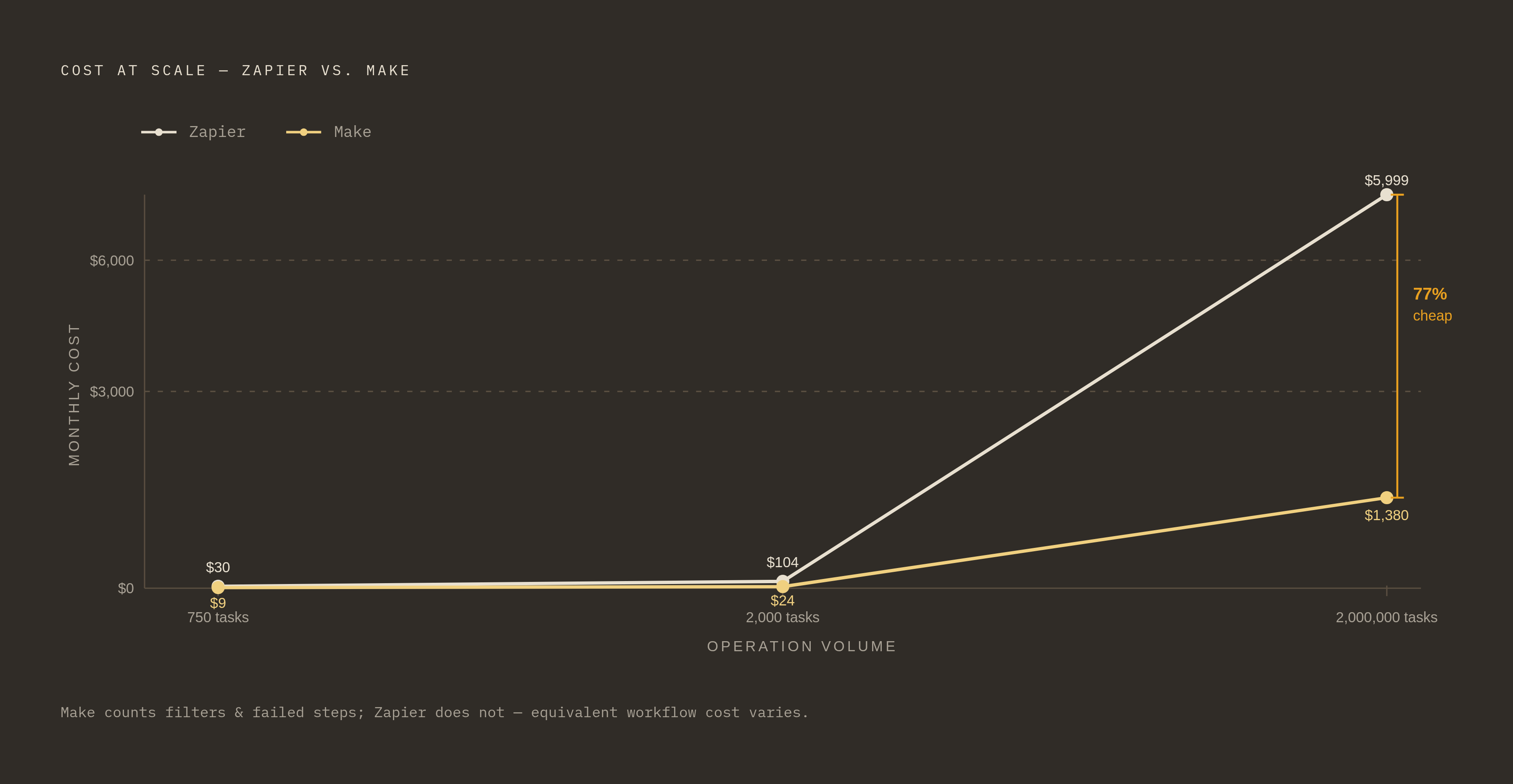
As of September 2026, Zapier's Free plan gives 100 tasks a month. Professional runs $29.99 a month for 750 tasks with unlimited multi-step Zaps. Team costs $103.50 a month for 2,000 tasks and shared workspaces. Enterprise is a custom quote. Zapier retired its old Starter plan back in April 2024, so Professional is now the cheapest paid tier available. As of June 2026, AI steps on Professional, Team, and Enterprise plans are priced by model tier rather than a flat per-step cost, and all of it, Zap workflows, AI steps, code steps, MCP calls, SDK calls, draws from the same pooled monthly allocation. At the high end, 2 million tasks a month runs $5,999.
Make's credit-based structure, as of November 2025, starts with a free tier and a Core plan at $9 a month, with AI apps and Make AI Agents included on every paid tier. Credits used beyond the monthly limit are charged at a premium rate above the included credit cost. A poorly optimized scenario with a lot of intermediate steps, or a trigger that polls too frequently, burns through that allocation faster than most teams expect, and the penalty compounds the mistake.
Zapier's model is easier to forecast because only completed work counts against the total. Make's model rewards efficient scenario design and punishes sloppy ones. A third-party comparison suggests Make runs roughly 77% cheaper than Zapier at 2,000 or more tasks a month for equivalent workflows, though that number should be read as directional rather than guaranteed, since workflow structure changes the math significantly. For an agency running four or more client accounts, Zapier's Team plan at $103.50 a month or higher is usually the realistic floor. Make's lower entry price looks appealing, but it demands active monitoring to stay cost-effective at scale.
Using Zapier or Make as the execution layer in an AI visibility content pipeline
Neither platform is a GEO analytics tool, and neither should be mistaken for one. Both function as connective tissue, moving data between the tools that actually generate insight and the tools that publish content.
That connective role now determines outcomes directly, because the search landscape has shifted and that shift produces this effect. Over 60% of searches now end without a click to any external website, and large language models cite only two to seven domains on average per response. Content has to be structured and distributed in a way that earns citation. Distributing and formatting content that way is difficult in the same way writing it is, and it's exactly the kind of task automation platforms are built to handle: scheduling structured content on a cadence that keeps AI training data current, triggering schema updates when a monitoring tool flags a citation gap, routing content from a GEO platform's output into a CMS for fast deployment, batch-applying structured markup across a large set of pages.
Zapier fits naturally at the distribution end of that pipeline. Pushing a GEO tool's output into a publication queue, a CRM, or a notification system is a linear job, and Zapier does linear jobs well. Make fits the processing end better: conditional routing of content updates based on citation performance data, parallel deployment across multiple brand properties at once, error-handling when a CMS write fails partway through a batch job.
None of this works without a signal to act on, though. Automation is only as good as the data feeding it, and a team needs a platform that actually tracks brand presence across AI surfaces before there's anything worth automating. Otterly tracks AI search visibility across ChatGPT, Perplexity, Google AI Overviews, and Microsoft Copilot, with Google AI Mode and Gemini available as paid add-ons, starting at $29 a month for 15 prompts; it reports more than 20,000 marketing professionals using the platform and was named a Top-Rated GEO tool by OMR Reviews in 2025. AthenaHQ is built for marketing, brand, and growth teams at companies of any size, with a focus on attributing AI search impact directly to traffic, conversions, and revenue. BrightEdge tracks content appearance across Google AI Overviews, ChatGPT, Perplexity, Claude, and Gemini in a single dashboard. Semrush's AI Visibility Toolkit is the lowest-friction option for teams already inside the Semrush ecosystem, though its per-domain pricing gets expensive fast for anyone managing multiple brands, and it has no multi-brand rollup.
Some agencies build their own version of this stack, combining Looker Studio, Zapier or Make, and custom AI scripts into a proprietary reporting pipeline. That's a legitimate path, but it demands in-house engineering capacity and ongoing maintenance that most teams don't have the bandwidth for.
Making the call: which platform fits which marketing team
Neither platform is objectively better. The decision comes down to which level of workflow sophistication the team actually operates at right now.
Choose Zapier when automations need to be running within hours rather than days, when workflows are genuinely linear (one trigger, a short chain of actions, no branching required), and when the tool stack includes niche or uncommon apps where Zapier's 9,000-plus integrations make coverage far more likely. Choose Make when the workflow involves conditional branching, batch processing, or parallel paths that a single trigger-action chain can't express, and when someone on the team has the time, or the technical background, to get through that 19-hour learning curve and actually use the canvas properly.
Most marketing teams don't sit permanently in one camp. A team might run Zapier for its day-to-day publishing chain while reaching for Make on the handful of workflows that genuinely need conditional logic across regions or brands. That's not indecision, it's matching the tool to the job in front of it, which is the only defensible way to make this call in the first place.