The Best AI Automation Tools in 2026: Our First Picks
Agencies waste money on tools when they need workflow redesigns to fix bottlenecks.

Agency operations in 2026 come down to matching tools to specific bottlenecks: client reporting, brand governance across a portfolio, and the fact that ChatGPT now works as a discovery channel most agencies haven't planned for. ChatGPT's weekly active user base has climbed to roughly 900 million. That scale changes what "visibility" means for a client's brand before a prospect ever picks up the phone.
Most agencies get the shape of the fix wrong before they even get to the tool. They buy a software platform when the job actually needs an implementation partner, or they buy a content generator when the real bottleneck sits in process and reporting instead of draft quality. McKinsey's 2025 State of AI report, drawn from close to 2,000 organizations across 105 countries, found that high performers are nearly three times as likely as other organizations to redesign workflows outright when they deploy AI, rather than bolting a new tool onto an old process. That distinction, tool versus redesign, separates agencies that get compounding returns from agencies that get a slightly faster version of the same bottleneck. Buying software doesn't fix a broken process. It just moves the same friction to a new interface, and the invoice still needs paying either way.
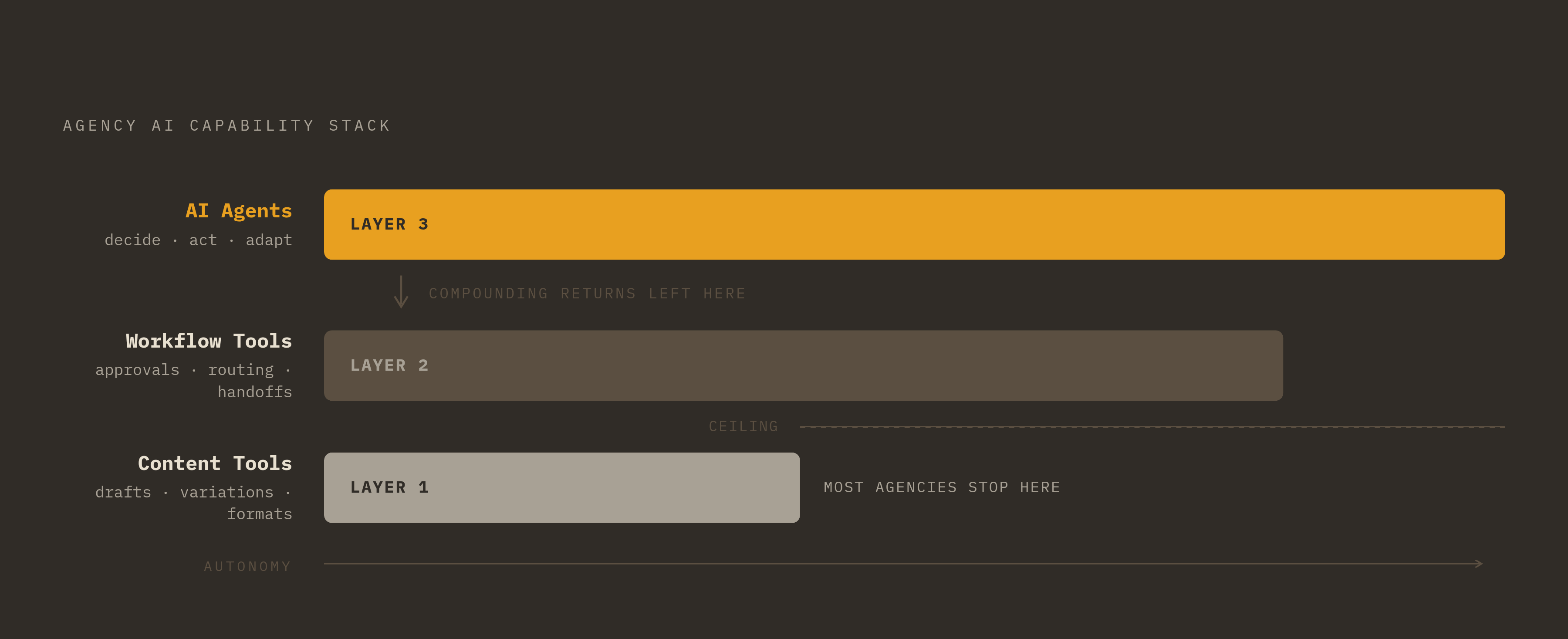
The landscape splits into three layers, and most agencies only ever operate in the first one. Content tools produce outputs: drafts, variations, formats. Workflow tools manage process: approvals, handoffs, data moving between systems without a human copying and pasting it by hand. AI agents go a step further, making decisions and taking action inside a defined scope instead of waiting for a prompt. Agencies that stop at layer one hit a ceiling fast, because content generation alone doesn't touch the admin hours, the reporting cycles, or the fact that AI answer engines now decide who gets recommended before a client ever sees a website.
Five bottlenecks show up again and again, and this guide maps tools against each one instead of treating "AI automation" as a single shopping category. First, visibility: whether a client's brand shows up, gets cited, or gets recommended inside AI-generated answers, a discipline now commonly shortened to GEO or AEO. Second, production and governance at scale: keeping a dozen client brand voices distinct while output volume climbs. Third, reporting: proving ROI to a client without an account manager spending a Friday afternoon copying numbers into a slide deck. Fourth, operational automation: the admin layer, approvals, onboarding, task routing, the stuff that eats hours without producing anything a client sees directly. Fifth, the case where the right answer isn't a tool at all, but an implementation partner for AI systems too complex to configure off a pricing page.
Before evaluating anything, ask one question: where does time actually go, and is that a content problem, a process problem, a reporting problem, or a visibility problem? Manual reporting, client email threads, and dashboard-hunting eat a real chunk of every week, and no content tool touches any of that no matter how good its output looks. That's a process problem. It needs a process fix aimed at the workflow itself rather than a better draft.
The categories below follow a rough maturity arc: visibility, then production, then operations. Jump straight to whichever bottleneck matches the week ahead. One distinction matters throughout: some of what follows is software an agency runs directly, and some is a service an agency hires to build something custom. Confusing the two is the exact category error this guide exists to prevent.
AI visibility monitoring tools for agencies tracking brand presence across AI answer engines
Google rankings used to be a decent proxy for whether a brand would get found. That proxy is breaking down, and agencies still treating it as gospel are already behind. ChatGPT, Perplexity, and Gemini pull from different signals, weigh authority differently than a search index does, and refresh their underlying models far more often than a results page changes. A client can rank well organically and still be invisible inside an AI-generated answer, and increasingly, that's where the question actually gets asked.
ChatGPT alone processes more than 2.5 billion prompts a day. Media executives are already forecasting a roughly 43% drop in organic search referral traffic over the next three years, and that is an urgent problem worth planning around now. It's happening on current client accounts right now.
AI visibility monitoring measures something specific: whether a brand gets mentioned inside an AI-generated answer, with or without a link back, how often it gets cited as a source, and its share of voice against competitors across ChatGPT, Perplexity, Google AI Overviews, Gemini, and Claude. GEO went from a niche concern to a heavily funded category almost overnight, attracting substantial venture investment across multiple platforms in a short window.
Scrunch AI is the most complete AEO/GEO platform built for agency use in 2026, combining multi-LLM monitoring and analytics with auditing, optimization, and AI content delivery in one system. Its standout feature is the Agent Experience Platform (AXP), which serves AI-optimized content directly to AI agents at the CDN layer without changing what a human visitor sees. Its enterprise client list includes Akamai, Lenovo, ADP, and NatWest. Agency pricing starts at $500/month for Agency Core, with Agency Enterprise custom-quoted, a structure built for managing multiple client brands rather than a single site.
Profound raised $155 million and carries a $1 billion valuation, with a Fortune 500 client base that reflects its early-mover position in AI visibility tracking. It offers a few genuinely hard-to-find features: real-user prompt volume data, front-end response capture, and a module built for Amazon's Alexa for Shopping (formerly Rufus). Pricing starts at $99/month for Starter, but that tier only covers ChatGPT. Growth, at $399/month, adds Perplexity and Google AI Overviews. For agencies managing multi-platform visibility across a client roster, that gap between tiers is worth weighing before signing anything.
Peec AI has built early traction in the agency market. It's a solid pick for agencies specifically because of how it's priced and structured: pricing and plan details worth verifying directly with the vendor before committing.
Semrush's AI Visibility Toolkit is the path of least resistance for agencies already running Semrush day to day, since it folds prompt tracking and share-of-voice data into the same stack as keyword and competitive research. Semrush One bundles SEO and AI visibility into a single plan, and the toolkit is also available as a per-domain add-on, with an Enterprise AIO tier for large-scale, multi-brand reporting. Here's the catch: per-domain pricing multiplies with every new client, so the cost structure doesn't scale gracefully for an agency adding accounts. On the upside, the prompt database covers more than 100 million queries, and the add-on includes a site audit that flags technical issues blocking AI crawler access.
Otterly.ai is the entry-level option, covering multiple platforms including Google AI Overviews, ChatGPT, Perplexity, Gemini, AI Mode, and Microsoft Copilot, with Claude available on higher tiers, starting at $29/month. It checks a range of technical GEO factors, generates audit reports with specific fixes, benchmarks share of voice against up to five competitors, and tracks citations down to the URL. The trade-off is a weekly refresh cycle rather than real-time data, and a steep jump from the $29 Lite tier to the $189 Standard tier once prompt volume moves from 15 to 100.
Ahrefs Brand Radar suits enterprises that want deep prompt data, and pricing and index details are best confirmed directly with the vendor.
Adobe LLM Optimizer reached general availability in October 2025 as part of Adobe Experience Cloud. It makes sense for organizations already running Adobe Experience Manager, and it's a weak standalone pick for anyone outside that ecosystem.
Thrad is positioned for agencies managing AI visibility across a client portfolio rather than a single brand, and is worth evaluating directly for current feature and pricing details. Thrad is oriented toward agencies selling AI visibility as a managed service, a different job than the other platforms in this section are built to solve. Billing details are best confirmed directly with the vendor.
Weighing all seven, the choice isn't close for most agencies. Scrunch and Profound lead on depth for enterprise needs, full stop, but Semrush only earns its place if the agency is already locked into that ecosystem for SEO. Otterly and Ahrefs Brand Radar work fine as starting points, though neither is where a serious multi-client operation should stay long-term. Peec AI wins on commercial structure built for agency use. Thrad is the one purpose-built for agencies selling AI visibility as a managed service, which is a different job than the other six are solving, and it's the one worth defaulting to if that's the actual business model.
Multi-brand content production and brand governance tools for agencies managing multiple clients
The operational problem here is holding quality and consistency at scale: producing content that sounds like each specific client, at volume, without an account team rebuilding tone guidelines from a blank page on every brief. That gets harder in direct proportion to every client added to the roster. Brand voice customization is a core requirement built into a generation tool. It's the constraint the whole system has to be built around, because without it, every brief starts from zero, and starting from zero is where agencies bleed hours nobody bills for.
Jasper is designed to carry brand context through the generation process rather than requiring teams to manage it separately on every brief. Jasper also runs purpose-built agents for GEO execution: scoring a piece of content's AI readiness, flagging citation gaps, and generating FAQ content and schema markup that answer engines actually pick up on. That connects the production layer directly to the visibility work covered above, instead of treating the two as unrelated disciplines.
Frontify works less as a generation tool and more as the governance layer that generation tools operate inside. It fits agencies managing large brand libraries and production workflows across multiple markets, where the risk isn't slow output but output that drifts from brand standards without anyone catching it in time. Frontify pairs with a generation tool. It doesn't replace one, and treating it as a Jasper substitute is a mistake worth naming plainly, because agencies make it often.
Search Atlas / OTTO SEO works best for agencies running high-volume SEO fulfillment across many client sites, combining automated technical fixes, AI-assisted content generation, and multi-site management from keyword research through deployment. Its gap is real: AI visibility monitoring inside the platform only covers keyword tracking, leaving out real-time analysis of how AI engines actually respond, so it complements the tools in the previous section rather than standing in for them.
No single platform in this category covers the full cycle end to end, and agencies shopping for one are wasting a procurement cycle on a fantasy. The strongest stacks in 2026 pair a generation tool that handles brand-voice-aware drafting with a governance layer like Frontify for larger, multi-market portfolios, and they add a third tool only once the actual bottleneck demands it, driven by genuine need rather than a spot on a vendor's roadmap.
Operational workflow automation tools for agencies reducing admin and process overhead
The biggest time savings in this category rarely come from better copy. They come from fixing the operational loops sitting underneath the content work: reporting cycles, meeting notes, and data moving between systems that don't talk to each other natively.
That's the distinction worth holding onto here. Content tools generate outputs. Workflow tools automate the process wrapped around that work: approvals, client onboarding, task routing, communication that used to need someone remembering to send it by hand.
Taskip is the strongest all-around pick for agencies that want client work, invoicing, reporting, and AI-driven workflows running in one platform instead of four disconnected ones. Estimated time saved runs upward of 10 hours a week, and pricing starts at $12/month with a free plan available. It directly fixes one of the most common agency stack problems: separate tools for project management, CRM, client portal, and automation that don't share data cleanly, forcing someone to reconcile it by hand every week.
Gumloop is built for non-technical agency owners who want to build AI agents without writing code, with an estimated time savings of 4 to 6 hours a week. It starts at $37/month with a 14-day trial, though there's no permanent free tier. The meaningful distinction with Gumloop is that its agents can reason and act on a task, which separates it from basic trigger-action automation that only fires in response to a single prompt.
Zapier, including Zapier Central, remains the default for agencies already invested in its ecosystem, with more than 8,000 app integrations, the largest directory in the category, plus cross-platform AI automation with scheduling and trigger management. The Professional plan starts at $19.99/month billed annually or $29.99/month billed monthly, with a free plan available and Zapier Agents offered as a roughly $20/month add-on. Estimated time savings sit around 2 to 4 hours a week, more modest than Taskip or Gumloop, but that reflects Zapier's role as connective tissue across a huge range of existing tools rather than a from-scratch automation build.
Choosing between these three comes down to what's actually broken, and treating them as interchangeable wastes money. An agency drowning in invoicing and client reporting across separate systems needs Taskip, a purpose-built solution rather than a general-purpose connector. One that wants to build custom agents without hiring an engineer needs Gumloop. One already running dozens of automated workflows across its existing stack gets more out of extending that automation platform than ripping it out for something new.